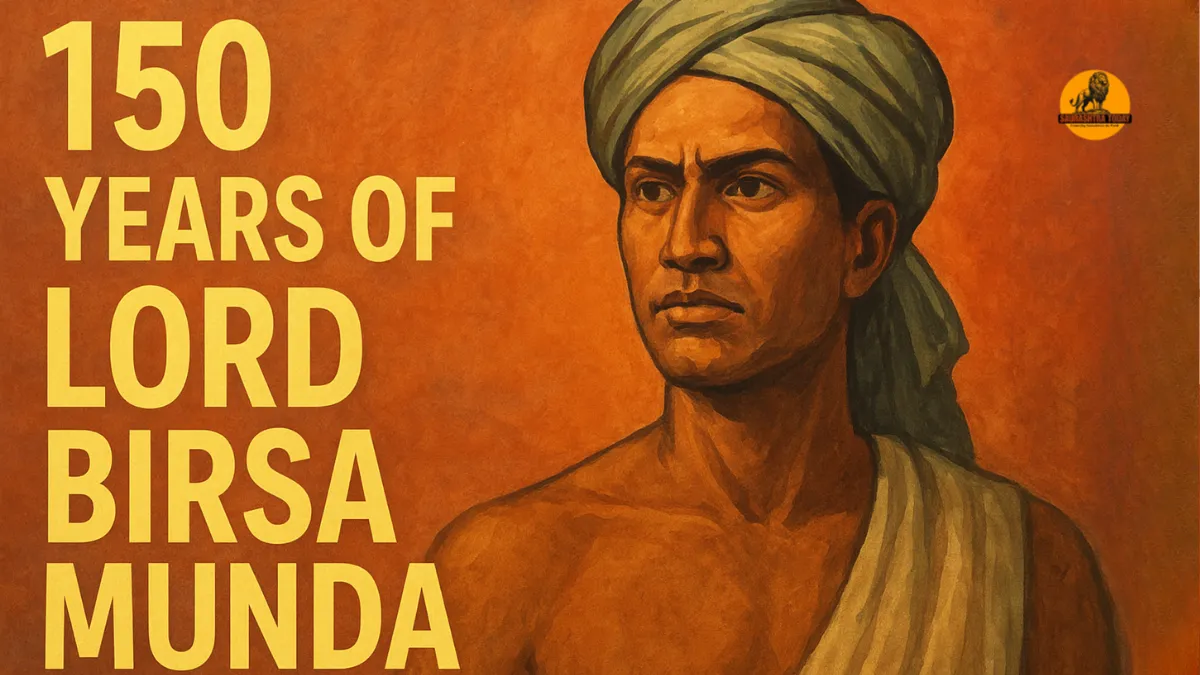
As India marks 150 years of Lord Birsa Munda, the nation steps into a year-long celebration honoring one of its most courageous and visionary tribal leaders. His life, though brief, reshaped the meaning of freedom, justice and identity for millions, especially within the tribal communities of central and eastern India. Today, his legacy continues to inspire the youth of a modern nation seeking dignity, equality and cultural pride.
Across every phase of India’s history, the land has given birth to extraordinary sons and daughters who dedicated their lives to protecting its people and values. Among them, Lord Birsa Munda shines like one of the brightest stars — a guiding force whose ideals still illuminate India’s path.
For many Indians, especially in the tribal belt, stories of Birsa Munda became a source of childhood inspiration. His bravery, compassion and spiritual leadership have long been symbols of pride rooted deeply in centuries-old tribal heritage.
A Revolutionary Born in a Small Village
Born in Ulihatu, located in present-day Jharkhand, Birsa Munda transformed from a village boy into the face of one of the most powerful anti-colonial uprisings in India.
Remarkably, he achieved this before the age of 25.
During the late 19th century, British authorities and local landlords were exploiting tribal communities — taking over their land, destroying their systems of self-governance, and suffocating their identity. It was in this period of exploitation that Birsa emerged as a voice of fierce resistance.
Known affectionately as “Dharti Aba” — Father of the Earth — Birsa united the tribal population and inspired them to fight for their ancestral land. His movement, known as Ulgulan, began in the 1890s and soon turned into a historical uprising against colonial rule.
Ulgulan: More Than a Rebellion
The Ulgulan, often translated as “The Great Tumult,” went far beyond a political movement. It was a fight for survival:
- A fight for the right to cultivate land without interference.
- A fight for the preservation of tribal culture, traditions and values.
- A fight for dignity long denied by colonial rule and oppressive landlords.
Much like Mahatma Gandhi, Birsa Munda’s struggle was rooted in truth, justice and moral conviction. But while Gandhi led a nationwide non-violent movement decades later, Birsa’s leadership represented the early flame of tribal resistance against systematic injustice.
Even today, anthropologists, historians and scholars recognize the Munda uprising as one of the most significant indigenous resistance movements anywhere in the world.
A Healer, Spiritual Leader and Protector of His People
Beyond being a revolutionary, Lord Birsa Munda was also a healer — a role that made him deeply respected among tribal communities. He studied traditional healing practices and devoted his time to helping the sick.
He often told villagers,
“If the sick cannot come to me, I will go to them.”
True to his word, he traveled from village to village, caring for people and reviving hope among communities terrorized by disease and poverty.
Many believed he possessed a divine touch, a gift from God that enabled him to heal both body and spirit. His compassion made him not just a leader, but a symbol of faith for thousands.
A Legacy That Defines Tribal Identity in India
Birsa Munda’s sacrifices occupy a central place in the long line of tribal freedom fighters — heroes who fought fearlessly but were often overlooked in mainstream historical narratives for decades.
Tribal communities have always been a vital part of India’s national fabric, even though they often lived on the geographic margins. Far from being “separate,” they contributed immensely to India’s cultural unity, environmental wisdom and ancient traditions.
For many years, however, their contributions remained unrecognized.
But that has begun to change.
During the nationwide celebrations of Azadi Ka Amrit Mahotsav, millions of Indians learned about such unsung heroes for the first time. Their stories reached classrooms, museums, and public platforms — ensuring that their memories will never again fade into obscurity.
The Government’s Recognition: Tribal Pride Day
In 2021, the Government of India formally declared 15 November, Birsa Munda’s birth anniversary, as Janjatiya Gaurav Diwas — Tribal Pride Day.
This historic decision placed tribal heritage at the very center of India’s national consciousness, acknowledging that the story of India cannot be told without the story of its tribal communities.
Celebrating 150 years of Lord Birsa Munda is not just about revisiting the past — it is about restoring dignity to a community whose contributions shaped the nation’s identity.
Relevance of Birsa Munda’s Ideals in the Modern World
Birsa Munda’s teachings resonate with issues of global importance today — especially environmental conservation.
Tribal communities across India, including the Mundas, live in deep harmony with nature. Their survival depends on balance, not exploitation. Their values prioritize community welfare over individual ambition.
Many elders still perform rituals expressing gratitude even before cutting dried wood for fuel — a gesture filled with respect for nature’s generosity.
At a time when the world is grappling with climate change and ecological loss, these indigenous values offer critical lessons for humanity.
Historic Initiatives for Tribal Development
Over the last decade, several national initiatives have sought to uplift tribal communities in recognition of their cultural, economic and environmental importance.
Key programs include:
1. Dharati Aba Tribal Village Upliftment Campaign
Launched recently, this campaign aims to improve infrastructure in nearly 63,000 tribal villages, addressing long-standing gaps in health, education, sanitation and connectivity.
2. PM-JANMAN (Prime Minister’s Tribal Justice and Welfare Mission)
A flagship initiative focusing on 11 key development areas, including education, healthcare access, livelihood opportunities, digital inclusion and social security.
These programs are designed to ensure that tribal communities are not left behind in India’s development story — a vision deeply aligned with Birsa Munda’s dream of justice and equality.
Also read: Devmogara Temple: Story, History, Pilgrimage and Tribal Legacy of Gujarat’s Sacred Shrine
Honoring Tribal Heritage: New Steps from Rashtrapati Bhavan
India’s President has also launched major initiatives to bring tribal history and culture to national attention:
- The ‘Janajatiya Darpan’ Gallery in the Rashtrapati Bhavan Museum showcases tribal art, culture and their contributions to nation-building.
- Engagements with representatives of all 75 Particularly Vulnerable Tribal Groups (PVTGs) have brought their voices directly to the highest office of the country.
For many tribal communities, seeing a woman from a humble background rise to India’s highest constitutional position represents a historic moment of acceptance, pride and emotional empowerment.
A Celebration of Unity, Identity and Youth Aspirations
As India begins the year-long celebrations marking 150 years of Lord Birsa Munda, the focus is not only on remembering history but on igniting a sense of pride in the new generation.
Birsa Munda’s dreams and demands —
freedom, justice, identity and dignity —
are the same aspirations held by millions of young people across India today.
He fought not only for tribal rights but for the larger ideal of human dignity.
His life proves that even the shortest journeys can leave the longest shadows.
And his legacy reminds India that no community, no matter how small, is ever outside the mainstream of the nation’s story.
Also read: BSF Raising Day 2025: First-Ever National Celebration to Be Held in Bhuj
Conclusion: 150 Years of Lord Birsa Munda — A Legacy for the World
The celebration of 150 years of Lord Birsa Munda is more than an anniversary. It is a global reminder of the power of indigenous leadership, environmental wisdom and spiritual strength.
His life continues to teach humanity that justice is worth fighting for, identity is worth protecting, and freedom belongs to everyone — not just a privileged few.
As the nation honors this extraordinary leader, his message becomes even more relevant for the world:
A just society is one where every community is seen, heard and respected.
Birsa Munda lived — and died — for this belief.
And today, as millions celebrate his legacy, it becomes clear that his light will continue guiding India for centuries to come.