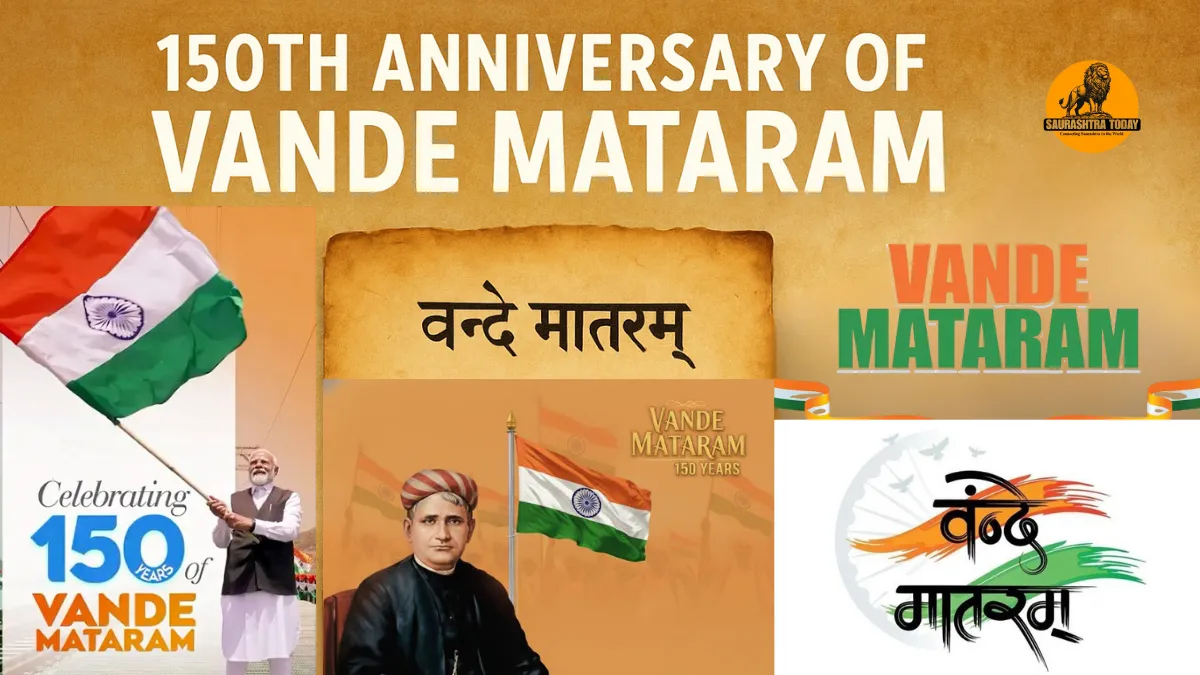
New Delhi, November 7, 2025–150th anniversary of Vande Mataram: Prime Minister Narendra Modi will inaugurate the year-long nationwide commemoration of the 150th anniversary of “Vande Mataram”, India’s National Song, on Friday, November 7, 2025, at the Indira Gandhi Indoor Stadium in New Delhi. The grand event marks the beginning of a series of celebrations that will continue until November 7, 2026, paying tribute to a song that has inspired generations and continues to resonate as a powerful symbol of unity, patriotism, and cultural pride.
The inaugural event will feature a mass singing of the full version of “Vande Mataram” at approximately 9:50 AM, taking place simultaneously across cities, towns, and villages in India. Millions of citizens — students, artists, armed forces personnel, and community groups — are expected to join the synchronized singing, creating a moment of collective national pride.
Alongside the ceremony, the Prime Minister will also unveil a commemorative postal stamp and a special coin dedicated to the 150th anniversary of Vande Mataram. Both the stamp and coin will serve as enduring symbols of India’s gratitude toward Bankimchandra Chatterjee, the literary genius who penned the immortal song in 1875.
A Nation’s Tribute to Its Timeless Anthem
The 150th anniversary of Vande Mataram is not just a milestone in Indian history but also a celebration of the country’s journey toward freedom and identity. Written by Bankimchandra Chatterjee on Akshaya Navami, November 7, 1875, the song first appeared in his literary magazine Bangadarshan and later became part of his landmark novel Anandamath.
More than just a poem, Vande Mataram became the heartbeat of India’s freedom struggle, echoing through rallies, protests, and public gatherings during the late 19th and early 20th centuries. It was the rallying cry for those who dreamed of a free India — a chant that united millions under one banner of nationalism.
The song’s opening words, “Vande Mataram” (meaning “I bow to thee, Mother”), invoke the spirit of Bharat Mata, or Mother India, as a divine and nurturing figure — symbolizing both the land and its people. This poetic imagery captured the essence of India’s spiritual and cultural ethos, blending devotion with patriotism.
The Legacy of Bankimchandra Chatterjee
Born in 1838, Bankimchandra Chatterjee was not only one of Bengal’s most celebrated novelists but also a visionary thinker whose writings ignited India’s national consciousness. When he composed Vande Mataram, India was still under British colonial rule, and expressions of nationalism were often censored. Yet, through his art, Bankimchandra found a way to express the deep-seated yearning for freedom in a form that was both poetic and spiritual.
In Anandamath, Vande Mataram was sung by monks who had renounced everything to fight for their motherland. The song quickly transcended literature, becoming a political and emotional anthem for an entire generation. Its melody, later set to music by Rabindranath Tagore, transformed it into a hymn that stirred the nation’s soul.
From the Freedom Movement to Modern India
By the early 1900s, Vande Mataram had become a fixture in India’s nationalist movement. It was sung at the 1905 Bengal Partition protests, the Indian National Congress sessions, and numerous other rallies demanding independence from British rule.
Freedom fighters such as Mahatma Gandhi, Subhas Chandra Bose, Lala Lajpat Rai, and Bal Gangadhar Tilak revered the song for its unifying power. It transcended regional, linguistic, and religious boundaries, binding Indians together with the emotional force of patriotism.
When India gained independence in 1947, the Constituent Assembly recognized Vande Mataram as the National Song of India, honoring its historical and cultural importance alongside Jana Gana Mana, the National Anthem. Today, the song remains a vital part of India’s national identity, sung on major occasions, in schools, and during public celebrations.
The 150th Anniversary: Honoring a Cultural Treasure
The 2025–2026 commemoration of the 150th anniversary of Vande Mataram is designed as a year-long cultural and educational initiative. The Ministry of Culture has outlined a series of events to highlight the song’s enduring significance — from art exhibitions and academic conferences to concerts, documentaries, and school competitions.
The celebrations will begin with the nationwide mass singing event on November 7, 2025. Citizens across all 28 states and 8 Union Territories will participate, with live telecasts connecting communities from Kashmir to Kanyakumari and from Gujarat to Arunachal Pradesh. The event aims to set a world record for the largest simultaneous rendition of a national song.
Throughout the year, universities and cultural institutions will host seminars on Bankimchandra Chatterjee’s life and works, exploring how Vande Mataram shaped Indian political thought and literature. Digital campaigns and multimedia exhibitions will also be launched to engage younger audiences and the global Indian diaspora.
Global Participation and Diaspora Involvement
The Government of India has invited Indian embassies and cultural centers worldwide to join the commemoration, ensuring the song’s spirit reaches every corner of the globe. Special events will be held in London, New York, Washington D.C., Dubai, Singapore, and Sydney, allowing the Indian diaspora and global community to connect with India’s cultural heritage.
In the United Kingdom, where a large Indian-origin community resides, the Indian High Commission will organize a choral performance of Vande Mataram at Westminster Central Hall. Similarly, in the United States, Indian-American organizations and students’ associations across universities are preparing to host community singing sessions and art exhibitions reflecting India’s journey of self-expression.
This global participation emphasizes how Vande Mataram has transcended time and geography to become a universal symbol of love for one’s homeland and respect for cultural roots.
PM Modi’s Vision for a Cultural Renaissance
Prime Minister Narendra Modi has often spoken about reviving India’s cultural consciousness and celebrating the country’s civilizational heritage. In his address at the event, he is expected to highlight how Vande Mataram embodies India’s core values of strength, unity, and devotion.
The Prime Minister’s Office stated that the commemoration will not only honor the song’s past but also inspire future generations to appreciate India’s literary and cultural legacy. “Vande Mataram is more than a song — it is a sentiment that unites every Indian heart,” the statement read.
The initiative aligns with the government’s broader vision of promoting “Cultural Pride, Global Recognition”, underlining the importance of connecting India’s ancient heritage with its modern aspirations.
Vande Mataram: Symbol of Unity and Strength
What makes Vande Mataram timeless is its ability to inspire across generations. The song portrays the motherland as both divine and earthly — fertile fields, flowing rivers, majestic mountains, and a nurturing heart that embodies every Indian’s sense of belonging.
Its verses celebrate India’s natural beauty and resilience while calling upon her children to rise in her defense. This blend of emotional devotion and moral courage continues to resonate in today’s world, where nations seek to balance progress with identity.
In the digital age, the 150th anniversary serves as a reminder that songs and stories still hold the power to unite, motivate, and heal societies.
Also read: 100 years of Indian Hockey Team: Grand Centenary Festivities Begin in New Delhi
Educational and Youth-Focused Initiatives
As part of the 150th-anniversary celebrations, schools and colleges across India will integrate Vande Mataram into their curricular and extracurricular programs. Essay contests, debates, and creative arts projects will encourage students to explore the historical and literary significance of the song.
A special “Vande Mataram Youth Festival” is being planned for early 2026, featuring music performances, theater adaptations of Anandamath, and interactive sessions on nationalism and cultural heritage. The festival will be broadcast on digital platforms to reach a global audience.
The government is also developing an interactive online archive — featuring historical documents, translations, recordings, and interpretations of Vande Mataram in various Indian languages — to preserve the song’s legacy for future generations.
Cultural Diplomacy and Global Awareness
The 150th anniversary of Vande Mataram provides an opportunity for India to engage in cultural diplomacy by sharing one of its most powerful literary creations with the world. Through exhibitions, film screenings, and collaborations with international cultural institutions, India aims to showcase how a single song can capture the essence of an entire civilization.
Scholars from Oxford, Harvard, and Jawaharlal Nehru University are expected to collaborate on a joint academic publication exploring Vande Mataram’s historical impact and philosophical depth. This initiative will help position the song not only as a national treasure but also as a global study in art, politics, and identity.
Conclusion: The Song That Defines a Nation
As India celebrates the 150th anniversary of Vande Mataram, it revisits the journey of a song that became the heartbeat of a nation. From its origins in the pen of Bankimchandra Chatterjee to its place in the national consciousness today, Vande Mataram continues to symbolize the eternal spirit of India — vibrant, united, and ever-evolving.
The year-long commemoration, launched by Prime Minister Narendra Modi, is not merely a celebration of history but a reaffirmation of national pride. It reminds Indians everywhere — from rural villages to global metropolises — that the call of “Vande Mataram” still echoes with meaning, emotion, and hope.
As the world watches India sing in unison, the message remains timeless:
To love one’s motherland is the greatest expression of freedom.