
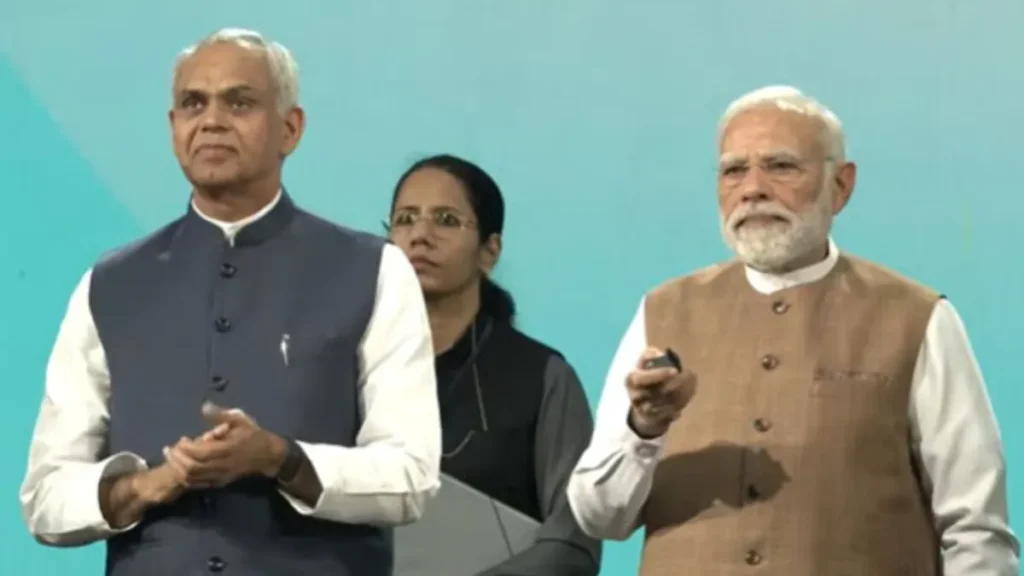
Maritime Week 2025: India showcased its growing global leadership and maritime ambitions at the Global Maritime CEO Forum, the flagship event of Maritime Week 2025, where Prime Minister Narendra Modi emphasised the nation’s role as a pillar of stability amid global tensions, trade disruptions, and shifting supply chains. Speaking to CEOs, investors, policymakers, and international delegates from more than 85 countries, the Prime Minister said India stands today as a symbol of strategic autonomy, peace, and inclusive growth.
#WATCH | Mumbai: Addressing the Maritime Leaders' Conclave, Prime Minister Narendra Modi says, "This event began in 2016, and it is a matter of great pride for all of us that today this summit has become a global event. The participation of more than 85 countries from around the… pic.twitter.com/5T5g9U7Yt9
— ANI (@ANI) October 29, 2025
India: A Lighthouse in Turbulent Global Waters
Addressing the international audience, PM Narendra Modi said the world is navigating a period of geopolitical uncertainty, economic fragmentation, and disrupted global trade routes. Amid this global turbulence, India has emerged as a reliable partner, offering stability and confidence to global supply chains.
“When global seas are rough, the world looks for a steady lighthouse. India can become that steady lighthouse,” the Prime Minister said, highlighting India’s growing influence in global maritime trade and logistics.
He added that India’s expanding maritime partnerships, its strategic location, and its strong economic fundamentals have positioned the country as a reliable and stabilising force for the international community.
Maritime Sector: A Key Driver of India’s Growth
PM Modi said India’s maritime sector is progressing at an unprecedented pace and has become one of the major engines of the country’s economic growth. “India’s maritime sector is in a very strong position and moving ahead very fast,” he told the gathering.
In the last decade, India has significantly modernised its port infrastructure, expanded shipping capacity, boosted trade efficiency, and implemented forward-looking maritime policies. These reforms are not only improving India’s internal logistics but also strengthening its position in global maritime networks.
The Prime Minister highlighted that India’s ports today are counted among the most efficient in the developing world, and in several aspects, they perform better than ports in many developed nations.
Next-Generation Reforms Transforming Indian Maritime Law
A major highlight of the address was the government’s introduction of “next-generation reforms” in the maritime legal framework. PM Modi said India has replaced century-old colonial shipping laws with modern, future-ready legislation designed for a rapidly changing 21st-century global maritime environment.
These reforms include updated shipping regulations, streamlined customs processes, digitalisation of port operations, new incentives for shipbuilding, and innovative policies promoting green shipping and sustainable maritime development.
These changes, the Prime Minister said, reflect India’s commitment to building a maritime ecosystem that is efficient, transparent, and globally competitive.
Global Maritime CEO Forum: A Platform for the Future
The Global Maritime CEO Forum, held during Maritime Week 2025, brought together global maritime CEOs, major investors, innovators, shipping giants, port operators, and international partners to discuss the future of the maritime ecosystem.
The discussions focused on:
- Sustainable and green maritime growth
- Resilient supply chains
- Blue economy opportunities
- Advanced port technology
- Shipbuilding and repair capacity
- Cruise tourism potential
- Maritime finance and global partnerships
The Prime Minister said the energy, innovation, and global participation at the summit demonstrate the world’s confidence in India’s maritime vision and long-term potential.
Maritime Amrit Kaal Vision 2047: India’s Long-Term Roadmap
PM Modi reiterated that India’s maritime transformation is anchored in the Maritime Amrit Kaal Vision 2047, a long-term strategy aimed at making India one of the world’s leading maritime powers.
The vision is built on four major pillars:
- Port-led development through world-class infrastructure
- Shipping and shipbuilding growth to boost domestic and global capacity
- Seamless logistics to strengthen supply chains
- Maritime skill-building to create a highly trained global workforce
These pillars collectively aim to position India at the center of global maritime trade, innovation, and blue economy development.
Also read: India and Malaysia Discuss Myanmar Crisis at ASEAN Summit in Kuala Lumpur
Maritime Week 2025: Uniting Oceans, One Maritime Vision
India Maritime Week 2025, held from October 27 to 31 under the theme “Uniting Oceans, One Maritime Vision,” is the government’s flagship platform for showcasing India’s maritime ambitions to the world.
The event witnessed participation from:
- 85+ countries
- 1,00,000+ delegates
- 500 exhibitors
- 350 international speakers
From advanced maritime technology to green shipping solutions, from port innovations to shipbuilding partnerships, IMW 2025 highlighted India’s roadmap to becoming a global maritime hub.
The platform also hosted key sessions on ocean sustainability, digital transformation, blue economy finance, and emerging maritime trends.
India’s Growing Maritime Influence on the Global Stage
PM Modi’s participation in the Global Maritime CEO Forum emphasised India’s deep commitment to shaping the future of global maritime trade and strengthening international cooperation. As the world looks for resilient supply chains and stable trade partnerships, India is positioning itself as a trusted global player.
With its rapidly modernising ports, policy reforms, strong industrial base, skilled workforce, and long-term maritime vision, India’s role in the global maritime landscape is set to grow exponentially.
Through Maritime Week 2025, India has sent a strong message to the international community:
it is ready to lead, innovate, and collaborate for a safer, greener, and more connected maritime future.