
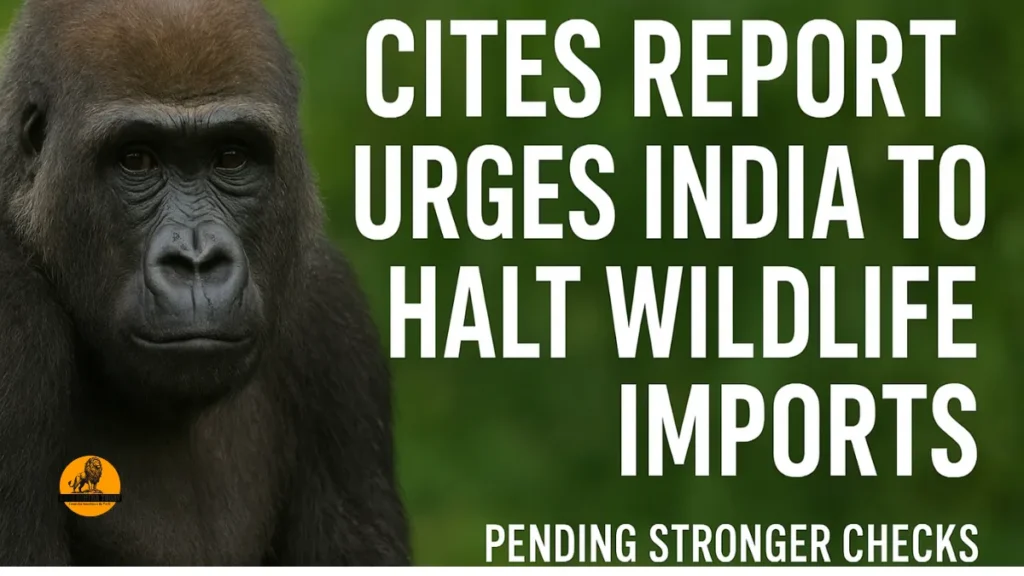
New Delhi, November 2025– Cites Vantara: A recent report by the Convention on International Trade in Endangered Species of Wild Fauna and Flora (CITES) has urged India to temporarily halt the import of critically endangered species until stronger verification systems are put in place. The recommendation comes after an official verification mission flagged possible loopholes and irregularities in India’s wildlife import procedures, particularly in relation to animal acquisitions by Vantara, the animal care and rehabilitation initiative based in Jamnagar, Gujarat.
Background: Why CITES Intervened
The CITES Secretariat raised serious concerns during its Standing Committee meeting in February 2025 regarding wildlife imports to the Greens Zoological Rescue and Rehabilitation Centre (GZRRC) — an institution operated under Cites Vantara. The mission also visited the Radha Krishna Temple Elephant Welfare Trust (RKTEWT), assessing compliance with international wildlife trade regulations.
According to CITES officials, while India’s wildlife trade framework is legally compliant on paper, verification gaps and inconsistent documentation processes could be allowing illegal wildlife trade to masquerade as legitimate “captive-bred” imports. This, the report warned, risks undermining India’s credibility as a global conservation leader.
About CITES: The Global Wildlife Trade Watchdog
CITES — short for Convention on International Trade in Endangered Species of Wild Fauna and Flora — was adopted in 1973 and is headquartered in Geneva, Switzerland. With 185 member nations, it acts as the world’s key legal framework to ensure that international trade in wild species does not endanger their survival.
Under CITES, species are classified into three appendices based on the level of protection required:
| Appendix | Description | Trade Regulation |
|---|---|---|
| Appendix I | Species threatened with extinction | Trade only allowed in exceptional circumstances |
| Appendix II | Species not immediately threatened but could be if trade is unregulated | Trade monitored to prevent overexploitation |
| Appendix III | Species protected in at least one country seeking assistance from others | Requires documentation and verification |
Every member country must issue valid export and import permits through its national CITES management authority before trade can occur.
India’s CITES Compliance Framework
India joined CITES in 1976, designating the Directorate of Wildlife Preservation under the Ministry of Environment, Forest and Climate Change (MoEFCC) as its national authority. The framework is reinforced by the Wildlife (Protection) Act, 1972, which regulates the acquisition, possession, and trade of both native and exotic species.
India officially allows the international trade of wildlife only with valid CITES permits. However, the recent report suggests that despite valid paperwork, the authenticity of many imports’ origins remains questionable.
Trigger: The Cites Vantara Wildlife Imports
The CITES verification mission was prompted by mounting international scrutiny over wildlife imports by the Greens Zoological Rescue and Rehabilitation Centre (GZRRC) in Jamnagar — an institution managed under Cites Vantara.
Investigations revealed that several animals, including chimpanzees, gorillas, orangutans, and even snow leopards, had been imported from non-breeding countries such as Egypt, Syria, Haiti, and the Czech Republic — a red flag suggesting potential violations of CITES provisions.
Key Findings of the CITES Mission
The mission’s detailed report revealed several serious inconsistencies:
- Permits Valid, But Source Questionable:
While import documentation and CITES permits were technically in order, the source codes (indicating whether the animals were wild-caught or captive-bred) raised doubts. Officials found discrepancies between India’s records and those of exporting countries. - Imports from Commercial Breeders:
Many of the animals imported by Cites Vantara reportedly came from commercial breeding facilities rather than recognized zoological institutions, which violates norms under India’s Wildlife (Protection) Act. - Conflicting Claims:
The Czech Republic, one of the exporting nations, informed CITES that certain animals sent to India were sold commercially, contradicting India’s claim that they were rescued or rehabilitated animals. - Imports from Non-Breeding Nations:
Several species were sourced from countries without breeding programs — for instance, chimpanzees from Egypt and cheetahs from Syria — suggesting possible laundering of illegally captured wildlife through third-party channels. - Mislabelled and Confiscated Animals:
Some Appendix-I species were declared as confiscated or zoo animals, but CITES inspectors found inconsistencies between the paperwork and the actual origin, raising red flags about mislabelling.
CITES Recommendations to India
Following the investigation, CITES issued a set of directives urging India to act swiftly and comprehensively:
- Strengthen Documentation & Verification:
Establish a centralized mechanism to verify the origins and breeding claims of imported animals. - Cross-Check with Source Nations:
Collaborate with countries such as Congo, Guyana, Iraq, UAE, and Mexico to validate permits and ensure animals were not illegally captured. - Rectify Mislabelled Imports:
Take corrective action in cases where wild-caught animals were falsely declared as captive-bred. - Report Compliance within 90 Days:
Submit a full compliance and action report to the CITES Secretariat detailing measures taken to prevent recurrence.
India’s Response and Legal Implications
India’s environment ministry has not yet announced a temporary suspension of wildlife imports, but officials have confirmed that an inter-ministerial review is underway. A senior MoEFCC source told reporters that “India takes its obligations under CITES seriously and will fully cooperate with the Secretariat to address all concerns.”
Legal experts say that if CITES’ concerns are not adequately addressed, India could face reputational damage or even trade restrictions on wildlife species in the international market.
Challenges Identified by CITES
The report outlines several systemic weaknesses within India’s verification and enforcement process:
| Challenge | Description |
|---|---|
| Weak Verification Systems | Lack of integration between customs, MoEFCC, and CITES databases delays source verification. |
| Misuse of ‘Captive-Bred’ Label | Wild-caught animals are often passed off as captive-bred to bypass restrictions. |
| Imports from Non-Breeding Nations | Indicates potential links to illegal trafficking networks. |
| Inadequate Due Diligence | Lack of mandatory third-party audits before import approvals. |
| Contradictions in Records | Mismatch between exporter and importer country data. |
| Imports Violating Zoo Norms | Commercial facilities importing animals under the guise of rescue centers. |
The Way Forward for India
Experts have suggested several corrective steps to strengthen India’s compliance:
- Digital Verification System:
Develop a unified digital platform that integrates data from customs, MoEFCC, and CITES to enable real-time tracking of wildlife imports. - Genetic Tracking Mechanism:
Introduce DNA-based certification to verify breeding claims and differentiate captive-bred animals from those caught in the wild. - International Cooperation:
Enhance partnerships with CITES source and transit countries for joint investigations and shared databases. - Capacity Building:
Train customs and wildlife officers to identify falsified permits and recognize red flags during import processes. - Stricter Enforcement:
Enforce the Wildlife (Protection) Act, 1972, more rigorously by allowing only recognized zoos and scientific institutions to import species under Appendix I or II. - Third-Party Audits:
Make independent verification mandatory before granting import clearance to private or commercial institutions.
Also read: Global Wildlife Authority Applauds Vantara’s World-Class Animal Care and Conservation Standards
Global Implications of the Cites Vantara Case
The Cites Vantara case has ignited a broader debate on the ethics of wildlife imports in developing economies. Conservationists argue that unverified imports under the banner of rescue or rehabilitation can inadvertently fuel global wildlife trafficking networks.
“India’s reputation as a conservation leader depends on transparency and adherence to CITES norms,” said a wildlife policy expert in Geneva. “The Cites Vantara case is a test of India’s enforcement integrity.”
International watchdogs have also urged other CITES member states to scrutinize their export documentation to India until verification mechanisms are improved.
Why This Matters for Global Conservation
Wildlife trafficking is estimated to be the fourth-largest illegal trade in the world, after drugs, arms, and human trafficking, valued at over $20 billion annually. CITES plays a critical role in curbing this trade by ensuring accountability in both exporting and importing nations.
India, home to nearly 8% of the world’s biodiversity, has long championed the protection of endangered species. However, lapses in documentation or enforcement could erode global trust and set back conservation progress across Asia.
Conclusion
The CITES report serves as a wake-up call for India to reassess its wildlife import protocols, particularly those linked to Cites Vantara and associated institutions. By strengthening due diligence, integrating digital verification, and collaborating internationally, India can reinforce its image as a responsible guardian of biodiversity.
Experts emphasize that India’s proactive response in the coming months will determine not only its standing under CITES but also the future of ethical wildlife trade across the globe.