
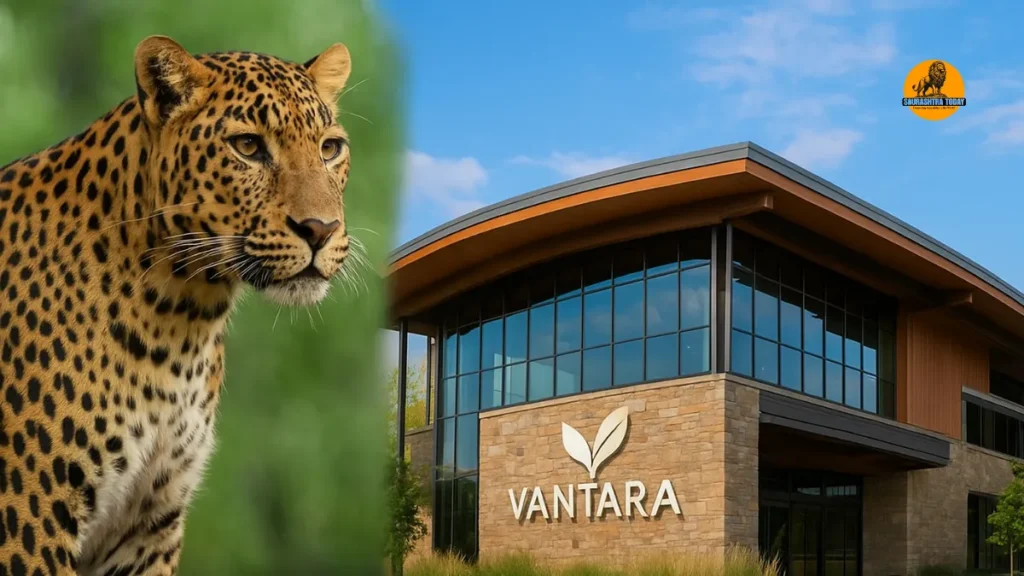
Vantara: In a significant move to manage rising cases of human-leopard conflict, the Maharashtra government has submitted a formal proposal to the Central Zoo Authority (CZA), seeking approval to relocate 50 rescued leopards to the Vantara animal care and rehabilitation centre in Jamnagar, Gujarat — a facility owned by the Ambani Group.
According to Chief Conservator of Forests (CCF) Jitendra Ramgaonkar, the proposal was officially forwarded to the Centre on November 6. The plan aims to ease the pressure on overcrowded rescue facilities in Maharashtra and provide a safer, well-managed environment for big cats that have been in captivity for several years.
Focus on Rescued Leopards Only
Speaking to Vantara News, Mr. Ramgaonkar clarified that the relocation will apply only to leopards that have been housed in rescue centres for extended periods.
“The proposal does not include wild leopards from forests or conflict-prone areas. It focuses solely on rescued leopards that cannot be released back into the wild,” he said.
He added that once these animals are shifted to Jamnagar, space will be freed up in Maharashtra’s rescue centres, allowing the forest department to accommodate newly rescued or injured wildlife more efficiently.
The official emphasized that no arbitrary relocation will take place, and every movement will follow scientific evaluation, veterinary clearance, and CZA protocols.
Rising Human-Leopard Conflict in Western Maharashtra
Over the past few months, leopard-related incidents have escalated sharply in western Maharashtra, particularly in Pune, Junnar, Shirur, Ambegaon, and Khed talukas.
On November 2, a 13-year-old boy tragically lost his life in Shirur, marking the third fatal leopard attack in the district since mid-October.
The spate of attacks has triggered panic among local residents and growing calls for stronger wildlife management strategies. Forest rangers have been working around the clock to install camera traps, conduct awareness drives, and deploy night patrols, but the frequency of encounters continues to rise.
According to wildlife experts, habitat shrinkage, sugarcane farming patterns, and easy access to livestock prey have contributed to the increase in leopard sightings near human settlements.
State’s Response: Birth Control and Better Monitoring
In response to the growing crisis, Chief Minister Devendra Fadnavis stated that the government is taking a multi-pronged approach to control the leopard population and reduce human-wildlife conflict.
Speaking on the issue, he said:
“We estimate around 1,300 leopards in the Pune and Ahilyanagar regions alone. With numbers rising each year, we are in talks with the Central Government to approve sterilization measures. Man-eating leopards, if identified, will be handled according to existing wildlife regulations.”
Officials have confirmed that proposals related to leopard sterilization and population management have already been forwarded to the Centre for consideration.
Mr. Ramgaonkar reiterated that leopard relocation and sterilization will proceed only after scientific validation and approval from relevant authorities, including the Central Zoo Authority and Wildlife Institute of India.
Inside Vantara: India’s Largest Private Wildlife Rescue and Rehabilitation Facility
The Vantara Centre, established by Anant Ambani, son of industrialist Mukesh Ambani, is one of India’s most sophisticated animal welfare projects. Spread over 3,000 acres in Jamnagar, Gujarat, the centre houses rescued, injured, and abandoned wild animals from across India.
Vantara, meaning “Star of the Forest,” provides state-of-the-art veterinary care, open enclosures, and enriched habitats designed to mimic natural surroundings. The facility has become a hub for conservation research, animal welfare, and rehabilitation efforts, aligning with international zoological standards.
Sources told Vantara News that the centre already houses several species, including lions, tigers, elephants, and rare herbivores, all rescued from critical conditions or captivity. The addition of rescued leopards from Maharashtra will further strengthen Vantara’s conservation initiatives.
Clarification from Forest Officials
Amid speculation on social media claiming that the Maharashtra government plans to relocate as many as 1,500 leopards, senior forest officials have dismissed these reports as “unscientific and exaggerated.”
A senior officer from the Forest Department clarified to Vantara News:
“We are not sending 1,500 leopards to Jamnagar. The plan currently includes only 50 rescued leopards, and relocation will occur gradually and only if necessary.”
The officer further added that inter-state coordination is underway, ensuring that every leopard transferred to Jamnagar is medically fit, microchipped, and accompanied by health records in compliance with CZA guidelines.
Public Reactions and Expert Opinions
The relocation proposal has sparked mixed reactions among wildlife activists and local communities. Some environmentalists have welcomed the move, calling it a practical step to manage human-leopard conflict, while others have expressed concerns over the long-term implications of removing animals from their native regions.
Wildlife biologist Dr. Shailesh Mehta, speaking to Vantara News, said:
“Relocation can be effective if done scientifically. However, authorities must ensure that this does not become a precedent for shifting wild animals every time conflict arises. Long-term strategies like habitat protection, corridor connectivity, and awareness are more sustainable.”
Animal welfare NGOs have also suggested that the relocation should remain transparent, with public data sharing on each leopard’s health status, transport, and post-relocation adaptation.
Human–Leopard Coexistence Challenges
Maharashtra’s forests, especially in the Western Ghats region, have long served as a natural habitat for leopards. But as human settlements expand into forest fringes, encounters have become increasingly frequent.
Experts point out that leopards are highly adaptable predators capable of surviving in sugarcane fields and semi-urban landscapes. However, this adaptability has made them more visible to humans, escalating both fear and conflict.
Studies by the Wildlife Institute of India (WII) have shown that leopard densities in western Maharashtra are among the highest in the country, and relocation without ecological assessment could disturb local balance.
Government’s Multi-Layered Plan
The Maharashtra Forest Department has outlined a three-tier plan to mitigate conflict and manage the leopard population:
- Rescue and Relocation: Transfer of non-releasable leopards to certified facilities like Vantara.
- Sterilization: Implementation of scientific birth-control programs to stabilize populations in high-density zones.
- Community Awareness: Engaging local residents through educational programs, compensation schemes, and rapid-response teams.
Mr. Ramgaonkar emphasized that all measures are being executed under the Wildlife Protection Act, 1972, and that transparency and animal welfare remain top priorities.
Also read: CITES Urges India to Pause Wildlife Imports Amid Concerns Over Illegal Trade Linked to Cites Vantara
Coordination Between States
The proposal to send rescued leopards to Vantara in Gujarat marks one of the first large-scale inter-state wildlife relocation initiatives in recent years.
According to officials, both the Maharashtra and Gujarat forest departments are in touch to coordinate logistics, veterinary assessments, and habitat readiness.
Special transport containers, monitored by wildlife veterinarians, will be used to ensure safe transfer of the animals over the 500-kilometre journey.
Also read: Global Wildlife Authority Applauds Vantara’s World-Class Animal Care and Conservation Standards
Looking Ahead: Balancing Conservation and Human Safety
The Maharashtra government’s move underscores the delicate balance between wildlife conservation and human safety.
As leopard populations grow and habitats shrink, policymakers face increasing pressure to adopt strategies that are both scientifically sound and socially responsible.
The Central Zoo Authority’s decision, expected later this month, will determine the fate of Maharashtra’s relocation plan. If approved, it could serve as a model framework for other states grappling with similar human-animal conflicts.
Until then, the forest department continues to patrol affected zones, rescue stray leopards, and raise awareness among rural communities about safe coexistence with wildlife.
Conclusion
The proposed relocation of rescued leopards from Maharashtra to Vantara in Jamnagar represents more than just a transfer of animals — it’s a reflection of India’s evolving wildlife management strategy, one that balances compassion, science, and pragmatism.
While experts urge caution and transparency, the initiative highlights the growing collaboration between state authorities, conservation scientists, and private institutions like Vantara.
As the world watches, this partnership could redefine how India — and the world — approaches wildlife rescue, rehabilitation, and conflict resolution in the 21st century.