
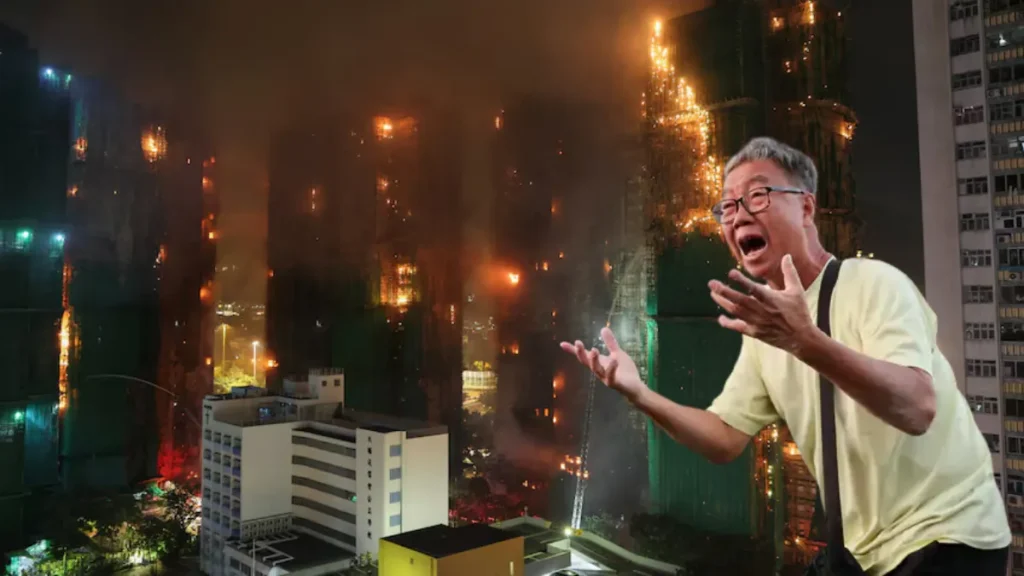
A deadly Fire in Hong Kong Apartment has sparked a major criminal investigation after a massive blaze tore through multiple residential towers in the Tai Po district, killing at least 44 people and leaving hundreds more missing. Officials have confirmed that the tragedy—one of the city’s worst high-rise disasters in recent decades—may have been fuelled by unsafe renovation practices and highly flammable construction materials.
The inferno broke out on Wednesday afternoon in Wang Fuk Court, a densely populated public housing estate with over 4,000 residents. As the flames rapidly engulfed building after building, emergency workers battled through the night to rescue trapped residents, many of whom were stranded on upper floors with smoke pouring through stairwells and corridors.
Authorities have already arrested three executives from a renovation company involved in the building’s repair work, launching a manslaughter investigation into whether negligence or illegal construction practices intensified the catastrophe.
#BreakingBad .
— PoonamSharma (@Poonam_1992) November 27, 2025
44 Dead After Massive Fire Ravages 7 High-Rise Buildings In Hong Kong, 3 Arrested pic.twitter.com/dwn5kf1YWj
A Rapidly Expanding Blaze
The fire began shortly before 3 p.m. at Wang Cheong House—one of the estate’s 32-storey towers currently undergoing renovation. The building was wrapped in bamboo scaffolding, a traditional construction method widely used across Hong Kong.
Fire Services Deputy Director of Operations, Derek Armstrong Chan, said the scaffolding was already engulfed in flames when the first crews arrived. Within minutes, burning bamboo poles collapsed and falling debris helped spread the fire across the façade. Strong afternoon winds accelerated the flames, pushing them across to neighbouring blocks.
Authorities said that seven of the estate’s eight towers eventually caught fire, leaving thousands of residents scrambling for safety. Many were unable to escape through smoke-filled staircases and instead waited at windows or on rooftops for firefighters to reach them.
Temporary shelters have been set up nearby for survivors who escaped with little more than the clothes they were wearing.
Flammable Renovation Materials Found Across Buildings
Hong Kong Security Secretary Chris Tang expressed deep concern about how rapidly the fire travelled across the buildings’ exterior surfaces. Initial inspections revealed that several materials used during the renovation performed far worse than allowed under safety regulations.
According to Tang, investigators discovered:
- Non-compliant netting and tarpaulin covering the scaffolding
- Plastic sheeting that ignited extremely quickly
- Materials that “burned far more intensely than permitted”
“These findings are highly unusual,” Tang said. “The speed at which the fire spread through the scaffolded exterior suggests that the materials present were significantly more combustible than legally allowed.”
Further complicating the investigation, Fire Services Director Andy Yeung confirmed that sheets of styrofoam had been glued around window frames in the block undergoing repairs. The use of styrofoam—highly flammable and capable of melting into burning droplets—created what Yeung described as “fuel channels” that helped flames travel through ventilation gaps and into residential units.
The South China Morning Post reported that the styrofoam may have allowed the fire to leap between floors, igniting apartment interiors across multiple levels.
“These materials effectively blocked ventilation and acted as accelerants,” Yeung added. “This made the blaze significantly more aggressive and difficult to control.”
Authorities have since launched a joint task force between the Hong Kong Police Force and the Fire Services Department to determine whether the use of these materials violated building codes or constituted criminal negligence.
Chief Executive John Lee said, “A dedicated investigation team has been formed to establish accountability and identify any misconduct or safety breaches that contributed to this disaster.”
Is Bamboo Scaffolding to Blame?
The deadly Fire in Hong Kong Apartment has reignited debate over one of the city’s oldest construction traditions—bamboo scaffolding. While most major global cities rely on steel scaffolding for tall buildings, Hong Kong remains one of the few places in the world where bamboo scaffolding is still widely used, even for skyscrapers.
Supporters of the method argue that bamboo is:
- Lightweight
- Flexible
- Cost-effective
- A vital part of local construction culture
However, critics point out that bamboo is also highly flammable, particularly when combined with plastic netting or tarpaulin used to protect construction sites.
Government officials have been gradually pushing for increased use of steel scaffolding in public projects after several workplace accidents raised concerns about both fire risks and structural safety. But labour unions strongly oppose a rapid shift, warning it could threaten the jobs of nearly 4,000 professional bamboo scaffold workers—often referred to as “spidermen” because of their ability to climb and assemble the structures at great heights.
The latest tragedy may accelerate policy discussions. As questions mount over whether bamboo scaffolding contributed to the rapid horizontal spread of the flames, experts say the city may have to reconsider where and how the material is used, especially in densely populated residential areas.
Massive Rescue Operation Involving 888 Firefighters
The scale of the emergency response reflected the enormity of the unfolding crisis. Authorities deployed an extraordinary 888 firefighters to the scene, rotating teams throughout the night as they attempted to contain flames across multiple towers simultaneously.
Fire crews were forced to navigate collapsing scaffolding, falling debris, and smoke-filled hallways. Many residents had barricaded themselves in bathrooms or sealed their doors with wet towels as they waited for rescue.
Search teams have continued combing through the devastated blocks, floor by floor. Officials warn that the casualty count may grow significantly, as a large number of residents remain missing. Many of the missing are elderly residents who lived alone or had limited mobility.
This tragedy marks one of the worst high-rise fires in Hong Kong in recent memory and has drawn comparisons to the city’s 1996 Garley Building fire, which killed 41 people and led to sweeping fire safety reforms.
A Community Devastated and Demanding Answers
Wang Fuk Court was considered a quiet, family-oriented housing estate, home to thousands of working-class residents. Entire families have been displaced, and many survivors remain in shock after witnessing neighbours trapped behind windows or calling for help from smoke-filled apartments.
Local community groups have appealed for donations of food, clothing, and temporary accommodation for affected families, while volunteer networks are assisting with missing-person reports.
The Hong Kong government has pledged full transparency as the investigation proceeds. Officials say determining how an afternoon fire could engulf an entire housing complex within minutes is now a matter of urgent public concern.
“This disaster should never have happened,” one resident told reporters. “We need answers. We need accountability.”
A Turning Point for Building Safety in Hong Kong?
As evidence mounts linking unsafe materials and traditional construction techniques to the rapid spread of the disaster, the fire in Hong Kong apartment buildings may become a pivotal moment for the city’s building safety regulations.
Key questions now facing investigators include:
- Were prohibited materials used during renovation?
- Did contractors cut corners to save time or costs?
- Should bamboo scaffolding be restricted for high-rise residential repairs?
- Were safety inspections performed adequately?
Until these questions are fully answered, families across Hong Kong are left mourning loved ones and hoping that such a devastating failure of safety standards is never repeated.