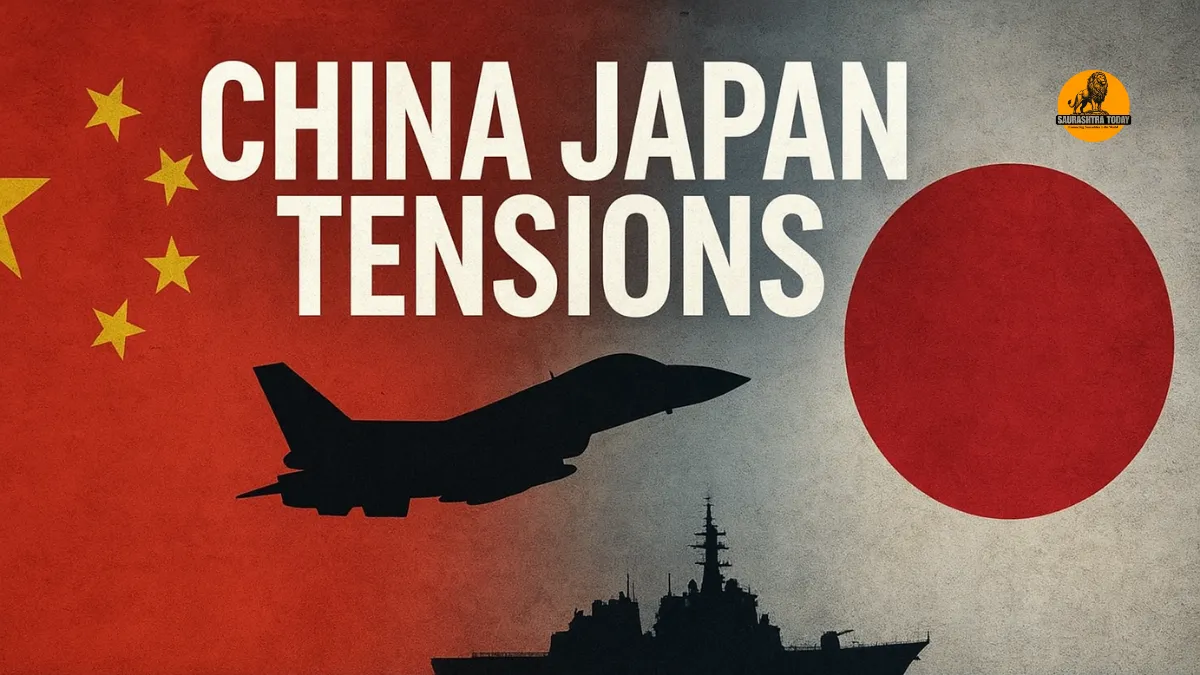
The Indo-Pacific region is witnessing a sharp escalation in diplomatic friction and military signaling, as China Japan tensions intensify over remarks made by Japan’s Prime Minister Sanae Takaichi concerning Taiwan’s security. The situation has triggered a cascade of warnings, counter-warnings, public advisories, and heightened military activity, raising concerns over the future stability of the region.
This unfolding episode underscores the growing volatility surrounding Taiwan—an island China claims as its own, while Japan views as crucial to its national security and maritime trade routes.
Japan Signals Possible Military Role in Taiwan Conflict
On November 7, Prime Minister Sanae Takaichi stated that Japan would consider sending military forces to assist Taiwan if China launched an attack. The message marked one of the strongest public commitments from a Japanese leader in recent years regarding Taiwan’s defense.
Takaichi emphasized that any attempt by China to forcibly change the status quo would directly threaten Japan’s own security interests. Taiwan lies roughly 110 kilometers from Japan’s Yonaguni Island, making it one of the closest potential flashpoints for Japan’s Self-Defense Forces.
The statement sparked immediate pushback from Beijing, which condemned the comments as “irresponsible and provocative.” Chinese officials argued that Japan was inserting itself into an internal Chinese matter and destabilizing regional peace.
Chinese Diplomat Issues Harsh Warning Online
Tensions took a dramatic turn the following day when Zhu Jian, the Chinese Consul General in Osaka, posted a highly aggressive message on Instagram. He warned that anyone interfering in the Taiwan issue would have their “head severed.”
The statement triggered strong reactions within Japan and led both governments to summon each other’s envoys for urgent diplomatic discussions. The alarming language further worsened China Japan tensions, fueling public concern and intensifying media scrutiny.
Travel Warnings and Safety Alerts Issued
In response to the diplomatic fallout, China issued a travel advisory urging its citizens to avoid non-essential trips to Japan, warning that they may face increased risks amid rising hostility.
Japan, in turn, issued its own safety advisory for Japanese citizens living in China. The advisory urged people to avoid crowded places, refrain from unnecessary conversations with strangers, travel in groups, and ensure children are closely supervised in public environments.
Japan’s Cabinet Secretary Minoru Kihara stated that the advisory was prompted by a noticeable deterioration in Japan’s public image across certain Chinese media outlets. Japan fears that anti-Japanese sentiment may spill over into public spaces, putting its citizens at risk.
China also issued a separate safety notice for Chinese students studying in Japan, citing rising crime rates and an environment it described as “less safe than before.”
US Reaffirms Commitment to Japan’s Security
The United States, a key treaty ally of Japan, weighed in as the situation escalated. Washington reaffirmed that under the US-Japan security treaty, any attack on territories administered by Japan—including the disputed Senkaku Islands—would trigger American military support.
This reassurance came after Chinese Coast Guard vessels were spotted near the Japan-administered Senkaku Islands on Sunday. Japanese authorities had to escort them out of the area, prompting renewed concerns over China’s assertiveness in regional waters.
For China, the US-Japan alliance remains one of the primary obstacles to its ambitions in the East China Sea. For Japan, American support acts as a critical deterrent against any attempt by China to assert control over contested waters.
China Halts Japanese Film Releases Amid Diplomatic Rift
As diplomatic tensions increased, Chinese film distributors halted the release of certain Japanese movies. State broadcaster CCTV reported that the decision was taken with “maximum caution” in light of current geopolitical sensitivities.
Although no explicit ban was announced, the move reflects the gradual spillover of China Japan tensions into cultural and commercial spaces.
Cultural exchanges have historically served as stabilizing bridges in Sino-Japanese relations. However, the latest actions show how broader political conflicts can influence softer forms of engagement.
Chinese Media Criticizes Japan’s Role in Taiwan Issue
State-controlled Chinese media outlets published strongly worded editorials accusing Japan of unnecessarily interfering in the Taiwan issue. They claimed that Japan’s involvement could generate serious security risks for the entire region.
One editorial warned that if Japanese forces were deployed in a Taiwan conflict, it could lead to catastrophic consequences, not only for Japan but for the broader Asia-Pacific region.
China views Taiwan as an inseparable part of its territory and has not ruled out the use of force to seize it. In contrast, Japan and the United States do not formally recognize Taiwan as an independent nation but support maintaining the status quo and oppose any coercive attempts to change it.
Strategic Importance of Taiwan for Japan
Taiwan’s geographic proximity and maritime significance make it indispensable for Japan’s security planning.
Key reasons why Taiwan matters to Japan:
- Close Distance: Only 110 km away from Japan’s southwestern islands.
- Vital Sea Routes: The waters around Taiwan serve as one of the world’s busiest maritime trade lanes.
- Energy Imports: Japan’s energy and resource shipments rely heavily on stable sea lines of communication near Taiwan.
- US Military Presence: Japan hosts the world’s largest concentration of US military forces outside the United States, intensifying the strategic convergence between Tokyo and Washington on Taiwan.
A Chinese takeover of Taiwan could reshape regional power dynamics in ways Japan sees as deeply threatening.
Senkaku Islands: The Persistent Flashpoint
The Senkaku Islands—known as Diaoyu Islands in China—have long been a major source of friction. These uninhabited islands in the East China Sea are controlled by Japan but claimed by China.
Why the islands matter:
- They lie close to major shipping routes.
- They may contain natural gas and oil reserves.
- They sit near important fishing grounds.
- They fall within overlapping air defense zones.
Chinese military aircraft regularly venture close to Japanese airspace, prompting Japan’s Air Self-Defense Force to scramble jets frequently. As China Japan tensions rise, the islands could become a focal point for further confrontation.
Rhetoric vs. Reality: Are We Moving Toward Conflict?
Despite the strong rhetoric exchanged by political leaders and diplomats, analysts note that both countries remain cautious of allowing tensions to escalate into military confrontation.
However, three critical factors contribute to rising concerns:
- Increasing military activity in contested waters
- Growing nationalism within both countries
- The strategic triangle between China, Japan, and the United States
Each of these elements creates opportunities for miscalculation—a risk experts describe as one of the most dangerous aspects of modern geopolitics in the Indo-Pacific.
The Global Strategic Context
The intensification of China Japan tensions comes at a time when global powers are recalibrating their positions in the Indo-Pacific.
- China seeks to expand its influence and assert sovereignty claims.
- Japan is bolstering its defense capabilities under a more assertive security doctrine.
- The United States is strengthening alliances to counterbalance China’s rise.
This geopolitical triangle places Taiwan in the center of a major strategic contest, making any development in the region immediately significant to global affairs.
Conclusion: An Uncertain Road Ahead
The current wave of diplomatic hostilities between China and Japan signals a potentially dangerous phase in East Asian geopolitics. What began as a provocative statement regarding Taiwan’s defense has evolved into a multi-layered escalation, involving military deployments, public safety advisories, media warfare, and cultural repercussions.
As the world watches closely, regional stability hangs in the balance.
The continuation—or escalation—of China Japan tensions will depend on diplomatic restraint, strategic communication, and the willingness of all parties to avoid actions that could inadvertently push the region toward open conflict.