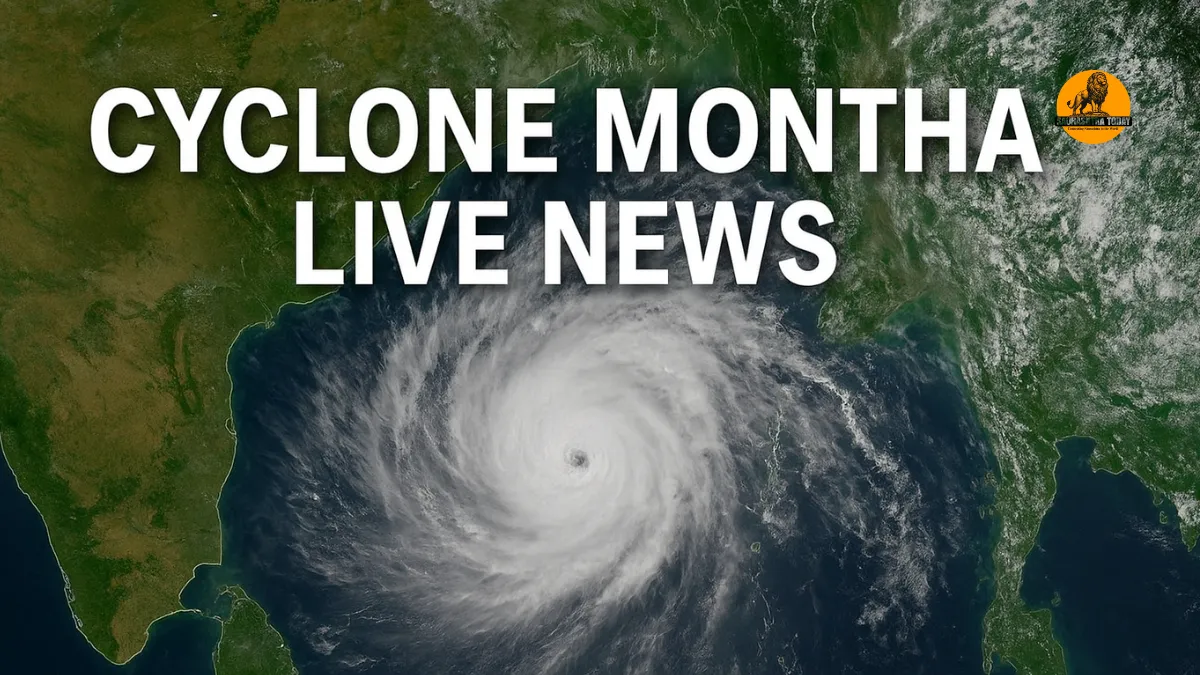
Cyclone Montha Live News: Even though the monsoon season officially ended on October 15, clouds are still refusing to leave India’s skies. Currently, around 90% of the country is under cloudy weather, with light to moderate rainfall continuing in several regions. According to the India Meteorological Department (IMD), nearly 15 states will continue to witness unseasonal rain over the next four days.
But where is all this post-monsoon rain coming from? Is it a blessing or a concern — and will it lead to an early winter? Here’s a detailed explanation based on Cyclone Montha live updates and expert forecasts.
Widespread Rain Across India: Where Is It Raining Now?
In the past 24 hours, more than 14 states across India have reported light to heavy rainfall. According to IMD data issued at 8:30 AM on October 27, rainfall above 7 cm was recorded across parts of Gujarat, Maharashtra, Tamil Nadu, Karnataka, Chhattisgarh, Madhya Pradesh, Rajasthan, Uttar Pradesh, Goa, and Andhra Pradesh between October 26–27.
These unseasonal rains have not only drenched the western and southern states but also disrupted harvesting activities across central and northern India. The intensity of rainfall has been particularly high in coastal regions due to active weather systems in the Bay of Bengal and the Arabian Sea.
What Is Causing Rain After the Monsoon’s Departure?
Experts say that three major weather systems are currently active over India, combining to produce heavy rainfall even after the monsoon season’s official retreat.
Let’s break them down:
Cyclone Montha in the Bay of Bengal
The primary system is Cyclone Montha, which formed over the Bay of Bengal on October 27. According to IMD, the cyclone is moving towards the Andhra Pradesh–Odisha coast and is expected to intensify into a severe cyclonic storm by October 28.
Wind speeds are predicted to reach 90–100 km/h, with gusts possibly hitting 110 km/h. The system is expected to weaken around October 29, after making landfall near Kakinada, between Machilipatnam and Kalingapatnam.
The IMD has issued high alerts for the coastal regions of Andhra Pradesh, Odisha, and the Andaman & Nicobar Islands, warning of strong winds, heavy rainfall, and sea turbulence. Fishermen have been advised to avoid venturing into the sea.
Depression Over the Arabian Sea
Simultaneously, a low-pressure depression has formed over the Arabian Sea. Though it is drifting away from the Gujarat coast, it continues to influence local weather conditions.
Several districts in Saurashtra and Kutch remain under a red alert as the system sustains rainfall activity across coastal Gujarat, Maharashtra, Karnataka, and Goa.
The IMD expects this depression to remain active for another 24 hours, after which it will gradually move southeastward. The combined moisture from both Cyclone Montha and this depression is feeding widespread rain across western and central India.
Western Disturbance Heading Toward the Himalayas
A Western Disturbance is approaching the northern Himalayan states, likely to hit by Monday. The system is expected to trigger snowfall in higher altitudes and a 3–4°C drop in temperature across north India by early November.
According to meteorologist Mahesh Palawat, moisture from all three active systems is converging over Uttar Pradesh, Bihar, Madhya Pradesh, Chhattisgarh, Rajasthan, and Gujarat — the reason these states are currently receiving unexpected rainfall.
The IMD has also issued a rain alert for Tamil Nadu and Puducherry, influenced by both Cyclone Montha and the Arabian Sea system.
Weather Outlook for the Coming Days
The IMD forecasts that rainfall will continue across most parts of India until October 30, after which only the northeastern states will experience showers. The latest bulletin from October 26 suggests heavy rainfall patterns as follows:
- West Madhya Pradesh: Heavy rain on October 27–28
- East Madhya Pradesh: Heavy rain on October 29–30
- Maharashtra (Vidarbha): Intense rain from October 28–30
- Chhattisgarh & Odisha: Heavy showers from October 27–30
- Bihar & Jharkhand: Rain from October 29–31
- West Bengal & Sikkim: Rain until October 31
- Gujarat & Rajasthan: Rainfall between October 27–30, especially heavy over Kutch (Oct 30) and Saurashtra (Oct 29)
- Uttar Pradesh: Thunderstorms on Oct 29 (West UP) and continuous rain till Oct 31 (East UP)
- Southern States: Thunderstorms and heavy rain till Oct 29 in Andhra Pradesh, Tamil Nadu, and coastal Karnataka
These weather changes could have significant agricultural and climatic impacts across multiple regions.
Impact on Agriculture: Blessing or Trouble for Farmers?
The unseasonal rainfall is not just affecting the skies — it’s also influencing farmers’ livelihoods. With Rabi sowing and Kharif harvesting overlapping, the rains are creating both opportunities and risks.
According to Dr. G.P. Singh, Director of the Indian Council of Agricultural Research (ICAR), this spell of rainfall could bring three major agricultural impacts:
Delay in Wheat Sowing – Daily Loss of 40 kg per Hectare
Wheat sowing in Punjab, Haryana, and Uttar Pradesh typically begins between October and December. Farmers were preparing to start this week, but waterlogged fields have delayed the schedule.
A delay beyond November 15 could reduce yield potential — estimated losses could reach 40 kg of wheat per hectare per day if sowing is postponed.
ICAR also notes that wheat seeds are time-sensitive: varieties designed for October sowing lose productivity if planted too late.
Chickpea Crop Gains, But Risk from Excess Rain
In Madhya Pradesh, farmers have already begun sowing chickpea (gram) and wheat for the Rabi season. Generally, good rainfall favors chickpea crops, while dry conditions benefit wheat.
So far, the moderate rain has been beneficial for chickpea, but continuous heavy rain could lead to waterlogging, damaging standing crops.
Challenges for Rice Harvest and Storage
Southern India is currently in the middle of the paddy harvest season. While most fields have been harvested, any pending crops could suffer from lodging or fungal attacks due to excessive rain.
Moreover, already harvested rice stored in open yards could absorb moisture, leading to spoilage.
Traders usually refuse to buy high-moisture rice, which could disrupt supply chains and cause price hikes.
Agri-trade expert Vijay Sardana warns that mustard, pulses, vegetables, and fruit crops could also face similar risks. Farmers who have already sown new crops may be forced to replant, increasing costs.
Will the Rains Lead to a Colder Winter?
Experts believe that good rainfall during this time can enhance the winter chill. Rain cools the soil surface and lowers atmospheric temperatures, paving the way for early winter conditions.
Additionally, global models indicate a La Niña phase, which usually brings colder-than-usual winters to India and South Asia.
The National Oceanic and Atmospheric Administration (NOAA) predicts a 71% chance of La Niña conditions between October and December, and a 54% likelihood between December and February.
As a result, Western Disturbances moving in from the Mediterranean region could become more powerful, leading to heavy snowfall in the Himalayas and dense fog over northern plains like Delhi, Punjab, and Uttar Pradesh.
Key Takeaways from Cyclone Montha Live Updates
- Cyclone Montha in the Bay of Bengal is the main driver of unseasonal rain across India.
- A Depression over the Arabian Sea and a Western Disturbance over the north are amplifying rainfall.
- Farmers may face mixed outcomes: chickpea crops benefit slightly, but wheat sowing and rice storage are at risk.
- Colder winter likely ahead, aided by La Niña and Western Disturbance activity.
- IMD advises continued alert for coastal states, urging fishermen and farmers to stay cautious.
Also read: Delhi AQI Today: Health Experts Warn of Rising Respiratory Risks Post-Diwali
Conclusion: Cyclone Montha Live News
As Cyclone Montha Live News continues to develop, India finds itself at a meteorological crossroads — where three active systems are rewriting post-monsoon patterns. While the rain brings temporary relief to some regions, it also threatens harvest cycles and infrastructure.
If forecasts hold true, Gujarat, Odisha, Andhra Pradesh, and many central states will continue facing heavy rainfall through October’s end. And as skies clear, a sharper winter chill may soon follow — signaling the true arrival of India’s cold season.