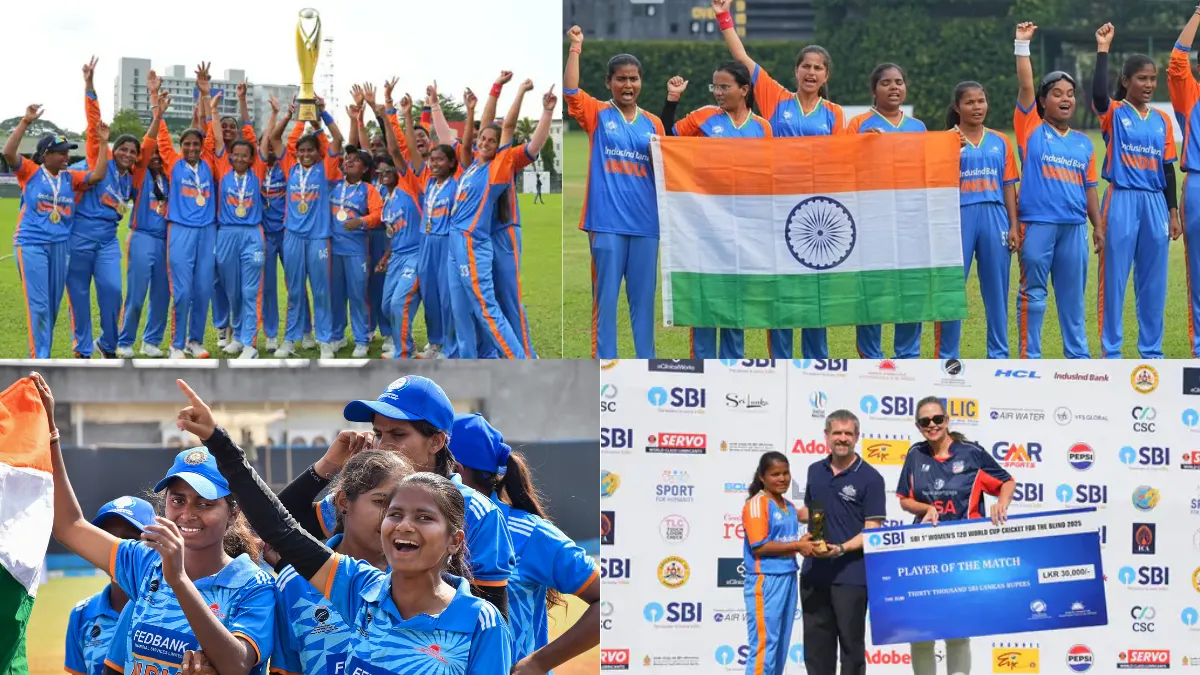
India has scripted a historic chapter in world cricket as India wins first Blind Women’s T20 World Cup, defeating Nepal by seven wickets in a thrilling final held on Sunday at Colombo’s P. Sara Oval Stadium. With this victory, the Indian visually impaired women’s cricket team completed an unbeaten run in the tournament, showcasing extraordinary skill, courage and consistency.
The final match turned into a one-sided affair as Nepal struggled to counter India’s disciplined bowling attack and exceptional fielding. India not only lifted the trophy but proved that their dominance in the format is unmatched after defeating cricket powerhouses including Pakistan and Australia earlier in the competition.
How the Final Unfolded: Nepal Managed Just One Boundary
The final began with India winning the toss and putting Nepal in to bat. The decision worked perfectly. Nepal’s batters were under constant pressure from India’s fierce bowling lineup, and despite trying to build steady partnerships, they were unable to break free.
Nepal finished their 20-over innings at 114 runs for 5 wickets, with the most striking statistic being that the entire team managed to hit only one boundary throughout the innings. India’s accurate line and length prevented Nepal from rotating the strike, and the pressure mounted as dot balls increased. The lack of boundaries became the turning point of the match, highlighting India’s tactical supremacy on the field.
India responded with a confident chase. The Women in Blue reached the target in just 12 overs while giving away only three wickets. The final run came amidst loud cheers from Indian supporters, coaches and players—marking the team’s greatest achievement to date.
Phula Saren’s Unbeaten 44: A Knock to Remember
India’s run chase was powered by a brilliant innings from opener Phula Saren, whose fearless approach stunned the Nepal bowling attack. Saren smashed an unbeaten 44 runs off just 27 balls, anchoring the innings from start to finish.
Her knock was a masterclass in timing, composure and confidence, perfectly suited for a championship match. With Saren at the crease, the target seemed within reach from the very beginning, and India’s chase never looked under threat.
Players from both teams praised Saren’s temperament and her ability to judge the ball with pinpoint awareness—especially in the high-pressure atmosphere of a world final.
A Tournament of Total Dominance – India Remained Unbeaten
From the opening match to the final moments of the championship, India maintained remarkable consistency. Their journey to the trophy included victories over some of the strongest contenders:
| Stage | Opponent | Result |
|---|---|---|
| League Stage | Australia | India won |
| League Stage | Pakistan | India won |
| Semifinal | Australia | India won by 9 wickets |
| Final | Nepal | India won by 7 wickets |
In the semifinal clash, India defeated Australia convincingly by 9 wickets, chasing down a target of 109 runs in only 12 overs. That match was a clear indication that India had arrived in Colombo not just to participate but to win.
With total composure, strong teamwork and relentless performance, India proved why India wins first Blind Women’s T20 World Cup is not just a headline—it is the result of years of hard work and sporting spirit.
Nepal’s Remarkable Journey to the Final
Nepal’s road to the final was equally inspiring. The team defeated Pakistan in the second semifinal held on Saturday, securing their historic place in the final against India. Their disciplined fielding and aggressive approach stunned Pakistan and earned appreciation from fans worldwide.
However, in the final, Nepal struggled to repeat that level of performance. Credit must go to India, whose strong game plan and psychological advantage kept the pressure on right from the first over. Though Nepal could not secure the trophy, their campaign highlighted the fast growth of visually impaired women’s cricket in the country.
Hosts Sri Lanka Failed to Leave a Mark
As the host of the tournament, Sri Lanka entered the competition with high expectations. However, they could not showcase their best cricket throughout the series. Out of five matches, Sri Lanka managed to win only one—against the United States.
Despite their average overall performance, Sri Lankan fans embraced the tournament and appreciated the presence of teams from across the world, creating an extraordinary atmosphere for the final stages.
Pakistan’s Mehrin Ali Emerges as the Tournament’s Top Scorer
Although Pakistan did not reach the final, one of the biggest highlights of the tournament was the extraordinary batting performance of Mehrin Ali, who finished as the top run-scorer.
Mehrin scored more than 600 runs across six matches, including a sensational 230 runs off just 78 balls against Sri Lanka, a knock that left spectators speechless. She also scored 130 runs against Australia in another brilliant display.
Pakistan fans hoped her incredible form would carry the team through to the final, but the semifinal defeat to Nepal meant their journey ended earlier than expected. Still, Mehrin’s unmatched batting brilliance will be remembered as one of the defining moments of the event.
A Historic Milestone for Global Women’s Blind Cricket
This tournament is being regarded as a turning point in international women’s blind cricket. For the first time, visually impaired women athletes from multiple countries competed at the highest competitive level with global attention.
The competition featured six participating nations:
- India
- Nepal
- Pakistan
- Australia
- United States
- Sri Lanka
The championship not only promoted the sport globally but also showcased the immense talent, mental strength and determination of women cricketers with visual impairment.
The victory of India wins first Blind Women’s T20 World Cup is expected to boost the development of the sport in India and inspire more young girls to participate.
Why India’s Win Matters Beyond Cricket
India’s victory has broader significance that goes beyond the cricket field:
Representation and Opportunity
The success highlights how athletes with disabilities can excel when given proper training, support and equal opportunities.
Inspiration for Millions
Young visually impaired girls who dream of playing sports now have role models, proving that barriers can be broken with hard work and belief.
Stronger International Recognition
The title places India at the forefront of international blind women’s cricket, establishing the country as a powerhouse of the sport.
Government and Institutional Support
With this victory, increased funding, training facilities and exposure for visually impaired cricketers in India are expected.
Voices of Celebration From the Indian Dressing Room
After the final, emotions ran high as players embraced each other, cheered with the tricolor and thanked fans and coaches for their unwavering support.
Team members expressed their gratitude, emphasizing how proud they were to bring the first-ever Blind Women’s T20 World Cup trophy home. Coaching staff highlighted the discipline and unity of the squad as the key factor behind the triumph.
The moment the cup was lifted became symbolic—not just of a cricket title, but of breaking barriers and showing the world what determination truly means.
Also read: PM Modi Meets World Champion Indian Women’s Team: A Historic Moment for Indian Cricket
Conclusion
The Colombo final will be remembered for decades to come as India wins first Blind Women’s T20 World Cup — a milestone that celebrates skill, perseverance and the unstoppable spirit of women athletes.
Defeating Nepal in the final, Australia in the semifinal and Pakistan in the league stage, India’s visually impaired women’s cricket team rose above every challenge with stunning confidence. From Phula Saren’s match-winning 44* to the bowling attack that restricted Nepal to a single boundary, every player contributed to a championship run that will inspire a new generation.
This historic win marks more than greatness in sport. It signals a new era — one where women with visual impairments take center stage, earn recognition and uplift millions with their courage.
India has not just won a World Cup. India has made history.