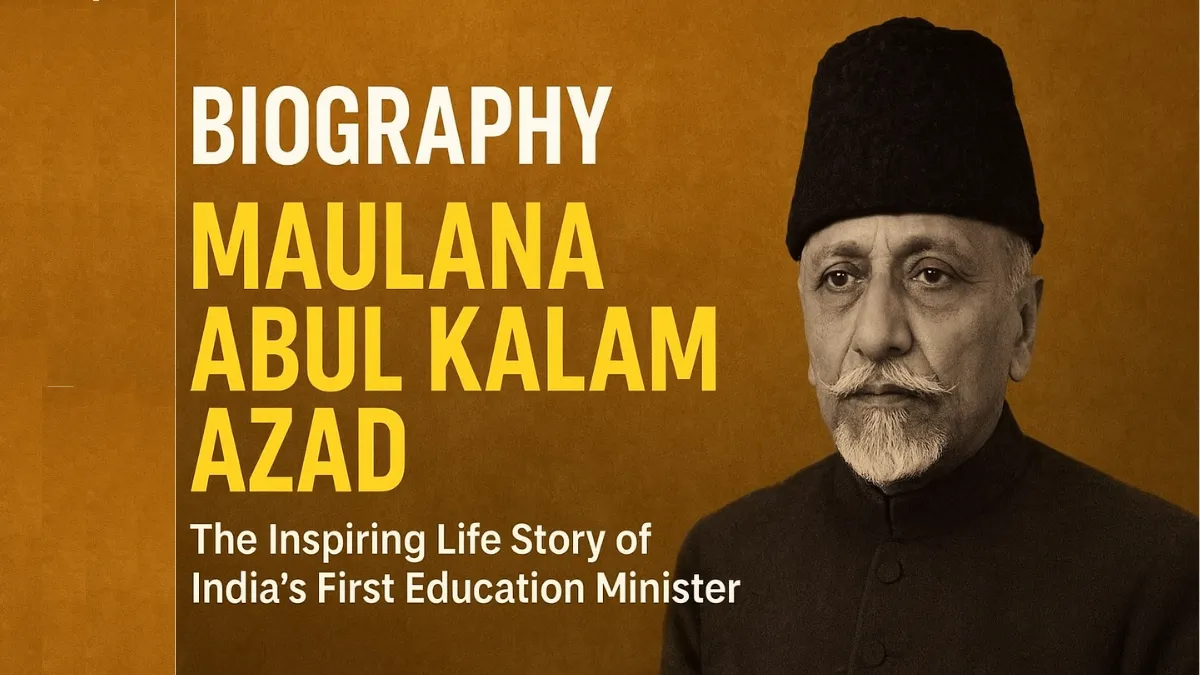
Explore the inspiring life and vision of Maulana Abul Kalam Azad, India’s First Education Minister — a scholar, reformer, and freedom fighter who built the foundation of modern Indian education and culture.
A Timeless Visionary Beyond Generations
Maulana Abul Kalam Azad stands as one of the most remarkable architects of modern India — a scholar, reformer, freedom fighter, and visionary who believed that the real strength of a nation lies not in its wealth, but in the education of its people. As India’s First Education Minister, Azad guided the destiny of the country for over a decade after Independence, laying the foundations for a learning society built on equality, reason, and human dignity.
His ideas continue to define India’s educational philosophy even in the 21st century. Azad imagined a country where knowledge was a right, not a privilege — where science and spirituality could co-exist, where women led with dignity, and where youth carried the torch of discipline, innovation, and compassion.
The Birth of a Scholar
Born in Mecca on November 11, 1888, Maulana Abul Kalam Azad came from a deeply religious and scholarly family. His father, Maulana Khairuddin, was a renowned theologian, and his mother, Alia, was an Arab and the niece of the respected scholar Shaikh Mohammad Zahir Watri of Madina. Originally named Feroze Bakht, he later became known as Abul Kalam — “father of discourse” — a title that perfectly reflected his command over thought and expression.
By the age of ten, Azad had already mastered the Quran, and by seventeen, he was recognized across the Islamic world as a young theologian of immense promise. His formal studies at Al-Azhar University in Cairo, one of the world’s oldest centers of learning, gave him a deep understanding of religion, philosophy, and world culture.
After his family settled in Calcutta, Azad launched his first magazine, Lisan-ul-Sidq, where he began articulating progressive and reformist ideas. Influenced by literary figures like Maulana Shibli Nomani and Altaf Hussain Hali, Azad developed a writing style that was both poetic and intellectual — blending Indian humanism with modern rationalism.
Awakening Through Politics
Maulana Azad entered politics at a young age during the 1905 partition of Bengal by the British, which sought to divide the population along religious lines. While many Muslim elites supported the move, Azad vehemently opposed it, joining underground revolutionary groups and associating with leaders such as Sri Aurobindo Ghosh and Shyam Sundar Chakravarty.
From that point, Azad’s ideology was rooted in national unity. He firmly believed that religion could never be a basis for dividing people. In his landmark autobiography India Wins Freedom, he wrote:
“It is one of the greatest frauds on the people to suggest that religious affinity can unite areas which are geographically, economically, and culturally different.”
Even in 1947, when most Congress leaders reluctantly accepted the Partition, Azad stood steadfast, warning of its long-term dangers. His immortal statement on Hindu-Muslim unity remains one of the most powerful expressions of secular nationalism ever spoken:
“If an angel were to descend from heaven and offer Swaraj in exchange for Hindu-Muslim disunity, I would refuse Swaraj. For the loss of freedom is a loss to India, but the loss of our unity is a loss to humanity.”
The Global Thinker: Travels That Shaped His Worldview
At the age of twenty, Azad traveled through Iraq, Syria, and Egypt, where he met young nationalist thinkers and reformers — both Muslim and Christian. These encounters shaped his understanding of global colonialism and inspired him to connect India’s struggle for independence with worldwide movements for liberation.
Upon his return to India, Azad launched the groundbreaking Urdu weekly “Al-Hilal” in 1912. The publication became a platform for his liberal, rationalist, and anti-imperialist ideas. His ability to blend Islamic scholarship with progressive political thought made Al-Hilal a revolutionary journal that reached a circulation of over 30,000 within just two years — a record for that era.
The British government, alarmed by its growing influence, banned Al-Hilal under the Defence of India Act in 1914. Azad was arrested and exiled to Ranchi Jail, where he endured severe hardship but continued writing and developing his ideas on education and reform.
The Voice That Transformed Urdu and Thought
When released, Azad resumed his intellectual work, writing in a style that redefined Urdu prose. His writings were intense, bold, and modern — introducing new phrases and ideas that reflected his vision for a liberated and educated India.
Though conservative clerics criticized his views, few could challenge his scholarship. Jawaharlal Nehru later wrote that Azad “spoke in a new language — not only in thought and approach, but even in its texture and rhythm.”
Following Al-Hilal, Azad launched another journal, “Al-Balagh,” but it too was banned, and he was imprisoned once again in 1916. He remained behind bars for four years. By the time he was released, he had emerged as one of the most respected leaders in Indian politics.
Partnership with Gandhi and Leadership in Freedom Struggle
Azad’s meeting with Mahatma Gandhi and Lokmanya Tilak in 1920 proved to be a turning point. He joined the Khilafat Movement, working closely with Gandhi under the Deoband school’s guidance. When the Muslim League distanced itself from Gandhi’s non-violent movement, Azad — who had joined the League as a youth — publicly withdrew, choosing instead the path of secular nationalism.
At just 35, Maulana Azad became the youngest President of the Indian National Congress. His leadership during the Quit India Movement of 1942 and his crucial role in the Cabinet Mission negotiations of 1946 established him as one of the intellectual giants of India’s freedom movement.
As India’s First Education Minister (1947–1958)
When India achieved independence on August 15, 1947, Azad was appointed India’s First Education Minister — a position he held until his passing in 1958. It was during these formative years that Azad laid the bedrock of India’s modern education system.
He championed the idea of a National System of Education, where every child — regardless of caste, religion, gender, or geography — could access quality learning. This concept later influenced the National Policy on Education (1986) and remains relevant in the Right to Education Act.
For Azad, education was the true wealth of the nation. “The wealth of India,” he said, “does not lie in its banks, but in its primary schools.”
The Architect of Educational Institutions
Under Azad’s leadership, India established some of its most iconic institutions:
- Sangeet Natak Akademi (1953)
- Sahitya Akademi (1954)
- Lalit Kala Akademi (1954)
- Indian Council for Cultural Relations (1950)
- University Grants Commission (UGC, 1956)
He played a crucial role in founding the Indian Institutes of Technology (IITs) — with the first at Kharagpur in 1951, followed by IITs in Bombay, Madras, Kanpur, and Delhi.
Azad was also the driving force behind the All India Council for Technical Education (AICTE) and the School of Planning and Architecture (1955). He insisted that primary education be imparted in the mother tongue, while maintaining English as a bridge for higher learning and global knowledge exchange.
Advocate of Universal and Secular Education
As Chairman of the Central Advisory Board of Education (CABE), Azad relentlessly promoted universal, free, and compulsory education up to age 14, women’s education, vocational training, agricultural learning, and technical skills.
He envisioned neighborhood schools and the Common School System, ensuring that children from all walks of life could study together, fostering equality and national integration.
For Azad, education was not just about literacy — it was about creating enlightened citizens who could uphold democracy, secularism, and social justice.
Concern Over Student Unrest
A secularist to the core, Azad often addressed India’s students with fatherly concern. Speaking at a CABE meeting in 1954, he warned:
“What worries me most is that the magnitude of student unrest often bears no relation to its supposed cause. Such unrest strikes at the roots of our national culture. The student of today is the potential leader of tomorrow.”
His message remains timeless — a reminder that discipline, tolerance, and moral strength must accompany education for it to build nations.
The Author and Philosopher
Maulana Azad was not only a statesman but a prolific writer and translator. His most celebrated works include:
- “India Wins Freedom” – his political autobiography
- “Tarjuman-ul-Quran” – a six-volume Urdu translation and commentary of the Quran (published posthumously by Sahitya Akademi in 1977)
- “Ghubar-e-Khatir”, “Hijr-o-Vasl”, “Hamari Azadi”, and “Tazkara”
His command of Urdu, Persian, and Arabic made him a towering literary figure. His writings remain classics of Indian thought, bridging tradition with reason and faith with progress.
He also played a vital role in preserving India’s linguistic and cultural heritage — helping institutions like Anjuman-e-Taraqqi-e-Urdu, Jamia Millia Islamia, and Aligarh Muslim University survive during critical financial times by securing government grants.
Also read: National Education Day: A Complete Guide to Its History, Importance, and Celebration in India
The Orator Who Moved Nations
As an orator, Maulana Azad had no equal. His speeches were electric, poetic, and deeply inspiring. One of his most historic addresses came in October 1947, when he spoke from the steps of Delhi’s Jama Masjid to Muslims contemplating migration to Pakistan:
“Behold, the towers of Jama Masjid ask you: where have you lost the pages of your history? You have nourished Delhi with your blood. Go back — this is your home, your country.”
The impact was extraordinary — thousands who had planned to leave decided to stay. His speech stands alongside Abraham Lincoln’s Gettysburg Address and Martin Luther King Jr.’s “I Have a Dream” in the annals of global oratory.
A Life of Simplicity and Integrity
Despite his towering intellect and influence, Maulana Azad lived with humility. When he passed away on February 22, 1958, he left behind no property, no wealth — only books, khadi garments, and a legacy of knowledge.
He embodied the spirit of selflessness, courage, and intellectual honesty. His life symbolized the rare fusion of faith and modernity, of East and West, of idealism and action.
Also read: World Animal Day 2025: Why This Global Movement Matters More Than Ever
Legacy of India’s First Education Minister
Today, Maulana Abul Kalam Azad’s contributions continue to guide India’s educational and cultural vision. His birthday, November 11, is celebrated as National Education Day, honoring his immense role in shaping independent India’s learning framework.
He remains a global symbol of intellectual courage and humanistic leadership — a man who dreamed of a world where the mind is free, and knowledge flows without barriers.
As poet-philosopher Allama Iqbal once wrote:
“For a thousand years the Narcissus weeps for its blindness;
With great difficulty, a man of vision is born in the garden.”
Maulana Abul Kalam Azad was that rare man of vision — a scholar extraordinary, a patriot unmatched, and a teacher to an entire nation.