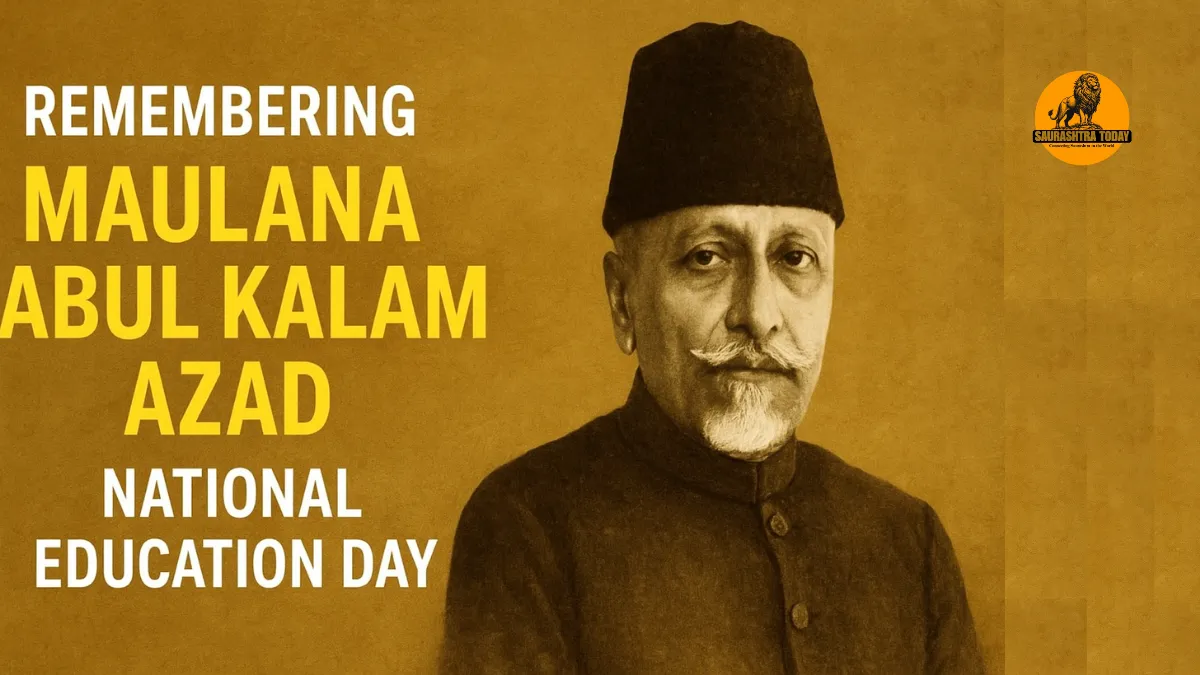
As India celebrates National Education Day, the nation fondly remembers Maulana Abul Kalam Azad — a towering intellectual, freedom fighter, and educationist whose vision helped lay the foundation of modern India. Beyond being a leader in the independence movement, Maulana Azad’s ideas on education, secularism, and national unity continue to guide India’s democratic ethos even decades after his passing.
Early Life and Family Heritage
Maulana Abul Kalam Azad was born on November 11, 1888, in Mecca, during a time when India was under British colonial rule. His birth name was Abul Kalam Ghulam Muhiyuddin, but he became widely known by the honorific Maulana Azad. His pen name “Azad,” meaning “free,” reflected his spiritual and intellectual liberation from orthodox constraints. The name “Abul Kalam,” meaning “Lord of Dialogue,” perfectly suited his exceptional gift for debate and oratory.
Azad hailed from a distinguished family of Islamic scholars. His father, Maulana Khairuddin, was a Bengali Muslim scholar of Afghan descent, and his mother was an Arab woman — the daughter of Sheikh Mohammad Zaher Watri. During the Indian Sepoy Mutiny of 1857, his father migrated to Mecca, where the family lived for several years before returning to Calcutta (now Kolkata) in 1890.
Traditional Education and Early Intellectual Curiosity
Born into a deeply religious household, Maulana Abul Kalam Azad received a traditional Islamic education at home. His early lessons were supervised first by his father and later by respected tutors. He mastered Arabic and Persian before studying logic, philosophy, geometry, mathematics, and algebra.
However, what made Azad extraordinary was his self-directed learning. Despite limited exposure to Western education, he independently studied English, world history, and political science, nurturing an early understanding of global events and political thought. This blend of traditional and modern education shaped his progressive worldview.
Emergence as a Scholar and Reformer
Though Azad was groomed to become a clergyman, his intellectual curiosity drove him to challenge rigid religious interpretations. He authored several works reinterpreting the Holy Quran, advocating for Tajdid (innovation) over Taqliq (blind conformity). His writings demonstrated a profound belief that Islam, rightly understood, encourages freedom of thought, rationalism, and progress.
Inspired by Jamaluddin Afghani’s pan-Islamic philosophy and Sir Syed Ahmed Khan’s reformist movement, Azad envisioned a renaissance among Indian Muslims. He believed education was the key to bridging gaps between faith and modernity, and between communities divided by colonial manipulation.
Journey Through the Islamic World
During his youth, Maulana Abul Kalam Azad traveled extensively to Afghanistan, Iraq, Egypt, Syria, and Turkey, where he met revolutionary thinkers and reformers. In Iraq, he interacted with political exiles striving for constitutional reforms in Iran. In Egypt, he met renowned scholar Sheikh Muhammad Abduh and Saeed Pasha, both of whom profoundly influenced his thought. In Constantinople (now Istanbul), he witnessed the Young Turks’ revolutionary spirit firsthand.
These encounters expanded his horizons and transformed him from a religious scholar into a nationalist revolutionary, committed to India’s freedom and unity.
Rise as a Revolutionary Leader
After returning to India, Maulana Abul Kalam Azad met revolutionary leaders Aurobindo Ghosh and Shyam Sundar Chakravarty in Bengal, joining their secret efforts against British rule. He soon realized, however, that most revolutionary activities were concentrated in Bengal and Bihar. Determined to spread the nationalist message, he established underground revolutionary centers across North India and Bombay.
During this period, he noticed widespread mistrust between Hindus and Muslims — a divide fueled by British policies. Azad worked tirelessly to build bridges between communities, emphasizing that the freedom struggle must be a collective movement.
Journalism as a Tool for National Awakening
In 1912, Azad launched the Urdu weekly “Al-Hilal”, aimed at awakening political consciousness among Indian Muslims. The journal rapidly gained influence, promoting anti-colonial ideas and Hindu-Muslim unity. Its sharp criticism of British rule alarmed colonial authorities, who banned Al-Hilal in 1914 under the Press Act.
Undeterred, Azad launched another weekly, “Al-Balagh,” which continued his mission of promoting Indian nationalism and communal harmony. This publication too was banned in 1916, and the British government exiled Azad from Calcutta, placing him under house arrest in Ranchi until the end of World War I in 1920.
The Khilafat and Non-Cooperation Movements
Upon his release, Maulana Abul Kalam Azad threw himself into the Khilafat Movement, which sought to restore the spiritual leadership of the Caliph in Turkey after World War I. Seeing it as an opportunity to unite Muslims under a broader national cause, Azad aligned the movement with Mahatma Gandhi’s Non-Cooperation campaign in 1920.
That same year, Azad formally joined the Indian National Congress, marking his full transition from a religious scholar to a national leader. His eloquence and intellect earned him recognition across political lines, and in 1923, at just 35 years old, he became the youngest person ever elected as President of the Indian National Congress.
Role in the Independence Struggle
Throughout the 1920s and 1930s, Maulana Abul Kalam Azad remained a key figure in India’s freedom struggle. He was imprisoned multiple times for participating in civil disobedience and for supporting Gandhi’s Salt Satyagraha in 1930. Even in jail, Azad continued to write and reflect, strengthening his philosophical resolve for a free and united India.
In 1940, at the Ramgarh session, Azad was once again elected as the President of the Congress, a position he held until 1946. This period was one of the most challenging phases in India’s history, as World War II and the growing demand for partition tested the nation’s unity.
Azad staunchly opposed the partition of India, arguing that it would destroy the centuries-old fabric of shared culture and coexistence. He advocated for a federation of autonomous provinces, united by common defense and economic systems. However, his vision of a united India was shattered when the subcontinent was divided in 1947.
India’s First Education Minister
After independence, Maulana Abul Kalam Azad became India’s first Minister of Education in Pandit Jawaharlal Nehru’s cabinet, a role he held from 1947 until his death in 1958. His contributions in shaping modern India’s education system were monumental.
Azad established several key institutions, including:
- University Grants Commission (UGC)
- Indian Institutes of Technology (IITs)
- Sahitya Akademi, Lalit Kala Akademi, and Sangeet Natak Akademi
He emphasized scientific and technical education, while also preserving India’s rich cultural and linguistic diversity. His vision helped lay the foundation for universal education, believing that no nation could progress without the enlightenment of its people.
Azad also championed the free and compulsory primary education policy and pushed for women’s education as a tool for social transformation. His work continues to influence India’s education policy to this day.
Also read: National Education Day: A Complete Guide to Its History, Importance, and Celebration in India
Philosophy and Legacy
Maulana Abul Kalam Azad was not just a politician but a philosopher of national integration. His belief in secularism was deeply rooted in faith — he saw religion as a unifying moral force, not a divisive one. His speeches and writings constantly emphasized harmony, tolerance, and the idea that India’s strength lay in its diversity.
His most celebrated work, “India Wins Freedom”, offers a firsthand account of India’s struggle for independence and reflects his nuanced understanding of both the triumphs and tragedies of that era.
Azad passed away on February 22, 1958, following a stroke. His death marked the end of an era, but his intellectual and moral legacy lives on. In recognition of his immense contribution to the nation, the Government of India posthumously awarded him the Bharat Ratna, India’s highest civilian honor, in 1992.
National Education Day and Continuing Influence
Since 2008, India observes National Education Day on November 11, commemorating the birth anniversary of Maulana Abul Kalam Azad. The day serves as a reminder of his belief that education is the true foundation of freedom, empowerment, and national progress.
Today, his life and philosophy inspire policymakers, educators, and students alike. His emphasis on unity in diversity, rational thinking, and inclusive growth remains relevant not only for India but for the entire world.
Also read: National Unity Day: Honoring the Spirit of Oneness and Integrity in India
Conclusion
Maulana Abul Kalam Azad was more than a freedom fighter — he was a thinker, reformer, and visionary who dreamed of a nation bound by knowledge and harmony. His message that “real freedom lies in the liberation of the mind” continues to resonate globally.
As India and the world celebrate his legacy, the life of Maulana Abul Kalam Azad stands as a timeless reminder that education, tolerance, and unity are the true pillars of progress.