Dolakha, Nepal — November 3, 2025:
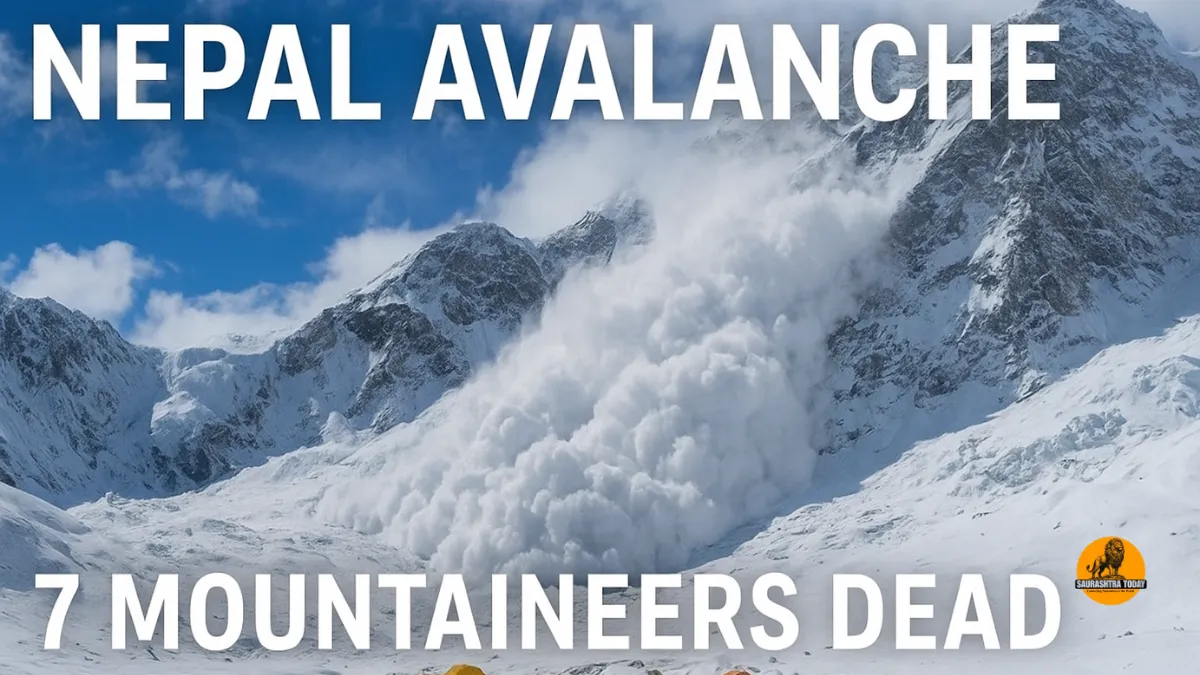
Nepal Avalanche: At least seven mountaineers, including climbers from the United States, Canada, Italy, and Nepal, have been killed after a massive avalanche struck the Yalung Ri peak in northeastern Nepal on Monday morning. The deadly Nepal avalanche hit near the base camp of the 5,630-meter-high mountain, leaving several others injured and four still missing, officials confirmed.
The tragedy unfolded around 9:00 a.m. local time (03:15 GMT) when a group of 15 climbers was ascending towards the Yalung Ri summit in the Dolakha district, part of Bagmati Province’s remote Rolwaling Valley — an area known for its challenging terrain and restricted access. The avalanche swept through the base camp area, burying climbers under tons of snow and debris.
Seven Climbers Confirmed Dead, Four Missing
Police in Dolakha district said the victims included three American nationals, one Canadian, one Italian, and two Nepali climbers. Four others sustained injuries of varying degrees, while rescue operations are underway to locate those missing.
“Seven bodies have been recovered so far, and search efforts are continuing for the four others who are unaccounted for,” a senior police officer told local media. “We are facing severe weather conditions, which have slowed down the rescue mission.”
Rescue Teams Hampered by Harsh Weather
According to The Himalayan Times, the avalanche struck while the team was advancing from Gaurishankar toward Yalung Ri. The massive wall of snow and ice engulfed their campsite before they could react.
Local ward chairperson Ninggeli Sherpa said multiple distress calls were made to authorities earlier in the morning, but the rescue operation began with a delay due to the region’s restricted access status.
“The Rolwaling Valley is a controlled area, so flight permissions for helicopters took time,” Sherpa said. “By the time the first rescue teams reached the site, bad weather had already worsened the situation.”
Helicopters from the Nepal Army, Nepal Police, and Armed Police Force were dispatched to the site, but heavy snowfall, low visibility, and high winds made aerial access nearly impossible. One rescue helicopter reportedly had to turn back midway due to dense cloud cover.
Ground teams are now trekking on foot to reach the avalanche zone, navigating through treacherous snowfields and freezing temperatures.
Difficult Terrain and Dangerous Weather
Yalung Ri, located near the Nepal–Tibet border, is known as one of Nepal’s less-traveled and technically demanding peaks. While it attracts experienced mountaineers seeking a remote challenge, the mountain is also notoriously avalanche-prone.
The combination of steep slopes, unpredictable snowfall, and shifting ice layers makes the area especially hazardous. Climbers require a special trekking permit to access this restricted zone, which is rarely visited compared to popular peaks like Everest or Annapurna.
“The Yalung Ri route is not commercialized, which means rescue logistics are far more complicated than in other climbing regions,” said an official from the Nepal Mountaineering Association. “Even minor weather changes can trigger avalanches there.”
History of Avalanches in the Region
This is not the first deadly Nepal avalanche in the region. In 2019, a team of French climbers was trapped on the same mountain, prompting a large-scale rescue effort. Similarly, after the 2015 Nepal earthquake, several climbers lost their lives along the Rolwaling Valley routes due to avalanches and falling debris.
Experts say that such incidents are becoming more frequent in the Himalayas due to climate change, which is causing glaciers to melt and destabilizing snow layers on steep mountain faces.
A 2023 report from the International Centre for Integrated Mountain Development (ICIMOD) noted that Himalayan glaciers are melting up to 65% faster than in previous decades, increasing avalanche risks dramatically.
What Is an Avalanche?
An avalanche—known locally as Himskhalan in Nepali—is a rapid flow of snow, ice, and rock down a mountainside. It can be triggered naturally or by human activity, and when it occurs at high speeds, it can destroy everything in its path within seconds.
During an avalanche, snow and debris accelerate downhill, sometimes reaching speeds between 120 km/h and 320 km/h (75–200 mph). A fully developed avalanche can weigh over one million tons, making it one of nature’s most destructive forces.
Types of Avalanches
Avalanches are classified into several categories depending on their material, speed, and cause:
- Rock Avalanche:
Involves large boulders and rock fragments that tumble down steep slopes, often triggered by earthquakes or erosion. - Snow Avalanche:
The most common type — consisting of either powdery snow or solid ice chunks. These often occur near glaciers and high-altitude snowfields. - Debris Avalanche:
A mix of snow, rocks, and soil that slides rapidly, often following heavy rainfall or melting ice.
How Do Avalanches Start?
Avalanches are typically caused by a sudden loss of stability in a snowpack. This can happen in two major ways:
- Snow Overload:
When fresh snowfall adds weight to existing layers, causing the lower layer to collapse and slide downward. - Melting Ice:
During warmer seasons, sunlight or rising temperatures can melt snow and weaken its bond with the surface below, leading to slippage.
Other contributing factors include deforestation, earthquakes, steep terrain, and human activities such as skiing, snowmobiling, or mountaineering.
Avalanche Speed and Power
A large-scale avalanche can gain enormous speed within seconds. Depending on snow density and slope angle, the avalanche can reach speeds up to 320 km/h (200 mph) — enough to sweep away rocks, trees, tents, and entire base camps.
Most avalanches occur during the winter and spring months (December–April), when snow accumulation is highest.
Types by Structure: Sluff vs. Slab Avalanches
Avalanches are also divided into two structural types:
- Sluff Avalanche:
Involves loose snow that slips from the surface, generally less destructive and short-lived. - Slab Avalanche:
The most dangerous form, where a thick layer of compacted snow breaks away as a single unit and rushes downhill with immense force.
Also read: Melania Trump Remains Silent as Historic East Wing Faces Demolition at the White House
Major Categories of Snow Avalanches
Experts further classify snow avalanches into four main types based on their composition and movement:
- Loose Snow Avalanche:
Typically triggered after fresh snowfall on steep slopes. It begins at a single point and widens as it descends. Although the snow is soft, it can still knock climbers off their footing. - Slab Avalanche:
Formed when a cohesive layer of snow breaks loose and slides on a weaker layer beneath it. Thicker slabs cause severe destruction and are responsible for most avalanche fatalities worldwide. - Powder Snow Avalanche:
A mix of air and fine snow particles, moving at speeds over 300 km/h. It creates a massive white cloud that can travel long distances and suffocate victims even if they aren’t buried under snow. - Wet Snow Avalanche:
Contains a combination of melting snow and water. It moves slowly due to high friction but can accumulate large debris, making it extremely heavy and destructive.
Also read: California Company Recalls Nearly 245,000 Pounds of Pasta Amid Listeria Outbreak
Why Do Avalanches Occur More Often Now?
According to climatologists, the frequency of Nepal avalanches and other Himalayan snow disasters has increased due to rising global temperatures. Warmer air causes glaciers to retreat and snow layers to become unstable.
Furthermore, human-induced factors — such as deforestation, road construction, and mountain tourism expansion — are disturbing fragile ecosystems, making slopes more prone to collapse.
Nepal’s Department of Hydrology and Meteorology has warned that mountain safety protocols need urgent strengthening, especially in lesser-known peaks like Yalung Ri, where early warning systems are limited.
Global Reactions and Rescue Efforts
As news of the Yalung Ri avalanche spread, condolences poured in from mountaineering communities worldwide. The American Alpine Club, Italian Alpine Federation, and Canadian Mountaineering Association expressed grief and urged better safety standards for Himalayan expeditions.
“Nepal’s high-altitude rescue infrastructure has improved since 2015, but more investment in early warning systems and weather monitoring is essential,” said Dr. Laura Mitchell, a mountain hazards expert at the University of Colorado Boulder.
Nepal’s Home Ministry said it is coordinating with foreign embassies to identify the victims and assist in repatriation once weather conditions improve.
Also read: Sanae Takaichi Japan: The Nation’s First Female Prime Minister Makes History Amid Political Turmoil
A Reminder of the Himalayas’ Growing Fragility
The Yalung Ri Nepal avalanche serves as another tragic reminder of how perilous the world’s tallest mountain range has become. Despite being a magnet for adventure enthusiasts and professional climbers, the Himalayas are increasingly unstable due to environmental shifts and unpredictable weather.
Rescue officials continue to brave the snow and ice in hopes of finding the remaining climbers alive. For now, the silence of the high Himalayas echoes with grief — and a stark warning about the delicate balance between nature and human ambition.