Prime Minister Narendra Modi’s presence at the Pm Modi G20 Summit in Johannesburg, South Africa, turned into both a platform for strong diplomatic outreach and a push for major global policy initiatives. From warm gestures with world leaders to strategic interventions on inclusive development, global health, and the fight against narco-terror networks, the Indian Prime Minister emerged as one of the most active participants at this year’s gathering.
Modi was welcomed with enthusiasm as he landed in South Africa to attend the summit, continuing India’s influential footprint on the global stage after a successful presidency of the G20 in the previous year. His arrival immediately drew attention, not only for his engagements with world leaders but also for a series of friendly interactions that became widely discussed worldwide.
#WATCH | Johannesburg, South Africa | Prime Minister Narendra Modi shares hug with several world leaders, including Brazil's president, Luiz Inácio Lula da Silva, at the G-20 Summit in Johannesburg
— ANI (@ANI) November 22, 2025
(Source: DD News) pic.twitter.com/yWNNal90jy
Warm Diplomatic Exchanges Mark Modi’s Arrival
The Pm Modi G20 Summit began with South African President Cyril Ramaphosa greeting Modi with folded hands, symbolising both respect and close bilateral ties. The cordial moment set the tone for an international forum where diplomacy appeared to blend seamlessly with personal rapport.
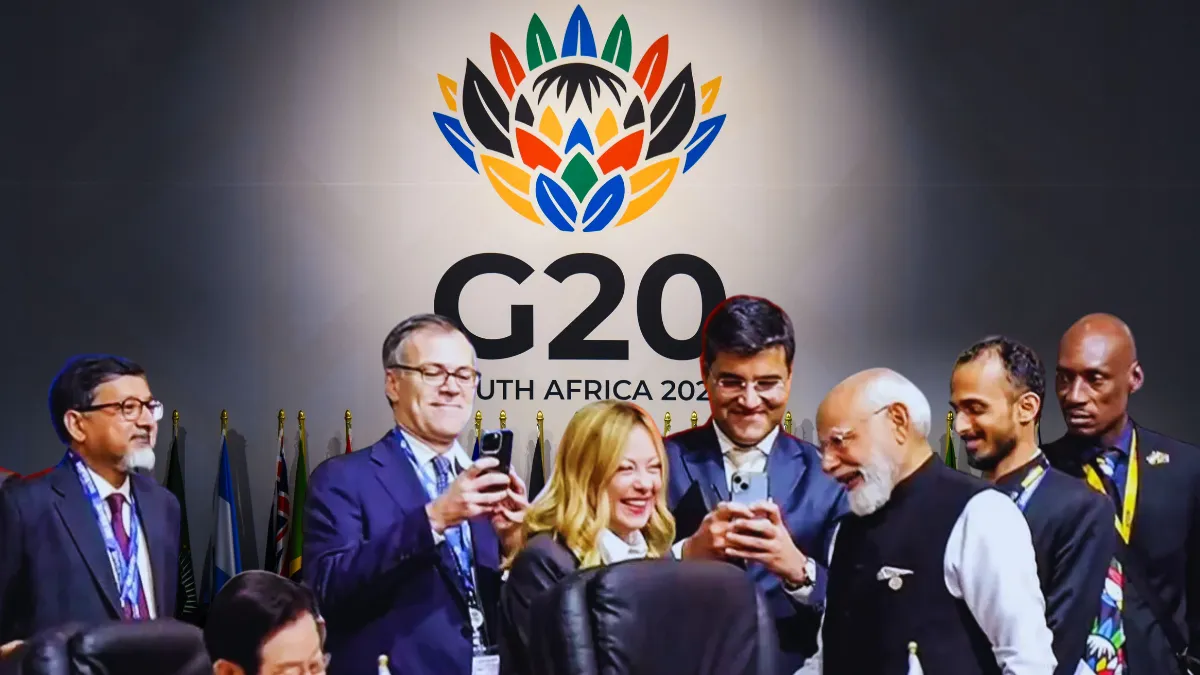
Italy’s Prime Minister Giorgia Meloni greeted Modi with a ‘namaste’, and the two leaders shared a light-hearted moment that quickly went viral on social media. Their casual laughter and relaxed conversation became a talking point online, highlighting a more personal dimension of diplomacy.
Brazilian President Luiz Inácio Lula da Silva, a key partner in the Global South alignment, welcomed Modi with a warm hug and a friendly pat on the back. Later, in another gesture of mutual respect, UAE President Sheikh Mohamed bin Zayed Al Nahyan also embraced Modi warmly. The Indian Prime Minister reciprocated these gestures, suggesting a deepening of ties across continents — from Asia to Africa to Latin America.
The energetic engagement did not end there. Throughout the opening hours of the summit, Modi continued interacting with leaders and high-level representatives from multiple countries, reinforcing bilateral relationships and underlining India’s growing influence in global decision-making circles.
#WATCH | Johannesburg, South Africa | Prime Minister Narendra Modi interacts with Italian Prime Minister Giorgia Meloni during the G-20 Summit
— ANI (@ANI) November 22, 2025
(Source: DD News) pic.twitter.com/a4DvBgOLmD
Absence of World Powers: Modi Remains a Central Face of the Summit
This year’s Pm Modi G20 Summit was notable for who was there — and who wasn’t. US President Donald Trump chose not to attend, and both Russian President Vladimir Putin and Chinese President Xi Jinping were also absent. Despite the absence of these leaders from major global power blocs, India’s role — and Modi’s — became even more pivotal.
Diplomatic observers noted that the vacuum left by the US, Russia and China allowed India and Brazil to emerge as the leading voices representing the Global South. African nations too leaned toward deeper cooperation with India, especially after the permanent inclusion of the African Union in the G20 during India’s presidency.
Modi is expected to conduct a series of bilateral meetings during the summit to strengthen collaboration in strategic sectors, economic partnerships, and defence cooperation.
India’s Push for Policy Reform: Focus on Human-Centric Development
When the summit transitioned from greetings to official sessions, Modi used his platform to send a clear message: global development must become more human-centred, inclusive and sustainable.
He urged G20 member states to reconsider economic models that emphasize profit and industrial scale at the cost of societal welfare. He reiterated that the world needs development that is collective rather than competitive — and that India’s philosophy of Integral Humanism can serve as a guiding compass.
According to Modi, the world must adopt policies that empower every community rather than only the financially dominant regions of the globe. The “Pm Modi G20 Summit” discussions repeatedly highlighted the importance of shared prosperity during an era marked by economic volatility, climate change risks and widening inequality.
Three Major Proposals Announced by Modi
Modi announced three major proposals during his address, positioning India at the forefront of shaping the G20 agenda for the coming decade.
1. Global Traditional Knowledge Repository
The first initiative calls for establishing an international repository focused on preserving traditional knowledge from different regions and cultures. Modi noted that societies around the world possess centuries-old heritage in wellness, sustainable living and environmental harmony — wisdom that is at risk of disappearing in the fast-paced digital age.
The proposed repository would archive practices that are:
- Environmentally conscious
- Community-driven
- Culturally rooted
- Beneficial to human well-being
By enabling global access to such knowledge, the initiative aims to create a bridge between ancient wisdom and modern science, offering holistic solutions to global challenges such as climate crisis, mental health issues and unsustainable patterns of consumption.
2. G20 Initiative on Countering the Drug–Terror Nexus
Sounding an urgent alarm on the rise of synthetic drug trafficking, Modi highlighted the global security risk posed by narcotics networks that fund terrorism. Substances such as fentanyl, he warned, have not only destroyed lives but also fuel criminal syndicates with far-reaching geopolitical consequences.
In a strong appeal to member nations, he said:
“Let us weaken the wretched drug-terror economy.”
The proposed G20 framework would enhance:
- Intelligence sharing
- Border security coordination
- Joint anti-narcotics operations
- Legal measures targeting transnational criminal networks
By describing drug trafficking as a direct threat to international security, Modi positioned the issue as a global priority rather than a regional crime.
3. G20–Africa Skills Multiplier Initiative
Reinforcing India’s deepening cooperation with Africa, Modi introduced the G20–Africa Skills Multiplier Initiative, aimed at developing professional training infrastructure across the continent.
The objective:
➡ Train one million certified instructors in Africa over the next ten years.
This would expand employment opportunities, enhance entrepreneurship and support Africa’s growing youth population. The initiative aligns with India’s commitment to ensuring that Africa plays a central role in shaping the future world economy — not simply as a resource hub, but as a skilled powerhouse.
Healthcare Security: A Dedicated Emergency Global Team
Modi’s final recommendation focused on worldwide crisis management. He urged G20 members to establish a Global Healthcare Response Team, a specialized medical force made up of trained health workers and emergency experts from member countries.
Its purpose would be rapid deployment during:
- Global health emergencies
- Pandemics
- Natural disasters
- Humanitarian crises
Learnings from COVID-19 formed the basis of this proposal. Modi stressed that the world cannot afford another delayed reaction to a crisis, and a unified international medical team would ensure preparedness and timely response.
India and Africa: Strengthening the Global South Alliance
India’s foreign policy under the Pm Modi G20 Summit continues to emphasize solidarity with developing nations. With India successfully advocating permanent G20 membership for the African Union during its presidency, Modi renewed the pledge that global decision-making must include Africa at the leadership table, not as an observer but as a full participant.
This alignment signals the emergence of a multipolar global economic order driven by collaboration between Asia, Africa and Latin America.
A Summit Defined by Diplomacy and Leadership
While the summit included serious deliberations on economic stability, climate action and international security, Modi’s personal diplomacy became a defining feature of the event. His friendly exchanges, laughter with Italy’s Giorgia Meloni, and hugs with Lula and UAE President Sheikh Mohamed bin Zayed reflected his distinct approach of global engagement.
More than just symbolic, these interactions showcased India’s growing stature and Modi’s strategic ability to build alliances through warmth as well as policy.
Also read: G20 Summit 2025: PM Modi and UK PM Keir Starmer Highlight New Era of India–UK Partnership
A Forward-Looking Blueprint for Global Cooperation
The Pm Modi G20 Summit in Johannesburg demonstrated that India is determined to shape the global agenda in favour of human values, equality and collective progress. Modi’s proposals — rooted in cultural knowledge, security cooperation and African empowerment — signal that India is no longer a follower in geopolitics but a key architect of global priorities.
As bilateral meetings continue in South Africa, diplomats and analysts predict that the outcomes of this summit will extend well beyond the event itself. Whether in the fields of education, counter-terrorism, global health or sustainable development, India is making it clear that the future of global governance must be collaborative, inclusive and people-centric.
Also read: Indian Fighter Jet Pilot Dies in Tragic Air Show Dubai Crash-Final Day of Event Turns Fatal
Conclusion
The Pm Modi G20 Summit has become a milestone in India’s global engagement. With strategic proposals, personal diplomacy and a commitment to shaping an equal world order, Prime Minister Modi has reinforced India’s leadership role on the international stage. His call for unity and collective growth resonated strongly across member nations, even in a year marked by the absence of several major powers.
Whether through hugs, policy proposals or philosophical outreach, one message defined Modi’s presence in Johannesburg:
global progress must be shared — or it will not be real progress at all.