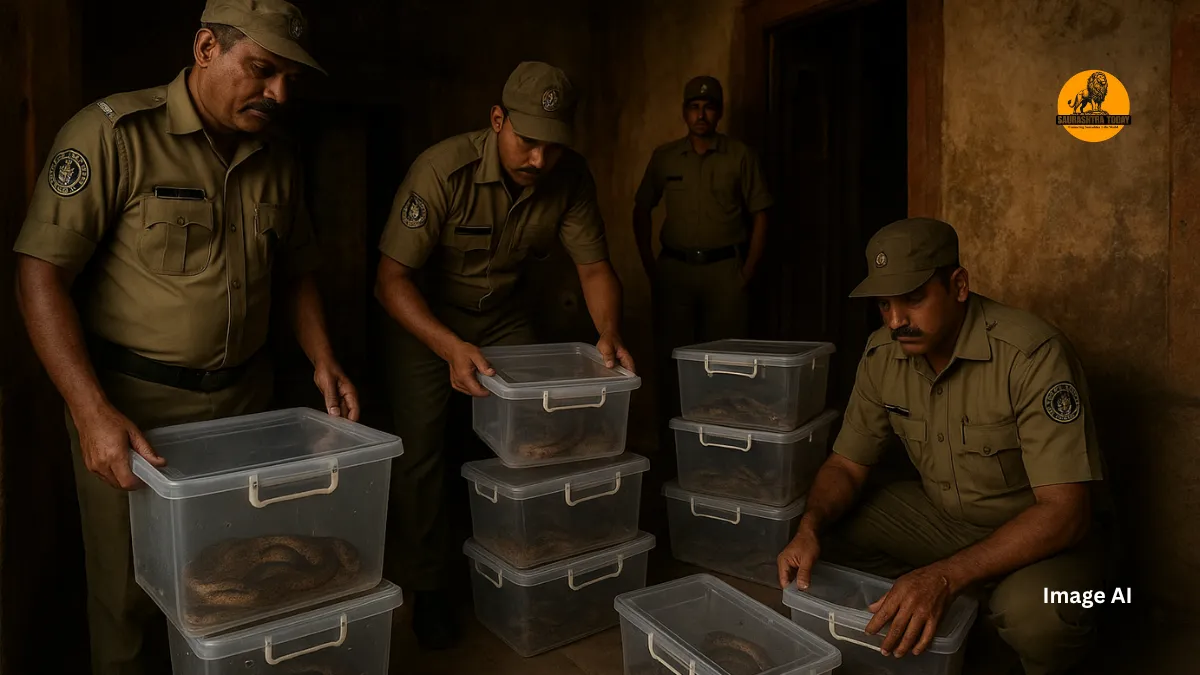
In a landmark crackdown on wildlife crimes, the Rajkot Forest Department has carried out its largest rescue and seizure operation to date, recovering 52 Schedule-I protected snakes from the Khetlappa Temple near the city’s marketing yard area. The department has arrested the temple priest, identified as Manu Maniram Dudhrejia, for illegally keeping the snakes for religious display and to attract visitors.
According to officials, the reptiles—primarily Common Sand Boa, a species protected under India’s Wildlife Protection Act—were stored at various hidden spots inside the temple premises. Forest officers say the priest used the snakes to create viral social-media content and portrayed the temple as a mystical “home of snakes,” misleading devotees and drawing crowds.
Tip-off Leads to High-Level Action
The breakthrough came when Rajkot North RFO Vikramsinh Parmar received intelligence suggesting that several protected snakes were being confined at a religious location. Considering the sensitivity of the case, Parmar immediately informed DCF Yuvrajsinh Jadeja and ACF S.T. Kotadiya, following which a special task team was formed.
This team included two RFO units:
- The Rajkot North RFO team led by Vikramsinh Parmar
- The South RFO team and wildlife warden H.B. Mokariya
The joint forces headed toward the Khetlappa Temple situated between the Old Yard and Greenland Chowkdi area. Once inside the premises, they questioned the priest, Manu Dudhrejia, and initiated a thorough search. Officials discovered dozens of snakes stored in concealed sections of the temple, confirming the intelligence report.
52 Schedule-I Snakes Rescued Safely
Upon inspection, the forest officers found 52 Common Sand Boas, each categorized under Schedule-I of the Wildlife Protection Act, giving them the same highest degree of protection as species like tigers, lions, and cobras.
Because of this classification, even possessing one such species without special permission is a serious criminal offence. The Rajkot Forest Department immediately initiated rescue operations to safely extract and relocate the snakes to secure wildlife facilities for medical evaluation and rehabilitation.
A formal wildlife crime case has been registered against the priest under relevant sections of the Wildlife Protection Act. He has been taken into custody and will be presented in court, where forest officers will seek remand to investigate the source of the snakes, how long they were kept, and whether any of them were sold or transferred to others.
Inside Story: Social Media Obsession Exposed the Crime
According to investigators, the snakes had been kept inside the temple for a considerable period. Sources say the priest began creating social media videos promoting the temple as “a spiritual home of more than 100 snakes,” branding it as a divine creation of nature.
He uploaded videos claiming there were sacred serpent dwellings within the temple. The videos quickly gained traction and went viral among devotees and curious viewers. The Rajkot Forest Department, while monitoring digital content related to wildlife, came across these clips, prompting an immediate inspection.
Ironically, the very social media content intended to bring fame to the priest eventually exposed his unlawful activities.
Scientific Clarification: The Snakes Were Not Cobras
Addressing widespread misinformation created by the viral videos, RFO Vikramsinh Parmar clarified important scientific details regarding the seized snakes. He explained that:
- The rescued reptiles were Common Sand Boas, a non-venomous species.
- These snakes do not belong to the Naga or cobra family, which is worshipped in temples.
- In local terminology, Sand Boas are often called “Angothiya”, as they resemble a thick finger in shape.
- They are harmless, slow-moving reptiles that usually remain buried in sandy regions.
Despite knowing this, the priest misrepresented Sand Boas as divine cobras, encouraging devotees to worship them and claiming spiritual benefits. This deception also helped him attract larger numbers of visitors, strengthening his image and influence.
Forest officials condemned this practice, noting that exploiting protected wildlife for religious publicity is both unethical and illegal.
Illegal Wildlife Possession and Public Deception
Investigators believe the motive behind keeping the snakes was two-fold:
- To boost temple footfall through sensational claims of divine snake presence
- To gain online popularity through sensational videos and narratives
The videos circulating online included captions such as:
- “House of Nag Dev”
- “Temple of 100+ Sacred Snakes”
None of these claims were grounded in truth. The snakes were placed inside the temple purely for display and to lure devotees who believed in serpent worship.
The Rajkot Forest Department stated that wildlife should never be used as a tool for superstitious beliefs or personal gain. Even non-venomous snakes, especially those protected under Schedule-I, must be allowed to live freely in their natural habitat.
Next Phase: Investigation into Source and Wildlife Trafficking Links
With the arrest of the priest, authorities have shifted focus to the next major question: Where did the snakes come from?
Officials plan to seek police custody of the accused so they can investigate:
- Whether the snakes were captured from the wild illegally
- Whether they were bought from wildlife traffickers
- Whether any of the reptiles were sold or transferred
- How long they remained in captivity
- Whether more individuals are involved in the supply chain
Given the scale of the seizure—one of the largest in the region—forest officials suspect that this may be part of a wider illegal wildlife network operating around Rajkot and nearby districts.
Why This Operation Matters
This incident marks a significant moment for wildlife protection efforts in Gujarat. The Rajkot Forest Department has stepped up surveillance amidst rising concerns about illegal wildlife trafficking, online promotion of wildlife abuse, and public display of protected species.
The rescue of 52 protected snakes underscores several critical points:
- Religious or cultural excuses cannot justify wildlife crime
- Protected species cannot be kept without official permits
- Social media surveillance is becoming a powerful tool against wildlife offenders
- Public awareness is essential to prevent the normalization of wildlife captivity
Forest officials also emphasized the importance of educating the public about non-venomous snakes. Many people consider all snakes dangerous, but species like the Common Sand Boa play an important ecological role and are harmless to humans.
Also read: RAJKOT NEWS: Speeding Honda City Car Kills Teenage Girl in Tragic University Road Accident
Public Reaction and Future Measures
Following the news, environmental groups, wildlife activists, and several citizens have applauded the Rajkot Forest Department for its swift and decisive action. Many expressed shock over the scale of the illegal possession, calling for stronger enforcement and harsher penalties.
Authorities have also announced:
- Increased inspections at religious places
- Monitoring of social media for wildlife-related content
- Community awareness programs about protected species
- Training volunteers to report suspicious wildlife activities
The department has reiterated that any individual found capturing, trading, or keeping protected species—whether for religious, commercial, or personal reasons—will face strict legal action.
Also read: Jamnagar to Inaugurate The Longest Flyover in Saurashtra on November 20
Conclusion
The Rajkot Forest Department’s decisive action in rescuing 52 protected snakes from the Khetlappa Temple stands as one of the most significant wildlife protection operations in the region. It not only highlights the dangers of mixing superstition with wildlife but also sends a strong message to anyone involved in illegal animal possession.
As investigations continue, authorities hope this case will encourage the public to respect wildlife laws and discourage any exploitation of animals in the name of faith, entertainment, or social media popularity.