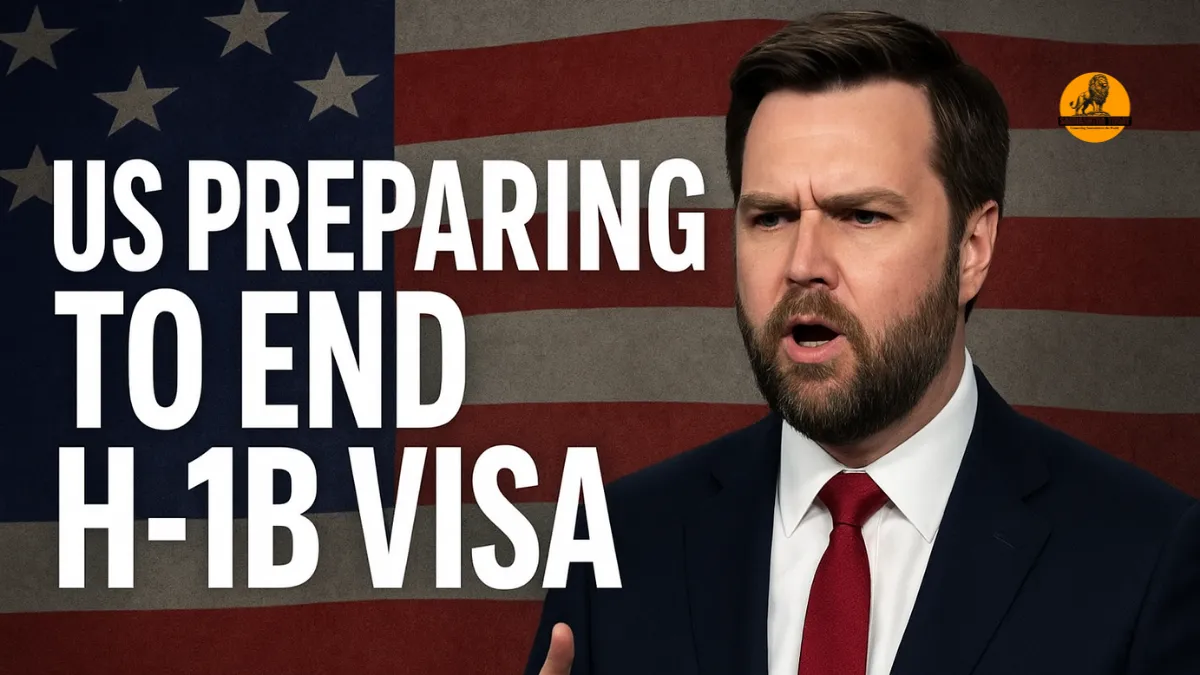
US Preparing to End H-1B Visa: In an unprecedented escalation of America’s immigration debate, the United States is reportedly preparing to take major steps toward ending the H-1B visa program — a move that could deeply impact global tech talent, multinational companies, and thousands of skilled professionals, particularly from India.
The controversy intensified this week after U.S. Vice President JD Vance publicly described foreign workers as “cheap labor,” arguing that America no longer needs to depend on overseas professionals for its economic growth. His statements immediately sparked nationwide debate, signaling a major shift in the country’s long-standing economic relationship with skilled immigrants.
Vice President Vance Calls Foreign Workers ‘Cheap Labor’
During a series of public appearances, Vice President Vance strongly criticized the current visa system, claiming that foreign workers are being used to depress American wages and undermine local job opportunities.
Vance accused the opposition party of promoting what he called a “low-wage immigration system,” stating:
“The Democratic model prioritizes bringing in low-wage immigrant workers. This harms American jobs, American wages, and the economic prosperity of our citizens.”
In contrast, Vance praised former President Donald Trump’s approach, arguing that Trump’s policies are designed to “unlock development within America” rather than relying on external talent.
The Vice President emphasized that the U.S. workforce should be empowered through technology and modernization rather than supplemented by what he described as “cheap foreign labor.”
Republican Leaders Move Toward Ending the H-1B Visa Category
In line with Vance’s comments, senior Republican lawmakers have confirmed that a new bill targeting the H-1B visa is already underway.
Representative Marjorie Taylor Greene, a close ally of former President Trump, announced that the legislation aims to completely abolish the H-1B visa category under the “America First” agenda.
Greene said the party believes the visa program is being “widely abused,” arguing that companies misuse it to hire foreign workers at lower wages, thereby displacing American talent.
If passed, the new bill would eliminate the entire H-1B category — a dramatic shift that would affect tens of thousands of skilled workers, including engineers, IT professionals, healthcare experts, and scientists.
However, Greene noted a limited exception: for the next 10 years, the U.S. would continue issuing 10,000 H-1B visas annually for doctors due to healthcare shortages.
Currently, the U.S. grants 85,000 H-1B visas per year, of which approximately 70% go to Indian professionals — making India the most affected country if the program is abolished.
Trump Previously Acknowledged America’s Shortage of Specialized Talent
Interestingly, former President Trump himself has expressed contradictory views on this topic.
Despite his party’s push to eliminate H-1B visas, Trump has repeatedly acknowledged that the U.S. faces a serious shortage of qualified professionals in many specialized fields.
In past statements, Trump noted:
“America lacks enough talented people to fill key positions. Skilled workers from abroad are necessary to meet industry demands.”
He recently referred to a case involving a major battery manufacturing plant in Georgia, operated in partnership with a South Korean firm. Because the U.S. lacked sufficiently trained battery engineers, the company had to bring 500–600 experts from Korea to both build the factory and train American workers.
When U.S. immigration authorities attempted to classify these workers as illegal immigrants earlier this year, Trump defended them, arguing:
“Battery manufacturing is difficult and dangerous. America simply does not have this level of expertise yet. This is why visas like H-1B are essential.”
Trump Administration Raised H-1B Visa Application Fee by 100 Times
In another dramatic move, the Trump administration recently increased the application fee for H-1B visas from $1,000 to $100,000, a 100-fold hike.
This fee hike was framed as a measure to discourage companies from overusing the visa program and to ensure they prioritize hiring American workers.
During an interview with Fox News anchor Laura Ingraham, Trump was asked whether reducing the number of H-1B visas would help protect American wages. Trump responded:
“Yes, I agree. But at the same time, we must bring in talent from outside when necessary.”
When Ingraham argued that the U.S. already has plenty of talented workers, Trump disagreed:
“No. In certain critical sectors, we do not have enough talent. You cannot simply take unemployed workers and put them into missile factories.”
His remarks highlighted the deep contradictions within America’s immigration policy — acknowledging domestic talent gaps while simultaneously supporting restrictive visa measures.
A Surprising U-Turn: Trump Now Supports Foreign Students in the U.S.
In a shift that surprised many, Trump recently softened his stance regarding foreign students studying in American universities.
He warned that reducing the number of international students — especially those from China, India, and East Asia — could cause nearly half of U.S. colleges to shut down.
“We cannot stop half the world’s students from coming here,” Trump said.
“Doing so would severely damage our college and university system. Foreign students are good for America, and I want to maintain positive relations with the world.”
Trump argued that international students play a crucial role not only in strengthening the U.S. education system but also in maintaining the financial health of universities, many of which rely heavily on tuition from foreign enrollees.
His remarks stand in stark contrast to ongoing Republican efforts to restrict H-1B visas — a contradiction that has confused both economists and immigration analysts.
Also read: Donald Trump’s Surprising U-Turn on Foreign Students: Calls Them Vital for America’s Future
What Ending the H-1B Visa Could Mean for the U.S. Economy
If the U.S. proceeds with ending the H-1B visa program, the consequences could be enormous:
1. Impact on the Tech Industry
Major companies such as Google, Microsoft, Amazon, and Meta rely heavily on H-1B workers for roles in AI, software engineering, cybersecurity, and data science.
Ending the program could:
- Slow innovation
- Increase labor shortages
- Push companies to relocate operations abroad
2. Impact on Indian Professionals
With Indians making up nearly 70% of H-1B recipients, the impact on India would be severe. Many skilled professionals may shift toward countries like Canada, Australia, and the UK, which actively welcome foreign talent.
3. Impact on U.S. Universities
Fewer international students could mean major revenue losses. Some institutions may face closure, especially smaller private colleges already struggling with declining enrollment.
4. Impact on American Workers
Economists are divided.
Some believe wages could rise if companies hire locally.
Others argue that innovation could slow down, harming long-term growth and competitiveness.
The Political Future of the H-1B Visa
As the debate intensifies, Washington is deeply divided.
Republicans pushing the “America First” agenda want to restrict or abolish the visa, while business leaders and universities warn that such a move could severely harm U.S. competitiveness.
For now, the H-1B program remains in place.
But with the U.S. preparing to end H-1B visa policies through legislative reform, uncertainty looms for thousands of skilled workers and students worldwide.
Also read: After Mamdani’s Win, Saikat Chakraborty Emerges as a Rising Star in U.S. Politics
Conclusion: US Preparing to End H-1B Visa
The future of the H-1B visa — and America’s broader skilled immigration system — hangs in the balance. With strong political voices on both sides, the fate of this long-standing program will likely be decided by upcoming legislative battles and shifting national priorities.
What remains clear is that any major change will have global consequences, especially for India, which currently supplies the majority of H-1B talent to the United States.