Gandhinagar, Gujarat – November 2025:
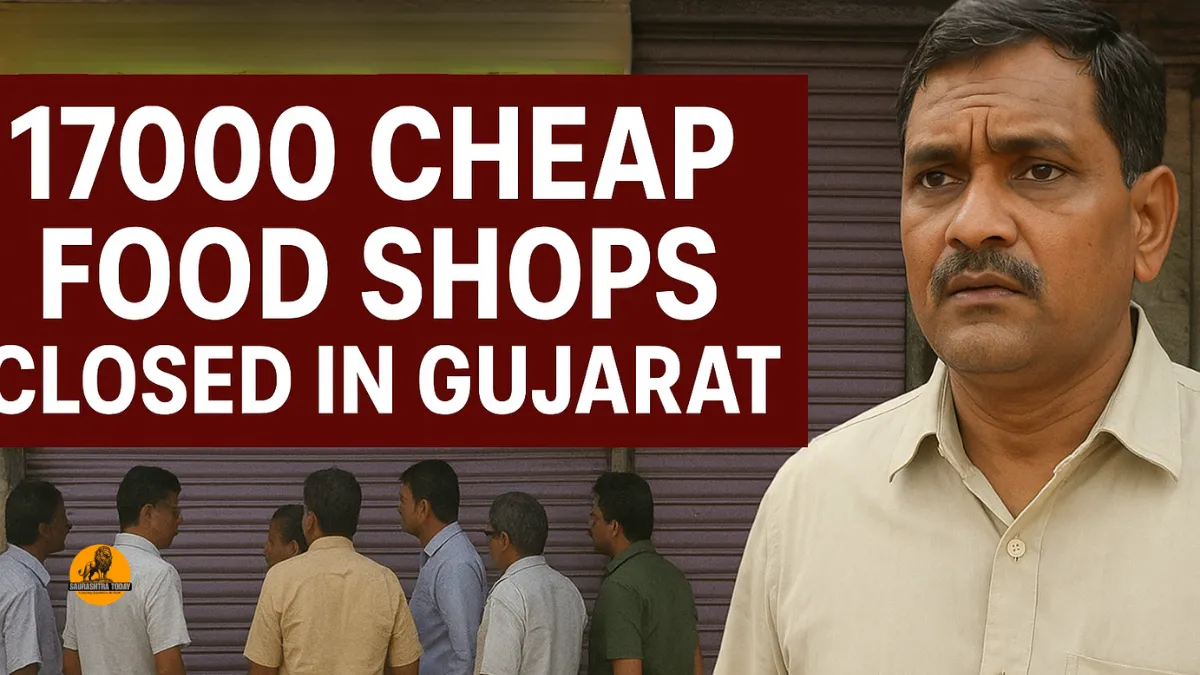
17000 Cheap Food Shops Closed in Gujarat: A major food supply disruption has hit Gujarat as over 17,000 cheap food shops closed in Gujarat today, marking the beginning of an indefinite strike by fair price shop owners across the state. The decision was announced by the All Gujarat Fair Price Shop Association, which represents ration dealers responsible for distributing subsidized grains and essential goods under government schemes.
The strike has caused the suspension of all government food grain distribution and billing operations from state warehouses, leaving millions of ration cardholders uncertain about their next supply of essential items.
Statewide Shutdown Affects Millions
According to the association, nearly 17,000 ration dealers have joined the movement, halting all fair price shop operations across Gujarat.
Cities including Rajkot, Surat, Vadodara, Ahmedabad, Bhavnagar, Mehsana, Junagadh, and Gandhinagar have reported a complete standstill in the rationing system.
In Rajkot, around 700 shopkeepers joined the strike, directly impacting over 300,000 ration cardholders.
Similarly, Surat witnessed closures of about 1,100 government grain shops, Mehsana reported 670 dealers joining, and Bhavnagar saw 750 shops shut down.
In Gandhinagar district, 300 out of 325 fair price shops remained closed, disrupting distribution of essential grains and daily necessities.
Table: Impact of Strike on Major Gujarat Districts
| City/District | Number of Shops Closed | Estimated Affected Ration Cardholders |
|---|---|---|
| Rajkot | 700 | 3,00,000+ |
| Surat | 1,100 | 5,00,000+ |
| Mehsana | 670 | 2,50,000+ |
| Bhavnagar | 750 | 3,20,000+ |
| Gandhinagar | 300 | 1,10,000+ |
| Vadodara | 600+ | 2,80,000+ |
| Ahmedabad | Data Being Updated | 4,00,000+ |
| Total (Statewide) | 17,000+ | 20,00,000+ households affected |
Protest Led by PM Modi’s Brother, Prahlad Modi
The protest has drawn national attention after Prahlad Modi, the younger brother of Prime Minister Narendra Modi and President of the All Gujarat Fair Price Shop Association, voiced his firm support for the strike.
Addressing dealers through a public message, he urged them to remain “united and unwavering” despite rumors of a settlement.
“The strike is not over. False news is being spread by certain officials and traders to weaken our movement,” said Prahlad Modi.
“We have already informed the government secretary that dealers are not legally bound to perform extra administrative tasks. We have won similar cases in the High Court before, and I urge all members not to be misled by false information. Stand firm, our unity is our strength.”
The Core Demands of the Fair Price Shop Dealers
The fair price dealers have been presenting their grievances to the Gujarat government for over a year. Their main concerns include:
- Increase in commission paid for ration distribution.
- Cancellation of new circular (dated October 15, 2025) requiring 80% biometric verification of vigilance committee members before releasing stock.
- Resolution of technical issues such as constant server failures and fingerprint mismatches during biometric verification.
- Restoration of sufficient grain supply as dealers claim that government warehouses deliver reduced quantities.
- Permanent solution to network and electricity issues affecting ration cardholder verification.
- Timely release of commissions and payments.
According to Alpesh Shah, General Secretary of the state association,
“We will continue our indefinite strike until our 19 key demands are accepted and the new circular is withdrawn. We are not generating or paying for any distribution challans for November 2025. The system will remain halted until the government responds.”
Widespread Impact Across Gujarat
The impact of the strike has been felt across both urban and rural Gujarat, particularly among low-income families who depend on the Public Distribution System (PDS) for affordable food grains, pulses, and essentials.
Due to the suspension of ration distribution, thousands of families in cities like Surat, Rajkot, and Vadodara have been unable to collect their monthly supplies.
“We are worried for poor beneficiaries,” said a dealer from Mehsana.
“We hope the government acts quickly so that both shopkeepers and cardholders are not forced to suffer.”
Dealers Speak Out: ‘We Have Served the Nation Through Every Crisis’
In Vadodara, Association President Jitendra Nanda criticized the government’s handling of the situation, calling it “systematic exploitation” of fair price shop operators.
“We have supported every government initiative during the pandemic, floods, and other crises,” Nanda stated.
“Yet, we are given minimal commissions and face endless bureaucratic hurdles. The government is slowly killing our livelihood through what feels like slow poison.”
He added that many dealers are prepared to launch peaceful hunger strikes and sit-in protests if their voices continue to be ignored.
Ground-Level Challenges: Technical Failures and Customer Frustration
Shopkeepers across multiple districts have reported technical failures that prevent smooth operations.
Frequent server crashes, fingerprint recognition issues, and power outages disrupt distribution, leaving both dealers and consumers frustrated.
Dealer Bhagwan Rana explained that incomplete grain allocations create tensions between shopkeepers and cardholders:
“The government lists several items on paper, but we don’t receive the full stock. Customers get angry and think we are hiding supplies. We are being blamed for problems beyond our control.”
Another dealer, Tushar Soni, added that elderly beneficiaries often struggle with the biometric verification system:
“Old people’s fingerprints fade with age. When the machine fails to recognize them, they have to wait for hours. The government must find an easier solution.”
Government Yet to Respond
As of now, the Gujarat government has not released any official statement regarding negotiations or possible solutions to the strike.
Sources from the Food and Civil Supplies Department have acknowledged awareness of the situation but have not confirmed any timeline for resolution.
The government’s silence has only strengthened the determination of the striking dealers. Prahlad Modi has repeatedly emphasized that no distribution will resume unless there is a written assurance and action plan addressing all 20 listed demands.
Public Concerns Grow
With ration distribution halted, many low-income families are turning to private markets, where prices of essential items have already started to rise. Social organizations have expressed concern that a prolonged strike could lead to food insecurity for marginalized communities.
“If the strike continues for weeks, it will hurt poor families the most,” said a local NGO representative in Ahmedabad.
“The government must intervene immediately before the situation worsens.”
The Way Forward
Analysts believe that resolving the conflict requires direct dialogue between the government and the Fair Price Shop Association. Increasing commission rates and improving supply logistics could prevent future disruptions.
Experts also suggest modernizing Gujarat’s Public Distribution System with better digital infrastructure, offline authentication options, and transparent grievance redressal to ensure smoother operations.
Conclusion: 17000 Cheap Food Shops Closed in Gujarat
The closure of 17,000 cheap food shops in Gujarat marks one of the most significant disruptions in the state’s food distribution network in recent years. While the fair price dealers stand firm on their demands, millions of ration cardholders are caught in uncertainty.
Until the government reaches a resolution with the All Gujarat Fair Price Shop Association, the state’s Public Distribution System remains at a standstill — and the livelihoods of thousands of small ration shop owners hang in the balance.