
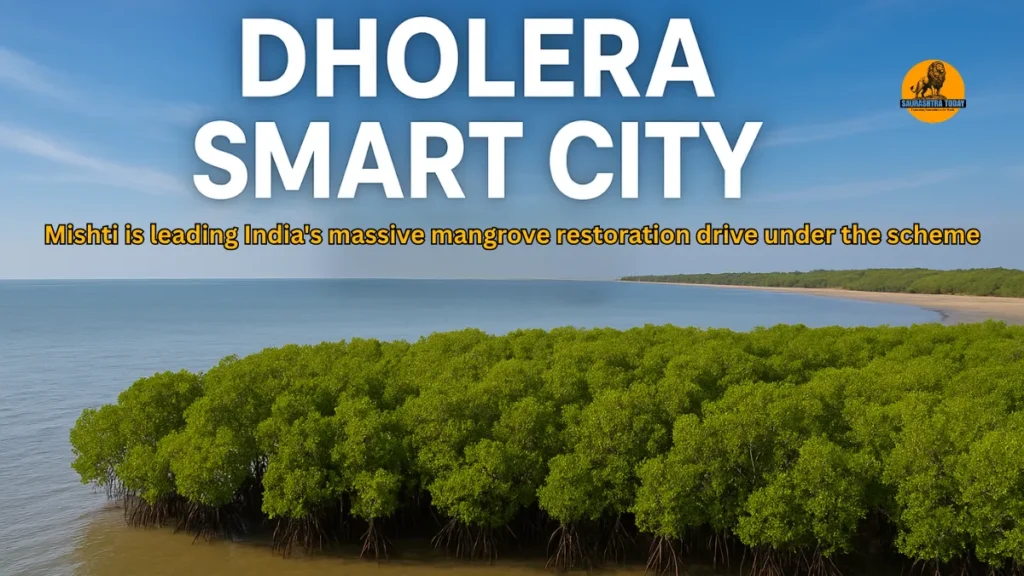
Over 22,500 Hectares Taken Up Nationwide, Gujarat Accounts for 85% of the Project Area
Dholera Smart City: In a significant step toward climate resilience and coastal sustainability, the Government of India has launched an ambitious mangrove restoration program under the Mangrove Initiative for Shoreline Habitats & Tangible Incomes (MISHTI). Over the past two years, the scheme has taken up 22,560 hectares of land across India for mangrove plantation and restoration—out of which a remarkable 19,220 hectares (around 85%) lies in Gujarat.
This large-scale initiative aims to strengthen coastal ecosystems, enhance biodiversity, and improve the livelihoods of coastal communities. Gujarat’s Dholera region, part of the state’s emerging smart city and eco-development zone, has emerged as a model for successful mangrove restoration.

MISHTI: India’s Coastal Green Shield
Announced in the Union Budget for 2023–24 and officially launched on June 5, 2023, MISHTI is a flagship initiative of the Ministry of Environment, Forest, and Climate Change (MoEFCC).
The goal is simple yet powerful — to restore degraded mangrove forests and promote new mangrove plantations along India’s vast 7,500-km coastline.
According to official data presented in the Lok Sabha (August 2025), land has been identified across 13 coastal states and union territories for mangrove restoration during the 2023–24 and 2024–25 financial years. The project is being executed through convergence of various government schemes, including the Mahatma Gandhi National Rural Employment Guarantee Act (MGNREGA), which provides rural jobs while promoting environmental conservation.
Gujarat Takes the Lead in Mangrove Restoration
Gujarat has emerged as the front-runner in mangrove conservation, taking up nearly 19,220 hectares of land under MISHTI. This coastal state now represents India’s largest share of the initiative, outpacing traditional mangrove-rich regions like West Bengal and Odisha.
Following Gujarat, the other leading states under MISHTI are:
- Tamil Nadu – 1,060 hectares
- Andhra Pradesh – 837 hectares
- Odisha – 761 hectares
In contrast, West Bengal, which holds India’s largest mangrove cover (42%), has so far taken up only 10 hectares under the initiative.
Low Plantation in West Bengal Despite Largest Mangrove Area
The Forest Survey of India (FSI) 2023 report estimates that India has a total mangrove cover of 4,991 sq. km, of which West Bengal alone contributes 2,119 sq. km — mainly across the Sundarbans delta.
Gujarat holds the second-largest mangrove cover with 1,164 sq. km, followed by Andhra Pradesh and Odisha.
Environmental experts have raised questions about why states with dense mangrove ecosystems like West Bengal are showing limited participation in MISHTI. They suggest that while Gujarat has focused on expansion and afforestation, states like West Bengal should prioritize restoration and regeneration of existing mangrove zones instead of merely planting new ones.
Prime Minister Modi Highlights Dholera’s Success Story
During his ‘Mann ki Baat’ program on Sunday, Prime Minister Narendra Modi highlighted Gujarat’s remarkable efforts in mangrove restoration, specifically mentioning the Dholera region near Ahmedabad.
“Five years ago, the Forest Department began planting mangroves near Dholera. Today, mangroves have spread over 3,500 hectares along the Dholera coast,” PM Modi said.
He noted that the ecological transformation in Dholera has been visible across the coastal zone.
“The number of dolphins, crabs, and other aquatic creatures has increased significantly. Even migratory birds are now visiting the area in large numbers,” he added.
Dholera’s coastal mangrove belt has not only boosted biodiversity but has also enhanced climate resilience — protecting nearby human settlements and industrial zones from erosion, floods, and cyclones. This development aligns perfectly with the region’s smart city vision, which emphasizes eco-friendly infrastructure and sustainable growth.
Also read: Dholera International Airport: India’s Largest Upcoming Logistics and Aviation Hub
Experts Call for Integrated, Community-Based Restoration
Environmentalists have acknowledged that MISHTI represents a multi-stakeholder, participatory approach to coastal restoration.
Ajanta Dey, of the Nature Environment and Wildlife Society (NEWS), explained that MISHTI draws from successful community-driven models like those implemented in the Sundarbans of West Bengal.
Her organization’s project — Sustainable Aquaculture in Mangrove Ecosystems (SAIME) — has recently received global recognition for integrating aquaculture with mangrove regeneration.
According to Dey, “The focus should not just be on new plantations but on reviving natural regeneration. Mangroves in fragile ecosystems like the Sundarbans act as bio-shields that protect against cyclones, flooding, and sea-level rise.”
She emphasized the importance of involving multiple government departments — from fisheries to rural development — in creating community-led restoration platforms that ensure long-term ecological and economic benefits.
Also read: PM Modi Highlights Dholera’s Green Transformation in Mann Ki Baat Episode 127
Why Mangroves Matter: A Lifeline for Coasts and Communities
Mangroves are among the most productive and climate-critical ecosystems on Earth.
They:
- Protect coastlines from storms, erosion, and rising sea levels
- Serve as nurseries for fish, crabs, and marine species
- Store up to four times more carbon than tropical rainforests
- Support livelihoods through eco-tourism and sustainable fisheries
As India intensifies its climate adaptation measures, the MISHTI scheme could become a global model for combining ecological restoration with economic empowerment.
Also read: Dholera Smart City: India’s First Greenfield Futuristic Smart City
Dholera Smart City and the Green Coastal Future
The rise of Dholera Smart City — India’s first planned greenfield smart city between Ahmedabad and Bhavnagar — is adding new momentum to Gujarat’s environmental achievements.
The city’s eco-industrial zones, renewable energy projects, and mangrove restoration initiatives together position Dholera as a benchmark for sustainable urban growth in Asia.
By integrating smart infrastructure with natural conservation, Dholera represents a new vision of eco-smart development — where technology and nature coexist for mutual benefit.
Also read: Dholera Smart City Scam: Businessman Cheated of ₹14.71 Crore in the Name of Investment
Conclusion
India’s MISHTI scheme, with Gujarat at its heart and Dholera as a shining example, is redefining coastal resilience and environmental policy. While West Bengal and other coastal states still have room to expand their restoration efforts, the Dholera model shows what’s possible when government vision, local participation, and environmental science come together.
As the Dholera Smart City continues to grow alongside its thriving mangrove forests, it offers the world a compelling story of development that protects nature, not replaces it.