
Surat News Today — A Political Family’s Housing Lottery Raises Eyebrows
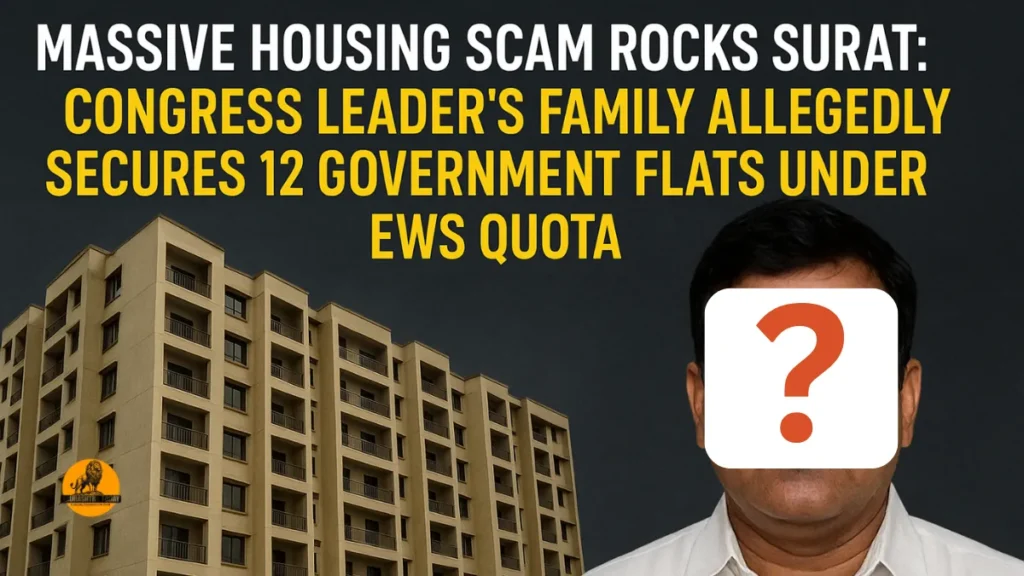
Surat news today highlights a major housing scam as a Congress leader’s family allegedly secures 12 EWS flats using fake documents. Gujarat Housing Board and CMO launch full investigation.
In what’s being described as one of the most shocking cases of misuse of a welfare housing scheme, a senior Congress leader from Surat and her family members have come under scrutiny for allegedly obtaining 12 government flats meant for the economically weaker sections (EWS).
The case has sent ripples through Gujarat’s political and administrative circles, prompting a swift investigation by the Chief Minister’s Office (CMO) and the Gujarat Housing Board (GHB).
The Scheme: Homes for the Poor, Not for the Powerful
The controversy surrounds the Tapi Residency Project in Chhaprabhatha, Surat, launched in 2016 under the Pradhan Mantri Awas Yojana (PMAY). The project aimed to provide affordable housing to those without permanent homes in India, ensuring that no family was left homeless.
Under the rules of PMAY and the Gujarat Housing Board, only applicants meeting the following criteria were eligible:
- They must not own any permanent home anywhere in India.
- They must not have availed of any central or state housing scheme in the past 20 years.
- Their annual income must be below ₹3 lakh for EWS flats or below ₹6 lakh for LIG flats.
Each beneficiary was required to submit income certificates and a sworn affidavit confirming these conditions.
However, as per new Surat news today, serious allegations suggest these rules were blatantly violated by a politically influential family.
The Allegations: A Congress Leader’s Family at the Center of the Storm
The complaint, filed by Kiran Parmar, a resident of Ahmedabad, claims that 12 EWS flats in the Tapi Residency project were fraudulently allotted to members of a single extended family linked to Congress leader Poonamben (Premilaben) Gambhava.
According to the complaint submitted to the Chief Minister’s Office, Gujarat Vigilance Commission, and several other authorities, these flats—meant strictly for low-income individuals—were obtained using false income certificates, fake affidavits, and concealed ownership of other properties.
Family’s Profile Contradicts Their “EWS” Status
Documents and local reports indicate that the accused family members are financially well-established, owning luxury bungalows, flats, and offices across Surat city. Some of them even hold government jobs or operate private businesses, directly contradicting their claimed “economically weak” status.
One of the primary beneficiaries, Rekhaben Jerambhai Gambhava, is reportedly married to Vijay Kanpariya, a businessman and travel agency owner currently lodged in Lajpore Central Jail in connection with multiple fraud cases worth approximately ₹100 crore.
Despite this, Rekhaben allegedly filed a false affidavit, hiding her husband’s identity and assets, while claiming eligibility for an EWS flat.
Massive Property Network Revealed
Further investigations uncovered that Rekhaben’s family owns a series of real estate ventures and properties under different names.
Her daughter reportedly operates a construction firm called “Rishita Developers”, with ongoing residential projects such as Shiv Villa (Olpad), Shiv Shakti (Talad), and Gokuldham Residency (Isanpur).
Additionally, the family is connected to “Tito Tours”, a travel agency organizing both domestic and international trips, and “FCN Training Academy”, which runs seven offices in Surat dealing in stock market training and investments.
These findings make the family’s qualification for low-income housing appear completely implausible.
Complaint Points to Deep Administrative Collusion
Complainant Kiran Parmar alleges that the scam could not have taken place without the direct involvement of Gujarat Housing Board officials, particularly estate manager Harshad Patel, who was responsible for verifying the documents.
Parmar claims that while the application of a truly needy citizen—Jagdish Jeram Ranva—was rejected because his old house was deemed “unsafe” by the Surat Municipal Corporation, the same housing board approved applications with fake income proofs from the Gambhava family.
Even after the flats were allegedly rented out for profit, no action was taken by the concerned officials, hinting at possible bribery and collusion.
RTI Requests Blocked, Transparency Questioned
In a follow-up to the initial complaint, Parmar filed a Right to Information (RTI) request seeking copies of the affidavits and income certificates submitted by the accused applicants.
However, the housing board allegedly refused to provide the documents, citing privacy reasons and even writing to the accused for “consent” before disclosure—despite the fact that such documents are part of public records in welfare housing schemes.
This refusal, Parmar argues, shows an intentional attempt to shield those involved in the scam.
Chief Minister’s Office Orders Probe
Following the complaint, the Chief Minister’s Office (CMO) reportedly instructed the Commissioner of Gujarat Housing Board to launch a detailed inquiry.
According to early findings, the controversial allotments took place after a draw conducted on September 25, 2020, and several beneficiaries were found to have submitted incorrect information in their application forms.
The Gujarat Housing Board has confirmed that an investigation is ongoing and that legal action will be initiated against those found ineligible.
Officials Under the Scanner
Sources within the housing board have hinted that several officials, including estate manager Harshad Patel, may face suspension or departmental inquiry for negligence and possible misconduct.
The complainant has also demanded criminal action, urging authorities to register FIRs against the beneficiaries who filed false affidavits and revoke the 12 flats immediately.
Political Reactions and Denials
When contacted by local media, Poonamben (Premilaben) Gambhava denied any wrongdoing.
“Everything we have done is legal. We submitted all required documents, and the government approved our applications. If anyone filed a false application, that’s not our fault,”
she said during a phone conversation.
However, critics argue that such large-scale irregularities cannot occur without political backing and administrative complicity.
A Broader Issue: Loopholes in India’s Welfare Housing System
This Surat housing scam raises critical questions about how easily welfare housing schemes can be manipulated by influential individuals.
Across India, the Pradhan Mantri Awas Yojana (PMAY) and various state housing initiatives aim to bridge the gap between the rich and poor by providing affordable homes. Yet, the absence of strict verification processes allows many ineligible applicants to exploit the system.
Housing activists say that digitizing ownership data, linking applications to PAN and Aadhaar, and conducting field verification could prevent such frauds in the future.
Public Outrage and Demands for Accountability
The revelation has sparked anger among citizens in Surat. Many have taken to social media platforms demanding that the 12 flats be revoked and reallocated to genuine beneficiaries who actually qualify under the EWS category.
Civil society groups have also urged the Gujarat government to set up a special anti-corruption task force to audit all PMAY allotments made since 2016.
Surat News Today: Investigation Continues
As of now, the inquiry is underway. The Gujarat Housing Board has stated that those found guilty will face legal consequences, and any flat obtained through fraudulent means will be reclaimed by the government.
The case serves as a stark reminder that India’s welfare programs, designed to uplift the underprivileged, must be protected from political manipulation and bureaucratic corruption.
Also read: Surat Kosamba Murder Case: Lover Arrested for Killing Woman and Hiding Her Body in a Suitcase
Conclusion
This developing story from Surat reflects a troubling intersection of politics, privilege, and corruption in India’s welfare housing system.
As the investigation progresses, the outcome will not only determine accountability in this case but also set a precedent for transparency and fairness in future public housing distributions.
For now, the people of Gujarat—and the nation—await justice.