
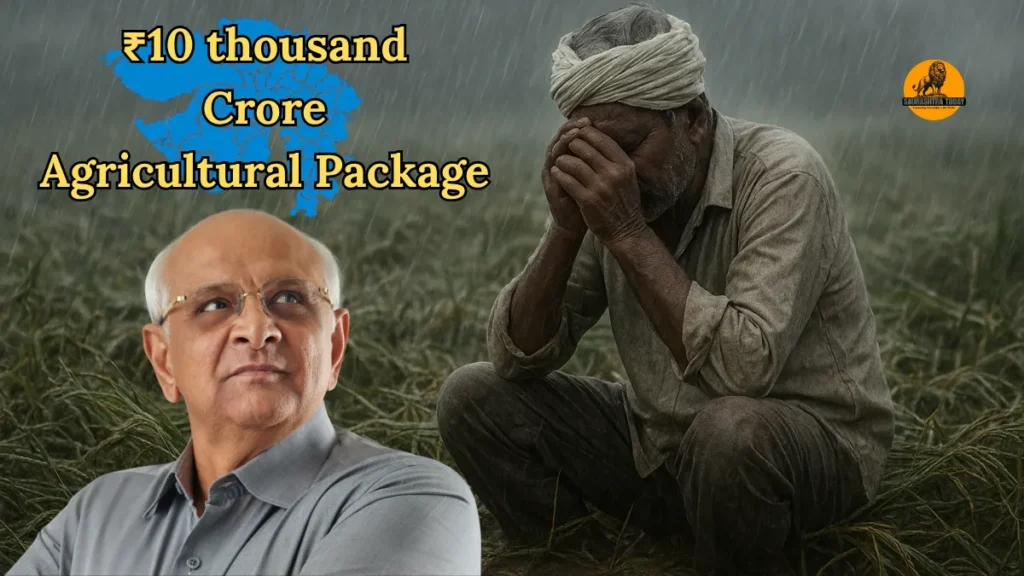
₹10 thousand crore agricultural package: Chief Minister Bhupendra Patel unveils Gujarat’s largest-ever farm relief initiative, offering financial assistance of ₹22,000 per hectare to affected cultivators across 251 talukas.
In a landmark decision marking one of the biggest agricultural relief initiatives in Gujarat’s history, the state government has announced a ₹10 thousand crore agricultural package to aid farmers whose crops were destroyed by unseasonal rains and natural calamities.
Chief Minister Bhupendra Patel declared the massive relief package after a high-level review meeting with senior officials from the Agriculture, Finance, and Revenue departments. The decision, aimed at providing swift compensation for crop damage, was shared publicly via his official account on social media platform X (formerly Twitter).
“This is the largest-ever assistance package in Gujarat’s history to support our farmers who suffered devastating crop losses due to erratic weather,” Patel stated, affirming the government’s commitment to stand by the state’s agrarian community during “these difficult times.”
ગુજરાતમાં ગત બે દાયકામાં ન થયો હોય એ પ્રકારનો અસાધારણ કમોસમી વરસાદ આ વર્ષે થતા રાજ્યના વિવિધ જિલ્લાના ખેડૂતોના પાકને મોટું નુકસાન થયું છે.
— Bhupendra Patel (@Bhupendrapbjp) November 7, 2025
આ સંદર્ભે, મેં તથા મારા સાથી મંત્રીશ્રીઓએ જુદા-જુદા જિલ્લાઓમાં જઈને અસરગ્રસ્ત ખેડૂતોની સાથે પ્રત્યક્ષ વાતચીત કરીને તેમની સ્થિતિ જાણી હતી.…
Relief for 16,500 Villages Across 251 Talukas
Under this package, farmers will receive ₹22,000 per hectare for crop loss, with a limit of two hectares per farmer. The assistance covers all types of crops cultivated across the state. Officials estimate that the relief will benefit farmers from 16,500 villages in 251 talukas, representing nearly the entire agricultural landscape of Gujarat.
Importantly, even those farmers who were not covered under the initial government survey will be eligible to apply for assistance, ensuring that no affected cultivator is left out.
Financial Breakdown: A Mix of State and SDRF Funds
According to official sources, the government has recognized crop damage across 4.4 million hectares (44 lakh hectares) of farmland.
Of the total ₹10 thousand crore agricultural package,
- ₹6,429 crore will come from the State Disaster Response Fund (SDRF), and
- ₹3,386 crore will be allocated from the state budget, bringing the total immediate assistance to around ₹9,815 crore.
Officials noted that as more farmers apply and qualify for support, the total disbursal is expected to cross the ₹10,000 crore mark.
“Unseasonal Rainfall of a Kind Not Seen in Two Decades”
Chief Minister Patel described the recent weather as “one of the most severe instances of unseasonal rainfall in the past two decades.” The erratic downpours wreaked havoc on crops across multiple districts, including Saurashtra, North Gujarat, and South Gujarat, damaging large swaths of groundnut, cotton, and pulse fields.
The Chief Minister personally visited several affected areas alongside other ministers, interacting with farmers and assessing the extent of the damage.
Deputy Chief Minister Harsh Sanghavi, Agriculture Minister Jitu Vaghani, and other cabinet colleagues including Naresh Patel, Arjun Modhwadia, and Dr. Pradyuman Vaja conducted district-level inspections and submitted field reports to the Chief Minister.
5,100 Teams Conducted Rapid Crop Loss Surveys
To ensure accuracy and speed in compensating affected farmers, the state mobilized 5,100 field teams that worked around the clock for three days to complete damage assessments across the affected regions.
“The survey was executed in record time to ensure that relief reaches farmers without delay,” a senior agriculture department official confirmed.
These surveys covered extensive regions across Gujarat’s agricultural belt, confirming widespread destruction due to excess rainfall, flooding, and soil erosion.
Government Purchase of Crops Worth ₹15,000 Crore to Begin
In addition to the relief package, the Gujarat government announced plans to procure crops such as groundnut, moong, urad, and soybean at Minimum Support Price (MSP) starting from November 9, 2025.
This procurement drive, estimated at ₹15,000 crore, aims to stabilize market prices and safeguard farmers’ incomes during the post-harvest season.
Patel reiterated that the government remains “fully committed to the economic welfare of its food providers”, adding that this support “is not a one-time measure but part of a sustained effort to ensure the state’s agricultural stability.”
Historical Context: The Largest Relief in Seven Years
This latest ₹10 thousand crore agricultural package is nearly triple the size of previous relief measures announced during earlier weather crises.
| Year | Relief Package (₹ crore) | Farmers Benefited (millions) |
|---|---|---|
| 2019 | 3,795 | 5.6 |
| 2020 | 3,700 | 2.7 |
| 2024 | 1,419 | 0.7 |
| 2025 | 10,000 | – |
The current initiative far surpasses the ₹3,795 crore package announced in 2019 and the ₹1,419 crore relief distributed in 2024 following heavy rains in 20 districts.
Farmers’ Debt Has Grown by 61% in Six Years
According to state data, Gujarat’s total agricultural debt has grown by nearly 61% between 2020 and 2025, highlighting rising economic pressure on the farming community.
| Year | Farmers (millions) | Total Agricultural Debt (₹ crore) |
|---|---|---|
| 2020 | 4.35 | 90,513 |
| 2022 | 4.60 | 1,06,435 |
| 2023 | 4.99 | 1,20,023 |
| 2024 | 5.34 | 1,36,237 |
| 2025 | 5.11 | 1,46,463 |
The relief package, officials hope, will bring partial respite to the state’s indebted farmers who have faced multiple seasons of losses due to extreme weather.
Political Reactions: Congress Calls It “Too Little, Too Late”
While the announcement has been widely welcomed by ruling party leaders and farmer unions, the opposition Indian National Congress criticized the move, calling it “an election-time eyewash.”
State Congress President Amit Chavda said, “This package is an attempt to mislead farmers. The actual production cost per hectare is far higher, and ₹22,000 is insufficient to compensate real losses. If the government truly wants to help, it should waive farmers’ loans and implement a comprehensive crop insurance plan.”
Despite criticism, ministers from across the state hailed the decision as a “historic act of sensitivity” by the Patel administration. Agriculture Minister Jitu Vaghani posted on X:
“Under the compassionate leadership of CM Bhupendra Patel and Deputy CM Harsh Sanghavi, the government has announced a ₹10 thousand crore agricultural package — the largest in Gujarat’s history — to support our farmers who suffered immense loss due to unseasonal rains.”
Past Precedents and Changing Rainfall Patterns
In August–September 2024, the Gujarat government had announced a smaller ₹1,462 crore relief package after 20 districts experienced heavy rainfall. That package compensated:
- ₹12,000 per hectare for non-irrigated crops with 33% or more loss,
- ₹22,000 per hectare for irrigated crops, and
- ₹27,500 per hectare for horticultural crops.
Experts say the increasing frequency of unseasonal rainfall in Gujarat over the past five years has disrupted sowing and harvesting cycles, particularly for cotton and groundnut, which dominate the Saurashtra region.
In 2025, around 2.2 million hectares were used for groundnut cultivation — nearly 1.6 million hectares in Saurashtra alone — reflecting a shift from cotton due to last year’s low market prices. Ironically, this diversification has made farmers even more vulnerable to erratic monsoons.
Also read: Diwali Brings New Life: 64-Year-Old Donates Organs to Save Five Lives in SOTTO Gujarat
A Digital-First Announcement
Interestingly, this is the first time a major relief package in Gujarat has been announced directly via social media.
Political observers noted parallels with a 2016 precedent when former Chief Minister Anandiben Patel resigned via social media. The digital-first approach underlines how government communications have evolved to reach citizens instantly.
Implementation and Farmer Queries
Under the new scheme, assistance will be categorized into two brackets:
- ₹22,000 per hectare for standard crop loss
- Up to ₹44,000 per hectare for higher damage zones
All farmers within the 251 talukas identified as disaster-affected will be eligible. Applications can be submitted even by those whose fields were not included in official surveys.
Funding will be disbursed jointly by the SDRF and the state treasury through direct benefit transfer (DBT) to farmers’ bank accounts.
CM’s Closing Remarks
Concluding his announcement, Chief Minister Patel stated:
“The state government stands with every farmer of Gujarat. Understanding their pain and challenges in these difficult times, we have approved a ₹10 thousand crore agricultural package — the largest in Gujarat’s history — to ensure no farmer faces this crisis alone.”
Also read: Rajkot Delhi 2 New Flights Started: Boost to Business, Tourism, and Connectivity
Conclusion
The ₹10 thousand crore agricultural package marks a defining moment in Gujarat’s rural policy. Analysts say it reflects both the scale of the agricultural crisis and the political significance of rural constituencies ahead of the next assembly polls.
For now, farmers across Gujarat are watching closely — hopeful that this time, government promises will translate into tangible relief on the ground.