
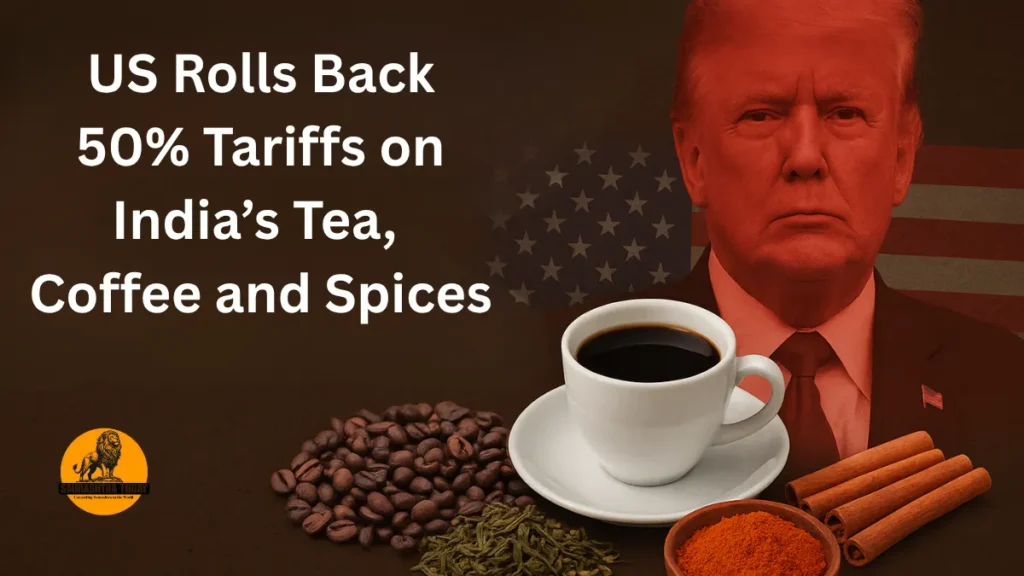
In a major development that is expected to significantly boost India’s agricultural exports, the United States has withdrawn the steep 50% reciprocal tariff imposed earlier on multiple Indian food and farm products, including tea, coffee, spices, tropical fruits and fruit juices.
The rollback marks a strategic shift by the Trump administration, which had earlier introduced the tariff as part of a broader trade retaliation linked to India’s purchase of Russian oil. However, with food prices in the US climbing steadily and domestic production falling short, Washington has stepped back, relieving nearly $1 billion worth of Indian exports from the tax burden.
The tariff withdrawal was formalized on 12 November through an executive order issued by the White House, and it came into immediate effect on 13 November. According to India’s Ministry of Commerce, this decision is expected to give Indian exporters a level playing field in the American market and strengthen bilateral trade ties.
A Major Relief Worth $1 Billion for India’s Agricultural Exporters
India exported nearly $2.5 billion (₹22,000 crore) worth of agricultural products to the US in the financial year 2025. Out of this, around $1 billion (₹9,000 crore) worth of goods were subjected to the 50% tariff—goods that are now completely tax-free.
The Directorate General of Foreign Trade (DGFT) confirmed the development on 17 November, noting that the tariff rollback will allow Indian exporters to compete more effectively, particularly in high-demand categories like spices, processed foods, tea and coffee.
Trade Deal Between India and the US Nearing Final Stage
India and the United States appear close to finalising a long-pending trade agreement. According to Commerce Secretary Rajesh Agarwal, negotiations have made substantial progress, especially on key issues such as:
- US market access demands
- Adjustment of the 25% reciprocal tariff
- The additional 25% duty India imposes on crude oil
He stated that both sides are “very close” to concluding the agreement, which has been under negotiation since February of this year. The tariff rollback is widely seen as a positive gesture to accelerate the final deal.
Why the US Withdrew the Tariff: Falling Production and Rising Food Costs
One of the major factors behind the tariff rollback was a significant drop in US domestic production of several food items, particularly spices and tropical products. As these items are not produced in large quantities in the US—due to climatic limitations—the high tariff was feeding into inflation and causing higher prices for American consumers.
The tariff withdrawal affects several key export categories:
• Spices — $358.66 million (₹3,200 crore) now duty-free
Indian spice exports, ranging from pepper to cumin and turmeric, will see a substantial boost as they now enter the US market without additional taxation. The US relies heavily on imports for these products.
• Processed Foods — $491.31 million (₹4,345 crore) exempted
Nearly 50 processed food items, including ready-to-eat snacks, packaged fruit items, and other food preparations, are now tax-free.
• Tea & Coffee — $82.54 million (₹731 crore) relief
This segment is particularly significant amid the ongoing debate around Trump coffee tariffs, which had become a major topic for US importers who rely on high-quality Indian coffee and tea.
• Fruits, Essential Oils, Vegetables and Roots — $54.58 million (₹484 crore) exempted
These include tropical fruits, almonds, essential oils, and certain vegetables, which the US imports heavily due to limited domestic production.
US officials reportedly acknowledged that withdrawal was necessary to prevent further food-price inflation.
India’s Total Exports to the US in FY25: ₹7.66 Lakh Crore
The United States remains India’s largest trading partner. In the financial year 2025:
- Total Indian exports to the US:
$86.51 billion (₹7.66 lakh crore) - Top five export categories:
- Textiles and garments
- Jewellery
- Engineering goods
- Pharmaceuticals
- Telecom and electronics devices
Before the tariff rollback, nearly $48.2 billion worth of Indian exports were affected by high US tariffs.
Direct Gains for Indian Exporters: DGFT Confirms Impact
Ajay Bhadu, Director General of DGFT, stated that the rollback will deliver a direct benefit of $1 billion to Indian exporters.
According to him:
- The earlier tariff made price competitiveness extremely difficult
- Indian products became costlier and less attractive in US markets
- Exporters struggled with pricing, logistics, and buyer confidence
He emphasized that the removal of the tariff will accelerate growth in sectors like spices, tea, coffee and processed foods. The move will also help improve the overall trade balance between the two countries.
This relief is expected to particularly boost small and medium-sized exporters who were struggling to maintain profitability amid the earlier tariff burden.
Broader Context: Energy Trade Also Strengthening
The tariff rollback comes shortly after India and the US concluded their first major agreement amid the ongoing tariff dispute. India agreed to purchase around 2.2 million metric tonnes (MTPA) of LPG from the US—representing nearly 10% of its annual requirement.
The agreement is valid until 2026 and is being viewed as a significant step to strengthen India’s energy security. It also indicates growing trust between the two nations, even as trade negotiations continue.
US–India Trade Snapshot
Total Bilateral Trade: ₹11 Lakh Crore
US Exports to India — ₹3.46 Lakh Crore
Major items include:
- Crude oil
- Petroleum products
- Coal
- Diamonds
- Aerospace and aviation components
India’s Exports to the US — ₹7.35 Lakh Crore
Major categories include:
- Pharmaceuticals
- Telecom devices
- Jewellery
- Petroleum products
- Textiles and garments
The large trade surplus in India’s favour is one of the reasons trade negotiations have sometimes been contentious.
Impact on Global Markets and the Keyword Focus: Trump Coffee Tariffs
The reversal of the tariff has become an important topic in global agri-trade and supply-chain discussions. The term “Trump coffee tariffs” has been trending among US importers, particularly coffee roasters, tea brands, spice distributors and ethnic grocery chains.
With the tariffs now removed:
- Prices of Indian coffee and tea in the US are expected to stabilise
- Import volumes are likely to rise sharply
- American food businesses that rely on Indian products can expect better margins
- Consumers in major cities such as New York, Chicago, Houston and San Francisco may see lower shelf prices for specialty foods
The rollback also sends a message that the US is willing to revisit protectionist measures when domestic inflation becomes a concern.
Also read: India and Romania Strengthen Trade and Investment Ties Through High-Level Talks
Conclusion: A Significant Win for India and a Strategic Move for the US
The withdrawal of the 50% tariff under the Trump administration marks a turning point in India–US trade relations. It provides:
- Immediate financial relief for Indian exporters
- Price stability for US consumers
- Improved market access for agricultural producers
- Momentum for the upcoming trade deal
- Boosted confidence on both sides
By eliminating the duty burden on key products such as spices, tea, coffee and tropical foods, the US has effectively opened the door for stronger trade ties. The decision also aligns with domestic American concerns regarding rising food inflation and supply shortages.
As discussions continue on the larger trade agreement, the tariff rollback—especially in the context of the Trump coffee tariffs debate—stands out as a significant step toward a more balanced and mutually beneficial trade environment.