
New Zealand India Trade: In a major development that could reshape the future of the Asian timber market, India and New Zealand are moving closer toward a potential Free Trade Agreement (FTA). This progress comes at a time when the global economy is shifting rapidly, supply chains are becoming more interconnected, and nations are seeking dependable trade partners beyond traditional giants like China and the United States.
The Kandla timber industry—already recognised as the largest timber trading hub not only in Gujarat or India but across the whole of Asia—may become one of the biggest beneficiaries if this agreement becomes reality. With India’s timber imports constantly rising, the groundwork for deeper cooperation under the New Zealand India Trade framework is gaining momentum.
High-Level Delegation from New Zealand Visits Kandla
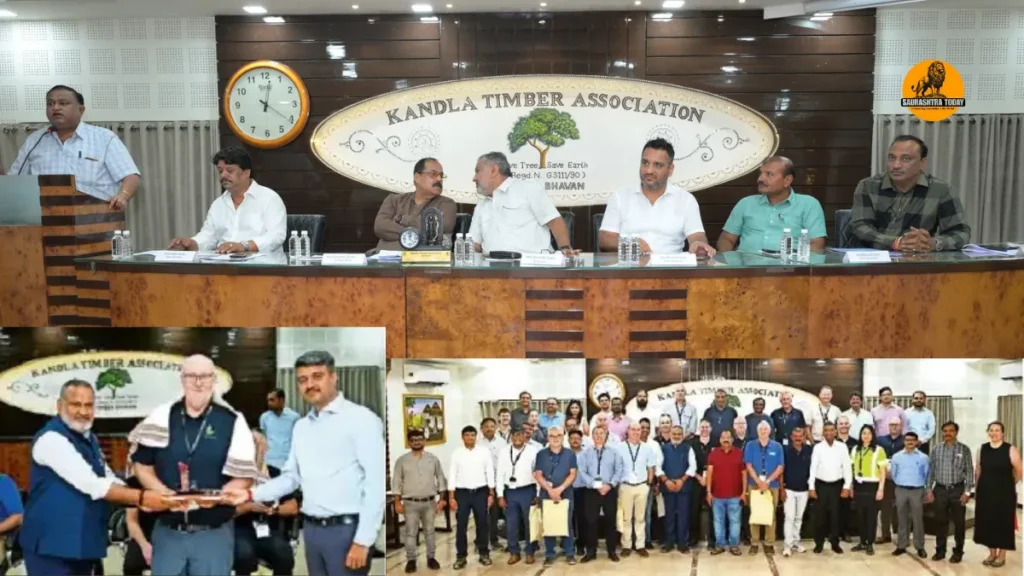
Last week, a high-profile delegation comprising New Zealand’s timber exporters, sawmill owners, senior industry leaders, and officials from the New Zealand Trade Commission visited Kandla, one of India’s most active import centres for wood products. The group aimed to understand how the Indian timber ecosystem operates and evaluate the capacity of local industries.
During discussions with industry representatives, the delegation expressed strong interest in expanding trade ties. They noted that India, particularly Kandla, has built an efficient and large-scale processing and distribution system for imported timber, making it a strategic destination for exporters worldwide.
Following the visit to Kandla Port and the Kandla Timber Association, the delegation also held further discussions with senior officials at the New Zealand High Commission in New Delhi, signalling that the talks are moving into a more serious phase.
Why New Zealand Wants a Free Trade Agreement with India
The world is increasingly functioning like a “global village,” where economic interdependence has grown stronger than ever. Many countries are now actively seeking new market partners for long-term stability and diversified trade networks. New Zealand is one such country exploring new avenues of cooperation with India, especially in the agricultural and timber sectors.
At present, the majority of timber imported into India—especially pine wood—comes from Australia. One of the key reasons for this dominance is the existing Free Trade Agreement between India and Australia, which allows Indian importers to bring in wood without paying heavy tariffs.
New Zealand, noticing this advantage, wants to level the playing field through a similar agreement under the expanding New Zealand India Trade framework.
Currently, New Zealand contributes around 20% of India’s total timber imports arriving at Kandla. However, this share could significantly increase if tariffs are eliminated through an FTA.
The Tariff Advantage: How the FTA Could Boost Trade
At the moment, Indian timber importers must pay 5.5% customs duty on wood imported from New Zealand. This duty increases the cost of raw materials and ultimately affects the entire supply chain, from manufacturers to end consumers.
If India and New Zealand sign a free trade deal:
- The 5.5% import duty would be removed
- Importers would receive high-quality pine wood at a noticeably lower price
- The timber industry would immediately experience a cost advantage
- Consumers in India would benefit from reduced prices for timber-based products
New Zealand’s pine wood is already well-regarded for its superior quality and durability. Even with the current duty charges, many Indian traders prefer importing from New Zealand. The removal of the tariff would therefore not only reduce procurement costs but also accelerate trade volume dramatically.
Officials from the Kandla Timber Association, including President Navneet Gajjar, Vice President Hemchandra Yadav, and Secretary Dharmesh Joshi, welcomed the New Zealand delegation and confirmed that discussions were positive. According to them, both sides showed strong intent to move forward with policy-level decisions that could strengthen the New Zealand India Trade partnership.
Understanding the Methyl Bromide Treatment Issue
One of the most critical topics in the timber import sector is the mandatory Methyl Bromide fumigation process, which is enforced by India’s Plant Protection, Quarantine & Storage (PPQS) Department. This process is required for all agricultural, plant-based, and wood products entering India, ensuring that foreign pests do not enter and harm local ecosystems.
However, Methyl Bromide treatment has been widely criticized by environmentalists, who argue that it contributes to ozone depletion and climate change. As a result, several countries—including New Zealand—have banned its use domestically.
Due to this ban, New Zealand-based timber exporters were unable to carry out the mandatory fumigation process before shipping their cargo to India. As a result:
- Indian authorities imposed strict penalties
- Importers faced fines amounting to five times the standard duty
- Timber shipments from New Zealand dropped sharply
The issue eventually reached the Indian courts, where the judiciary ruled that importers should only be charged the actual cost of alternative treatment rather than excessive penalties. This judgement provided much-needed relief to the timber industry.
Also read: India and Romania Strengthen Trade and Investment Ties Through High-Level Talks
Why New Zealand Timber Imports Declined — And Why They Are Rising Again
Up until about four years ago, New Zealand was one of the largest and most preferred exporters of pine wood to India. Its timber was valued for its uniform texture, high strength, and excellent finishing quality. However, because New Zealand had banned Methyl Bromide fumigation, India restricted untreated cargo at its ports.
This led to a steep drop in imports.
But recently, India introduced a system allowing fumigation on arrival at Indian ports, removing the dependency on exporters to perform the treatment in their home country. As a result, imports from New Zealand have started to rise again—a trend that could accelerate rapidly if the FTA is finalised.
What the Future Holds for the India–New Zealand Timber Trade
If India and New Zealand succeed in establishing a free trade agreement:
- New Zealand’s share in India’s timber imports could rise significantly from the current 20%
- Kandla could emerge as one of the world’s busiest timber processing hubs
- Indian manufacturers in sectors like furniture, real estate, packaging, and décor would receive cost benefits
- The global timber supply chain could shift strategically towards the India–New Zealand corridor
Given the scale of the Indian market and the efficiency of New Zealand’s forestry sector, the proposed agreement could be one of the most impactful developments in the Asia-Pacific timber economy.
As discussions advance between policymakers and industry leaders, the future of the New Zealand India Trade ecosystem appears increasingly promising. With global supply chains diversifying and nations aiming for cleaner, sustainable trade practices, both countries are poised to benefit from a partnership grounded in mutual growth and economic security.