
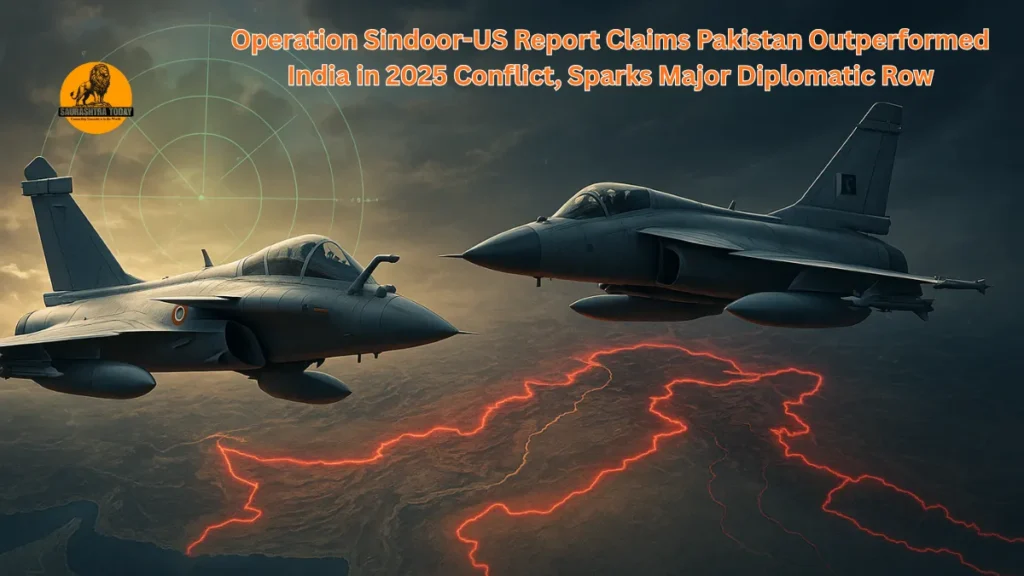
A recently released American report has triggered a major geopolitical debate across South Asia. The document claims that during the four-day conflict between India and Pakistan in May 2025—an episode now informally termed Operation Sindoor—Pakistan gained significant military advantage over India. The report, spanning more than 800 pages, was published by the US-China Economic and Security Review Commission (USCC), a bipartisan body established by the US Congress.
The findings have caused an uproar in India, particularly because the report categorises the Pahalgam attack—the event that triggered the short conflict—not as a “terror attack”, but as a rebellion-led assault, contradicting India’s long-standing position. Indian political parties, defence experts, and diplomatic observers have sharply criticised the document, calling it a serious blow to India’s international standing.
Congress leader Jairam Ramesh questioned whether the Indian government would formally object to the report, adding that such claims undermine India’s diplomatic credibility. He termed it “yet another setback for Indian diplomacy.”

Pakistan’s Military Gains Highlighted in US Report
According to the USCC document, Pakistan successfully leveraged the conflict that unfolded under Operation Sindoor to showcase its combat capabilities. The report notes that Pakistan claimed to have shot down at least six Indian fighter jets, including the newly inducted Rafale aircraft.
While the USCC confirms only three downings, it states that the narrative surrounding these claims—particularly amplified by China—resulted in reputational damage to the Rafale platform globally. Defence analysts quoted in the report argue that even unverified battlefield claims can influence global defence markets and perceptions.
China’s Alleged Role: Weapons, Intelligence Support, and War-Time Advantage
One of the most contentious aspects of the USCC report is its assertion that China used the India-Pakistan conflict to test and demonstrate its advanced military weaponry in real combat conditions.
The report claims that China supplied Pakistan with several modern defence systems that played a “decisive role” in the conflict. Among the weapons mentioned are:
- HQ-9 Air Defence System
- PL-15 Long-Range Air-to-Air Missiles
- J-10 Fighter Jets
India has consistently maintained that Pakistan benefitted from Chinese intelligence-sharing, though both Pakistan and China officially deny such cooperation.
The report further highlights that between 2019 and 2023, around 82% of Pakistan’s defence imports came from China—an indicator of deep military dependence.
China’s Global Messaging Campaign After Operation Sindoor
Following the conflict, Chinese embassies worldwide reportedly praised the performance of Chinese-origin weapons used by Pakistan. The report suggests that China actively used Pakistan’s claims to promote its defence products in the global market, positioning them as “battle-tested” systems.
The narrative, the report claims, enabled China to strengthen its footprint in the global arms trade while portraying India as struggling with operational vulnerabilities during Operation Sindoor.
What Is the USCC and Why Does Its Report Matter?
The US-China Economic and Security Review Commission is a bipartisan institution with a mandate to monitor and report on the evolving economic and security dynamics between the United States and China. Each year, it submits an assessment to the US Congress, offering recommendations on how America should respond to China’s global activities.
This year’s report focuses on:
- China’s military build-up
- Strategic influence operations
- Economic leverage
- Technology competition
- Supply chain risks
- China’s geopolitical engagements in Asia and beyond
The segment involving Operation Sindoor appears within a broader analysis of China’s role in regional conflicts and its use of proxy nations to advance strategic objectives.
Chinese Media Calls Report ‘Politically Motivated’
The Chinese state-run newspaper Global Times has strongly criticised the USCC report. It argues that the document exaggerates China’s military and technological progress, portraying it as a global threat without presenting balanced evidence.
Global Times claims:
- The report reflects political bias, not objective analysis.
- The US misunderstands China’s rise and projects its own insecurities.
- Highlighting China’s role in the Pakistan-India conflict is part of a broader US strategy to promote anti-China sentiment.
It further states that China’s defence industry is focused on legitimate national security needs and that criticising its growth is equivalent to denying sovereign rights.
China Accuses the US of Weaponising the Supply Chain
In another sharp response, Global Times countered US allegations by claiming that the United States—not China—is responsible for “weaponising” global supply chains. The editorial cited:
- Export restrictions on semiconductor technology
- Sanctions on military equipment
- Blacklisting of Chinese companies
- Pressure on allied nations to curtail partnerships with China
China insists that its rare-earth mineral policies and global trade practices aim to maintain stability, not disrupt global markets.
According to the Chinese media, the US continues to repeat the same narratives every year, ignoring facts and relying on outdated geopolitical assumptions. Such actions, it claims, diminish the credibility of US-authored reports globally.
India’s Diplomatic Challenge After Operation Sindoor
The USCC report has compelled Indian policymakers to reassess the international narrative surrounding the 2025 conflict. New Delhi maintains that:
- The Pahalgam incident was a terror attack orchestrated by Pakistan-backed groups
- India responded proportionately under Operation Sindoor
- Pakistan’s claims of downing Indian aircraft are exaggerated
- China played a destabilising role by aiding Pakistan
However, the report’s findings may complicate India’s efforts to shape global opinion on cross-border terrorism and regional security.
Foreign policy experts suggest that India may need to:
- Formally contest the “rebellion attack” classification
- Counter the narrative around Rafale’s performance
- Address suspicions of China-Pakistan intelligence collaboration
- Engage diplomatically with the US to correct misrepresentations
Strategic Significance of Operation Sindoor
Operation Sindoor, as the conflict is now being informally labelled in international discourse, represents a critical moment in South Asian geopolitics. Several analysts argue that the four-day war exposed:
- India’s need to modernise its air defence systems
- Pakistan’s agility in asymmetric warfare
- China’s growing influence over Pakistan’s military operations
- The vulnerabilities of imported defence platforms in high-intensity conflict
The episode has since become a reference point for scholars studying rapid-escalation conflicts and multi-state involvement.
A Wider Global Context: US-China Rivalry and South Asian Stability
At its core, the debate around Operation Sindoor extends beyond India and Pakistan. The USCC report frames the conflict as a case study illustrating how China leverages regional crises to:
- Expand its geopolitical influence
- Test military technologies
- Promote defence exports
- Challenge US strategic dominance
This viewpoint reinforces the belief that South Asia is becoming a key front in the broader US-China rivalry.
Conclusion
The controversy over the USCC’s analysis of Operation Sindoor has opened new fault lines in international relations. While Pakistan views the findings as validation of its military preparedness, India sees them as misrepresentation that undermines global understanding of terrorism and regional security.
China, meanwhile, rejects the report entirely, framing it as yet another attempt by the United States to counter China’s rise.
As diplomatic exchanges intensify, one thing is clear:
Operation Sindoor is no longer just a short-lived conflict—it has become a pivotal case in the evolving power dynamics between India, Pakistan, China, and the United States.