
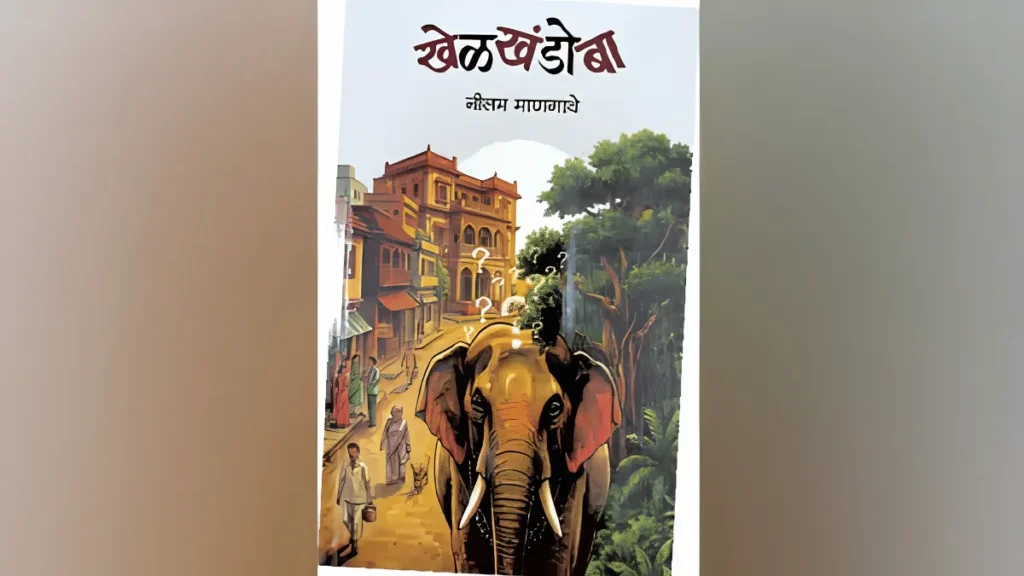
Neelam Mangave’s Marathi novella ‘Khelkhandoba’uses the story of Madhuri elephant to examine the complex relationship between humans and animals, while also questioning social attitudes, religious traditions and the way people interpret compassion and non-violence.
The story of Madhuri elephant, who was associated with Nandani Math in Kolhapur, became the starting point for Neelam Mangave’s novella ‘Khelkhandoba’. The decision to move Madhuri from Nandani Math to Vantara in Gujarat sparked considerable discussion and reactions not only in Kolhapur but across Maharashtra.
Mangave has drawn inspiration from this real-life episode while also introducing fictional situations into the narrative. The result is a story that goes beyond the life of an elephant. Through Madhuri’s story, the author looks at the wider social questions surrounding animals, religious practices, human responsibility and the place of other living beings in society.
Madhuri Elephant Becomes the Centre of a Larger Social Question
Although Madhuri remains at the heart of ‘Khelkhandoba’, the novella is not simply a story about an elephant. Her situation becomes a way for the author to examine how society responds when questions involving animals, faith, tradition and human interests come into conflict.
The book raises an important question: can the existence and rights of an animal be overlooked in the name of human convenience or tradition?
Animals are also part of the natural world, and their lives have value independent of their usefulness to humans. Through the circumstances surrounding Madhuri, the book encourages readers to look at this relationship from a different perspective.
Religion, Tradition and the Idea of Non-Violence
One of the important aspects explored in ‘Khelkhandoba’ is the relationship between religion and the way religious traditions are interpreted. The novella also touches upon ideas of compassion, kindness and non-violence.
The story does not restrict these questions to the religious sphere. Instead, it uses Madhuri’s circumstances to examine the larger human tendency to make decisions about animals according to social customs, beliefs or practical convenience.
This makes the Madhuri elephant story relevant beyond the specific incident that inspired the book. It invites readers to think about whether traditions should always take precedence over the well-being and dignity of another living creature.
A Story About More Than One Elephant
A major strength of Khelkhando is that the narrative does not remain limited to Madhuri alone. While the elephant provides the central thread, the author uses the incident to explore several layers of society.
Real events and fictional episodes are woven together, allowing social and political dimensions to enter the narrative. Because of this approach, the book becomes more than a retelling of an incident involving an elephant. It turns into a reflection on human behaviour, public reactions and the ways society forms opinions around sensitive issues.
Understanding the Human-Animal Relationship
The relationship between humans and animals has always taken different forms. In some households and communities, animals are treated as members of the family. In other situations, they become connected with religious traditions, cultural practices or social customs.
At times, humans also make decisions about animals based largely on their own needs and interests. ‘Khelkhandoba’ examines these different dimensions through Madhuri’s story.
The novella ultimately leaves readers with a fundamental question: Why should the right to exist on this planet be considered primarily a human privilege?
Every living creature has a role within nature. Ignoring the existence, needs and natural lives of other species can have consequences that extend beyond individual animals and affect the wider ecological balance.
Simple Language Gives the Story Its Strength
Another notable feature of ‘Khelkhandoba’ is its accessible and flowing language. The different incidents and situations develop naturally, allowing the author to address serious subjects without making the narrative unnecessarily heavy.
The story looks at the bond between humans and animals from several angles, while keeping Madhuri at its emotional centre. This combination of a real incident, fictional storytelling and social commentary gives the novella its distinctive character.
Rather than presenting Madhuri merely as the subject of an incident, Neelam Mangave uses her story to encourage readers to reconsider how humans view animals, tradition and their own responsibilities toward other forms of life.
Book Details
Book:‘Khelkhandoba’
Author: Neelam Mangave
Publisher: Akshardeep Prakashan
Pages: 108
Price: ₹200
Disclaimer: This article is published solely for informational and educational purposes. The information presented is based on the book and the available details related to it. This article is not intended to promote or criticize any individual, organization, religion, community, or ideology. We do not have any affiliate relationship or promotional partnership with the author, publisher, or any other party associated with the book. This content is not sponsored and has not been published for advertising, promotional, or commercial purposes.
Also read: Vantara University Announced to Train Future Conservation Leaders and Wildlife Experts