Ahmedabad, India – The Bharatiya Mazdoor Sangh (BMS), one of India’s most powerful labor unions, organized a massive statewide protest in Gujarat opposing the government’s controversial decision to extend daily working hours from 8 hours to 12 hours for industrial employees.
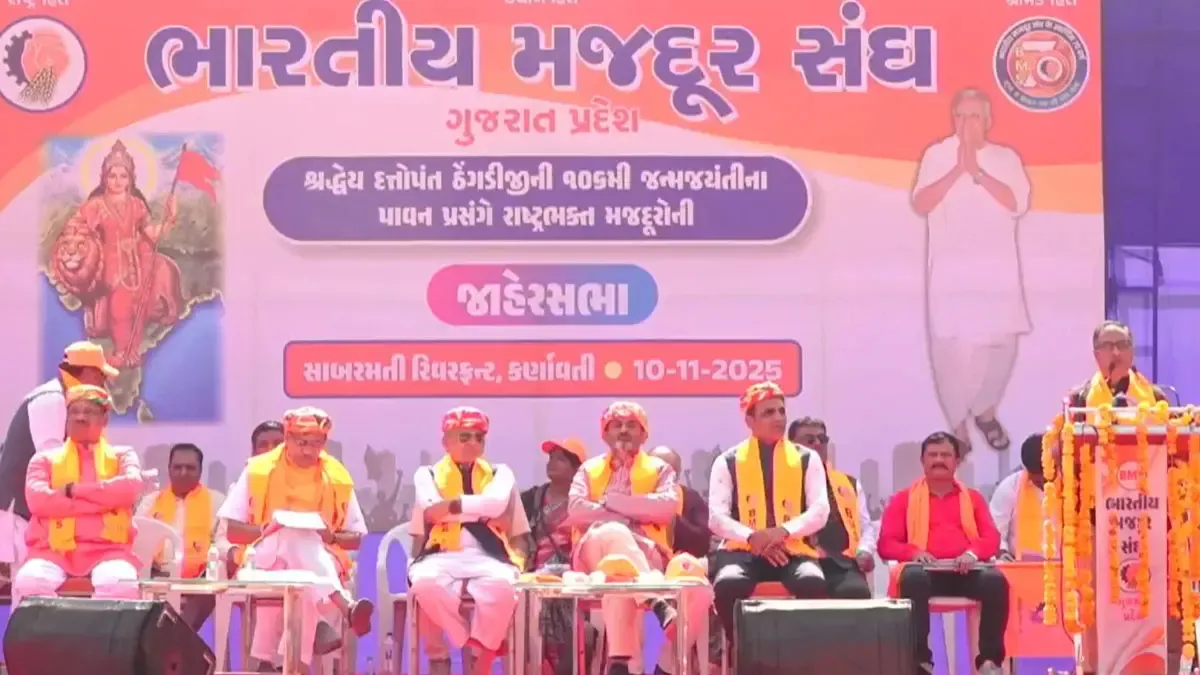
Thousands of workers, representing over 161 affiliated unions, assembled at the Sabarmati Riverfront in Ahmedabad to mark the 106th birth anniversary of Dattopant Thengadi, the revered founder of the Bharatiya Mazdoor Sangh. The event turned into a grand labor rally, symbolizing the united voice of workers demanding justice and fair labor practices across the state.
Massive Turnout at Riverfront Mega Rally
The atmosphere at the Riverfront was charged with energy as thousands of workers from various sectors—textile, engineering, construction, and transport—arrived in processions and small rallies. Each group carried banners highlighting their local grievances and demands under the central leadership of the Bharatiya Mazdoor Sangh.
According to union leaders, this protest was not an impulsive move but the result of months of unheeded petitions and representations to the Gujarat government. Despite several rounds of discussions, authorities have failed to take decisive action on long-standing labor issues, prompting the BMS to intensify its movement.
Addressing the massive crowd, Rajendra Singh Chudasama, State Vice President of the Bharatiya Mazdoor Sangh, stated:
“We have prepared fourteen detailed memorandums that will be submitted to the Chief Minister and respective ministers today. If the government refuses to open its eyes, the anger of workers will soon reach its peak.”
Controversy Over 12-Hour Workday Policy
The core issue driving the protest is the Gujarat government’s proposal to increase the official workday from 8 to 12 hours for industrial workers.
The Bharatiya Mazdoor Sangh has vehemently opposed this plan, calling it a direct assault on workers’ rights and health. The organization demanded that the decision be put on hold immediately and that a tripartite committee—including representatives from labor unions, employers, and the government—be formed to review the implications thoroughly.
The BMS argues that such a drastic change cannot be implemented without full consultation with all stakeholders. According to union representatives, longer work hours would jeopardize worker safety, reduce efficiency, and adversely affect family life.
They further insist that any amendment to labor laws must follow a transparent review process rooted in social dialogue and backed by expert recommendations.
Comprehensive List of Bharatiya Mazdoor Sangh’s Demands
The rally also served as a platform to present an extensive charter of demands covering a wide range of labor welfare issues. The Bharatiya Mazdoor Sangh emphasized that its fight is not only about work hours but also about dignity, social security, and equitable working conditions.
The key demands include:
- Speedy Resolution of Labor Issues – The government must ensure quick and fair redressal of all pending industrial disputes and worker grievances.
- Immediate Filling of Vacant Posts – Vacant positions in labor administration, including ALC (Assistant Labor Commissioner), DLC (Deputy Labor Commissioner), and GLO (Government Labor Officer), as well as directors in safety and health departments, should be filled immediately.
- Strengthening Industrial Judiciary – The government must promptly fill vacancies in Industrial Courts and Labor Tribunals to avoid long delays in justice delivery.
- Abolition of Contract Labor System – The BMS demands a complete end to the contract employment system, beginning with government departments.
- Fair Compensation for Contract Workers – The union reports that many contract workers are underpaid and sometimes forced to return part of their salaries to contractors. The BMS proposes the creation of a Contract Worker Welfare Board, modeled after Haryana’s successful initiative, to prevent such exploitation.
- Regularization of Fixed-Term Employees – The tenure of fixed-term workers should be limited to one year, after which they must be absorbed into the regular pay scale with full benefits and continuity of service.
- Statewide Implementation of ESI Scheme – The Employees’ State Insurance (ESI) scheme must be expanded to cover all industrial areas of Gujarat.
- Opening of Sub-Regional ESI Office in Bhavnagar – To serve workers in the Saurashtra region more efficiently, a dedicated sub-regional ESI office should be established in Bhavnagar.
- Establishment of 100-Bed ESI Hospitals – The BMS has demanded new 100-bed ESI-run hospitals in Mehsana, Halol, and Savli, to provide quality healthcare to workers.
- Creation of Welfare Board for Scheme Workers – A separate welfare board should be formed to ensure fair treatment and benefits for scheme-based employees.
- Reinstatement of the Old Pension Scheme (OPS) – The Bharatiya Mazdoor Sangh has reiterated its long-standing demand for the restoration of the Old Pension Scheme for government and semi-government employees.
Union Plans to Meet Chief Minister and Ministers
Following the rally, delegations of five members from each union will personally deliver memorandums to the Chief Minister and key ministers. These documents outline the union’s grievances and seek immediate governmental intervention.
Union leaders have emphasized that the Bharatiya Mazdoor Sangh’s movement is peaceful but resolute. If the government continues to delay action, the BMS may expand the agitation to other states and involve national-level federations.
“Our patience has limits,” said Chudasama. “If the administration keeps ignoring the voices of the working class, we will have no choice but to escalate this struggle across the nation.”
Wider Concerns About Labor Reforms in Gujarat
This protest has reignited the national debate on India’s evolving labor laws and the balance between economic growth and worker welfare.
Gujarat, known as one of India’s most business-friendly states, has been pushing several industrial reforms to attract investment. However, the Bharatiya Mazdoor Sangh argues that these reforms are being implemented without adequate safeguards for workers’ rights.
Labor experts warn that the proposed 12-hour workday could violate international labor standards, particularly those outlined by the International Labour Organization (ILO), which recommend humane working hours and adequate rest periods for workers.
Bharatiya Mazdoor Sangh’s Call for Constructive Dialogue
Despite the sharp tone of its protest, the Bharatiya Mazdoor Sangh has clarified that it seeks dialogue, not confrontation. The union urged the state government to adopt a participatory approach by forming a joint review committee composed of:
- Representatives of the Bharatiya Mazdoor Sangh
- Industrial associations
- Labor department officials
- Health and safety experts
Until such a committee is formed and the matter thoroughly examined, the BMS insists that the 12-hour workday policy should remain suspended.
Workers’ Voices Reflect Deep Discontent
Many participants at the rally expressed their frustration and fear about the government’s new labor measures.
Ramesh Patel, a factory worker from Surat, said:
“Working 12 hours a day in industrial heat is unbearable. It’s not only exhausting but also dangerous. We want fair hours and fair pay.”
Another worker from Vadodara shared:
“We understand productivity goals, but the government must remember that workers are human beings, not machines. Extending work hours without increasing wages or improving conditions is exploitation.”
These voices highlight the growing disconnect between policy decisions made in offices and the realities faced by factory workers on the ground.
Government’s Response Awaited
So far, the Gujarat government has not issued any official statement in response to the Bharatiya Mazdoor Sangh’s protest. Sources suggest that a review committee might be established soon, though no formal announcement has been made.
If no satisfactory action is taken, the BMS has warned that it will take its campaign nationwide, calling for solidarity from unions across India and support from global labor rights organizations.
Global Implications of the BMS Movement
The Bharatiya Mazdoor Sangh’s stand has begun to attract international attention. Labor rights observers in the UK and the US have cited the Gujarat protests as part of a broader global struggle for fair working conditions.
India’s rapid industrial expansion has made it a focus of global labor discussions. The BMS’s insistence on ethical labor practices, humane working hours, and pension security positions it as a responsible force within the global labor movement.
Experts believe that how the Gujarat government handles this protest could shape India’s labor reputation worldwide, influencing foreign investment and corporate social responsibility standards.
Also read: RSS Centenary Yatra to Begin on November 11: Gujarat CM to Inaugurate Grand Celebration in Ahmedabad
Conclusion: A Defining Moment for Worker Rights
The Bharatiya Mazdoor Sangh’s massive rally in Gujarat represents more than just opposition to longer work hours—it symbolizes a larger movement for fairness, dignity, and human rights in India’s workplaces.
By demanding reasonable working hours, restoring the Old Pension Scheme, ensuring healthcare for workers, and eliminating exploitative contract labor, the BMS has reaffirmed its role as the voice of India’s working class.
As India continues its push for industrial growth, the balance between economic development and social justice will depend on whether governments listen to organizations like the Bharatiya Mazdoor Sangh—unions that strive not just for wages, but for respect and humanity in labor.