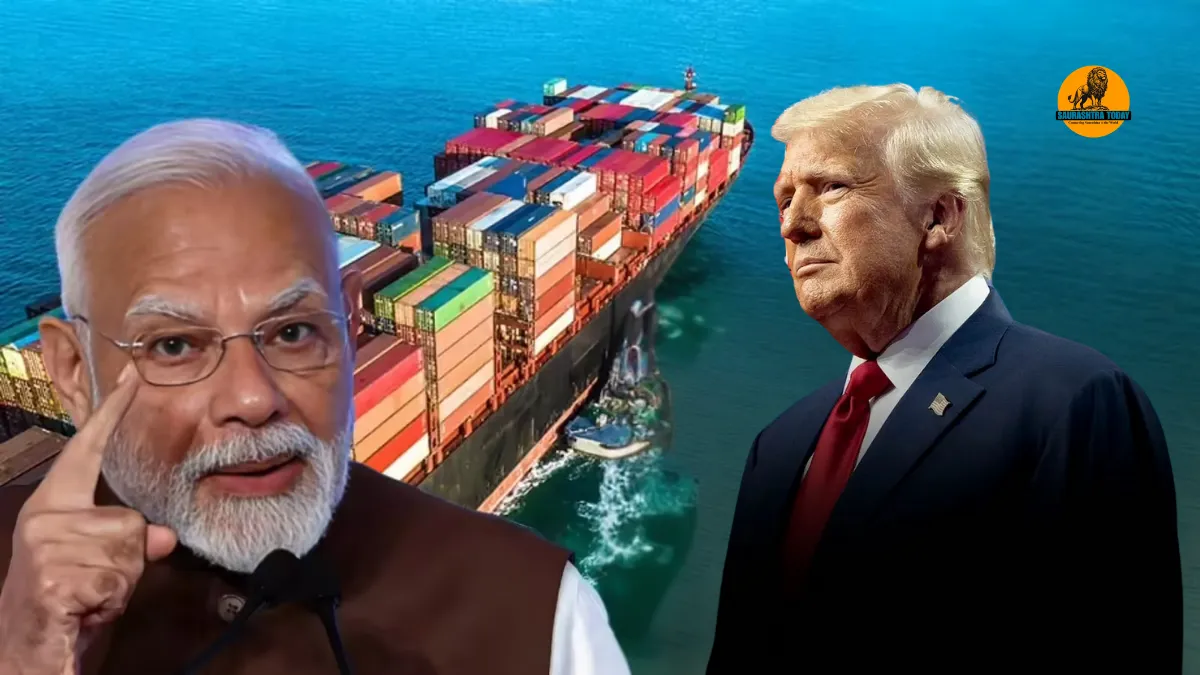
Trump tariff news: In a fresh political storm under the banner of Trump tariff news, former U.S. President Donald Trump has once again claimed that his aggressive tariff warnings prevented what could have been a major conflict between India and Pakistan. Speaking at the U.S.–Saudi Investment Forum on Wednesday, Trump said he intervened at a critical moment and stopped the two nuclear-armed nations from heading toward war.
Trump stated that he first received a call from Pakistan’s Prime Minister Shehbaz Sharif, who allegedly thanked him for saving “millions of lives.” According to Trump, Sharif told him that his warning changed the course of events during a period of heightened military tension.
Immediately after Sharif’s call, Trump says Indian Prime Minister Narendra Modi reached out to him as well. Trump described the call by saying Modi told him, “We are done.” When Trump asked what he meant, Modi reportedly said, “We will not go to war.”
This is not the first time Trump has made such a claim. In fact, he has repeated this assertion more than 60 times this year, arguing that his tough tariff threats forced both countries to step back. However, India continues to maintain that the de-escalation and ceasefire were the result of direct bilateral communication, with no third-party involvement.
India’s Ministry of External Affairs has consistently stated that no foreign power, including the United States, played any role in defusing military tensions between New Delhi and Islamabad.
On May conflict, US Prez Donald Trump claims the Pakistani PM called him to say, "thank you" & PM Modi called him to say, "We're not going to go to war".
— Sidhant Sibal (@sidhant) November 20, 2025
PS: 1st call between Trump, Modi took place on June 17th, over a month after the conflict pic.twitter.com/WUzNFiesio
The 250% Tariff Claim Resurfaces
In the same speech at the APEC CEO Summit in South Korea on October 29, Trump once again mentioned India–Pakistan tensions. He said that when the two countries were unwilling to cease hostilities, he threatened them with a 250% tariff on imports from both nations.
Trump claimed that just two days later, New Delhi and Islamabad contacted him and signaled their agreement to halt further escalation. During this conversation, Trump praised Prime Minister Shehbaz Sharif and Pakistan’s powerful military chief, Field Marshal Asim Munir, referring to Munir as “a strong warrior.”
These claims have been widely debated among policy analysts, diplomats, and trade experts, many of whom question the accuracy of Trump’s version. Yet the statements continue to dominate international headlines under the ongoing trend of Trump tariff news, especially as global markets remain sensitive to his commentary on trade and geopolitics.
India–U.S. Seal Major LPG Trade Deal Amid Tariff Uncertainty
While political statements continue to circulate, India and the United States finalized their first significant energy agreement this week. In the middle of ongoing tariff disagreements, both countries signed a deal under which India will import around 2.2 million metric tonnes (MTPA) of LPG from U.S. suppliers. This covers approximately 10% of India’s annual LPG demand.
The agreement, which will remain in effect until 2026, was negotiated between India’s state-run oil corporations—Indian Oil Corporation (IOC), Bharat Petroleum (BPCL), and Hindustan Petroleum (HPCL)—and American suppliers such as Chevron, Phillips 66, and Total Energy Trading.
India is currently the second-largest consumer of LPG in the world, importing over 50% of its domestic needs, with much of the supply traditionally coming from West Asian markets.
Why This Deal Matters for India
According to energy economists, the deal is expected to significantly strengthen India’s energy security by:
- reducing dependence on traditional Middle Eastern suppliers
- stabilizing supply chains
- reducing exposure to global price fluctuations
- balancing the bilateral trade equation between the U.S. and India
Analysts believe this agreement marks a new phase in India-U.S. economic cooperation, especially at a time when tariff-related uncertainties continue under discussions highlighted in Trump tariff news.
Trump Announces Gradual Reduction of Tariffs on India
Adding another layer to the unfolding geopolitical and economic narrative, Trump recently stated on November 10 that the U.S. is close to finalizing a new trade agreement with India. He suggested that the tariffs imposed on India would be gradually reduced.
Trump claimed that high tariffs were initially introduced because India had significantly increased its purchase of Russian crude oil. According to him, Washington imposed strict trade barriers—including penalties—to discourage such imports.
However, Trump also said India has “substantially reduced” its Russian oil purchases, which is why he is now willing to roll back portions of those tariffs.
During his speech, Trump added,
“They don’t love me right now, but they will love me again. We’re getting a good deal.”
This statement immediately made waves across global markets and was widely covered under the trending keyword Trump tariff news, signaling potential trade recalibrations between Washington and New Delhi.
Strong Words for India–U.S. Relations and Modi
Despite his controversial tariff decisions, Trump repeatedly emphasized his positive relationship with Indian Prime Minister Narendra Modi.
He said,
“India is one of the world’s oldest civilizations and now the most populated nation, with more than 1.5 billion people. Prime Minister Modi and I have had a very strong relationship, and Ambassador Sergio has further strengthened it.”
Trump called India one of the fastest-growing major economies and a crucial strategic partner in the Indo-Pacific region. He underscored New Delhi’s importance in global security architecture, energy supply frameworks, and trade networks.
Trump also mentioned that Ambassador Sergio is working toward:
- strengthening diplomatic ties
- boosting American investment in Indian industries
- increasing U.S. energy exports
- expanding bilateral security cooperation
This diplomatic emphasis arrives at a time when the global discussion on Trump tariff news continues to reflect uncertainties around U.S. trade policies.
The 50% U.S. Tariff Already Imposed on India
Alongside all the new statements, it is important to note that the United States has already imposed a cumulative 50% tariff on several Indian imports during Trump’s term. This includes:
- 25% reciprocal tariff
- 25% penalty tariff associated with India’s purchase of Russian oil
The reciprocal tariff came into effect on August 7, while the penalty tariff was enforced on August 27. According to Trump, these measures were meant to pressure India to align with U.S. foreign policy interests, particularly concerning Russia.
Trump has often argued that India’s purchase of Russian crude helps fund Moscow’s war efforts in Ukraine. He insists that tariffs were necessary to counterbalance that.
India’s Official Response: “No External Mediation”
Amid Trump’s many claims, Indian officials have firmly dismissed the idea that any external power mediated between India and Pakistan during recent military tensions.
New Delhi’s consistent position is that all ceasefire decisions were made exclusively through direct communication between the Indian and Pakistani authorities. Officials maintain that “no foreign intervention was involved.”
Diplomatic sources in New Delhi have repeatedly stated that India’s policy remains unchanged:
“Talks and issues with Pakistan are bilateral. No third country plays a role.”
Despite these clarifications, Trump continues to highlight the subject in public speeches, making the topic a recurring headline in global media, particularly under the search trend Trump tariff news.
A Broader Geopolitical Context
Experts say that Trump’s repeated claims serve multiple political purposes:
- Strengthening his image as a decisive global leader
- Positioning tariffs as a powerful diplomatic tool
- Appealing to voters who support strong trade measures
- Reinforcing his persona as someone who prevents wars through “tough action”
However, many international analysts argue that global tariff threats rarely prevent military escalation and that Trump’s statements oversimplify complex geopolitical realities.
Conclusion
The controversy surrounding Trump’s statements about India–Pakistan tensions, combined with shifting U.S.–India trade dynamics, continues to dominate global headlines under the keyword Trump tariff news. From claims of stopping a war with a single phone call to imposing and now reducing trade tariffs, Trump remains at the center of a high-stakes international narrative.
Simultaneously, India and the United States are expanding cooperation through major energy deals, strategic partnerships, and new trade negotiations. But as long as Trump keeps mentioning tariff threats, diplomacy, and wartime intervention in his speeches, the debate over his role in South Asian geopolitics is likely to continue.
For now, New Delhi maintains that no foreign power intervened in any ceasefire, while Washington—through Trump—insists otherwise.
The truth, as experts say, “lies somewhere between complex history, political strategy, and the unpredictability of Trump’s rhetoric.”