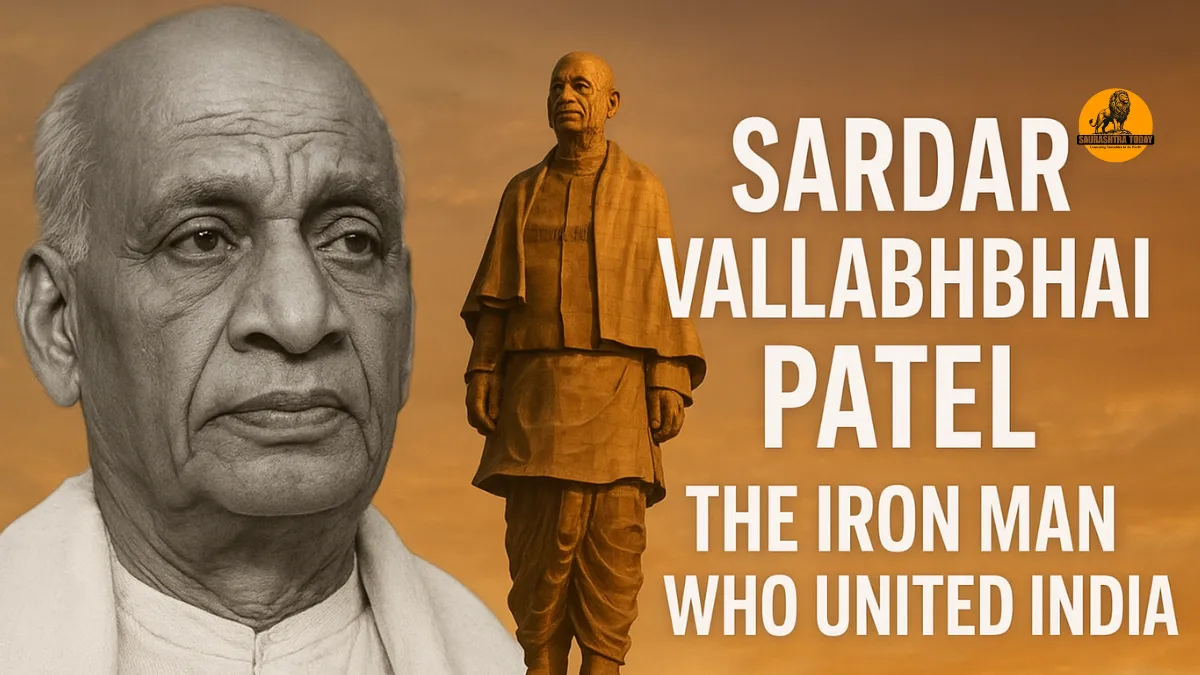
Sardar Vallabhbhai Patel, fondly remembered as the Iron Man of India, remains one of the most powerful and respected figures in India’s history. A dynamic freedom fighter, visionary leader, and architect of India’s political unity, Sardar Patel’s life continues to inspire millions across the world. His unmatched contribution to India’s independence and integration stands as a timeless lesson in leadership, courage, and nationalism.
Early Life and Education of Sardar Vallabhbhai Patel
Born on October 31, 1875, in Nadiad, Gujarat, Sardar Vallabhbhai Patel came from the Leuva Patel Patidar community. His father, Jhaverbhai Patel, served in the army of the Queen of Jhansi, while his mother, Ladbai, was known for her spiritual nature. From a young age, Vallabhbhai displayed courage, discipline, and an unshakable sense of determination — qualities that would later define his life.
A famous childhood story reveals his fearless character: as a young boy, he once used a heated iron rod to treat a painful boil himself, without hesitation. Such courage became symbolic of the strength that would later earn him the title “Iron Man of India.”
At the age of 22, Patel completed his matriculation — much later than his peers — leading many to underestimate his potential. But he proved them wrong. Determined to rise above limitations, he studied law and soon became a respected barrister. Later, he traveled to England to further his legal education, and upon returning to India, he began a successful legal practice in Ahmedabad.
Patel’s Role in India’s Freedom Movement
Sardar Vallabhbhai Patel’s transformation from a lawyer to a national leader began in 1917, after meeting Mahatma Gandhi. Deeply influenced by Gandhi’s ideals, Patel joined the Indian National Congress and became an active participant in India’s freedom struggle.
He first gained national recognition through his leadership in the Kheda Satyagraha and Bardoli Satyagraha, where he fought against unfair British taxation on farmers. His ability to organize, negotiate, and inspire people earned him the title “Sardar”, meaning “leader.”
During the Quit India Movement of 1942, Patel played a vital role alongside Mahatma Gandhi in mobilizing people across the nation. He was arrested multiple times by the British government, yet his determination never wavered. His goal was clear — to see India free from colonial rule.
Patel’s political strength was not just in words but in his ability to unite. He brought people from different religions, regions, and backgrounds together for one cause — India’s independence. His patriotism and sense of duty became the backbone of India’s fight against British rule.
Why Sardar Vallabhbhai Patel is Called the Iron Man of India
The title “Iron Man of India” perfectly reflects Patel’s strength of character and his firm resolve in protecting national unity. He believed that true independence could only be achieved if the people of India stood together, irrespective of caste, creed, or region.
Patel’s leadership during critical moments — both before and after independence — demonstrated his unmatched political vision. He was not just a freedom fighter but also a nation-builder who embodied the principle of “Unity in Diversity.”
He lived by values of honesty, simplicity, and unwavering patriotism. Even in the face of personal hardship, Patel never compromised on national interest. His leadership inspired millions to remain strong and united, earning him an immortal place in India’s history.
Sardar Patel and the Unification of India
After India achieved independence in 1947, the country faced a major challenge — integrating over 560 princely states that were scattered across the subcontinent. As the first Home Minister and Deputy Prime Minister of India, Sardar Patel took on this monumental task.
With his exceptional diplomacy, strategic vision, and firm leadership, Patel persuaded most princely states to join the Union of India peacefully. When required, he took decisive actions to prevent any threat to national unity. His efforts resulted in the creation of “One India – One Nation.”
Patel also played a key role in establishing the administrative foundation of newly independent India. His work in reorganizing civil services and strengthening law enforcement set the tone for modern Indian governance. As Commander-in-Chief of the Armed Forces, he ensured internal stability during one of the most turbulent periods in India’s history.
Also read: PM Modi Highlights Dholera’s Green Transformation in Mann Ki Baat Episode 127
Final Years and Legacy
By the summer of 1950, Sardar Patel’s health began to deteriorate. Despite illness, he continued serving the nation until his last days. On December 15, 1950, he passed away at Birla House, Bombay (now Mumbai) after suffering a heart attack. His death marked the end of an era, but his ideals and vision continue to guide India’s unity and governance.
In recognition of his unparalleled service, the Government of India posthumously awarded him the Bharat Ratna in 1991, the country’s highest civilian honor.
In 2018, the world’s tallest statue, the Statue of Unity, was inaugurated in his honor in Kevadia, Gujarat — standing as a global symbol of strength, integrity, and national pride.
Conclusion
Sardar Vallabhbhai Patel was more than a political leader — he was the very spirit of Indian unity and resilience. His life story teaches the importance of courage, unity, and determination in nation-building. From his fearless youth to his towering legacy as the Iron Man of India, Patel’s journey is an everlasting inspiration for generations to come.
Today, as India continues to progress on the global stage, the values Sardar Vallabhbhai Patel stood for — integrity, national unity, and self-reliance — remain more relevant than ever. His contribution is not just a chapter in history but the very foundation of modern India.