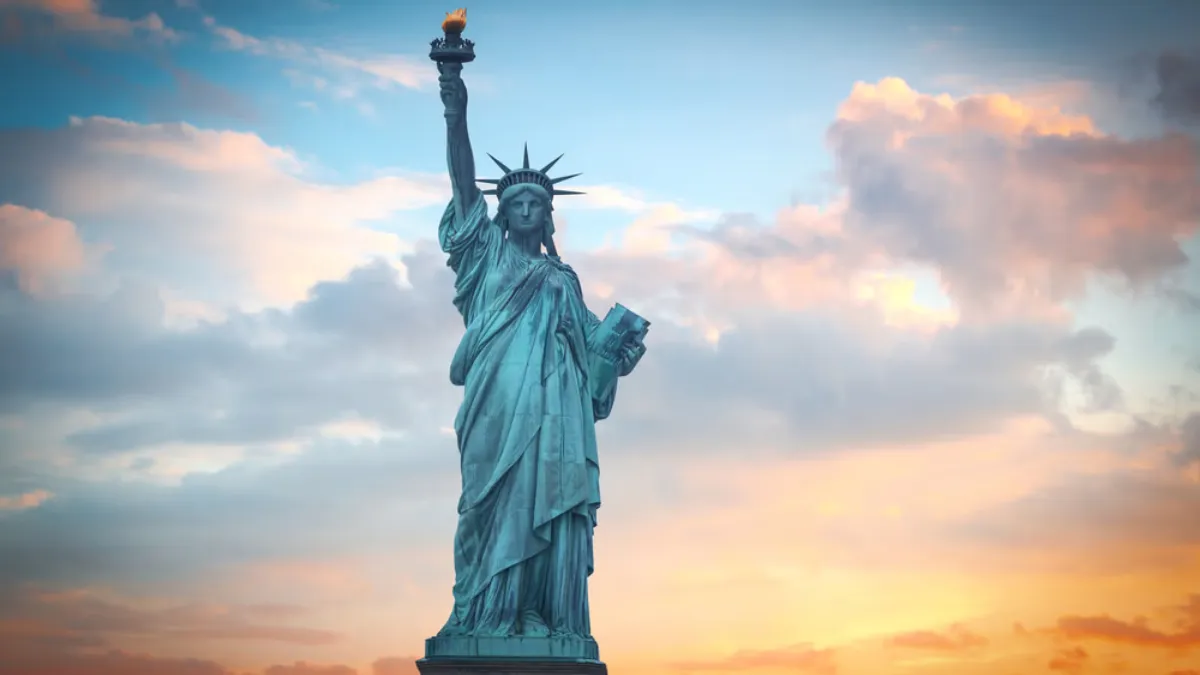
New York, USA — The Statue of Liberty remains one of the most recognizable landmarks in the world, a powerful emblem of freedom, democracy, and international solidarity. More than a century after it was raised on Liberty Island, the monument continues to attract millions of visitors each year and stands as a timeless reminder of humanity’s pursuit of liberty. Built in Paris and gifted by France to the United States, the statue represents not only a masterful fusion of art and engineering but also an enduring commitment to shared democratic values.
A Historic Gift from France to America
The idea behind the Statue of Liberty originated in the 19th century, when French political thinker Édouard René de Laboulaye proposed creating a monument that would celebrate the alliance between France and the United States and highlight their mutual dedication to liberty. Sculptor Frédéric Auguste Bartholdi was chosen to bring this vision to life, while celebrated engineer Gustave Eiffel—who would later design the Eiffel Tower—constructed the intricate internal framework.
The statue was crafted in Paris, where sheets of thin copper were hammered into shape and supported by a pioneering metal skeleton. Once completed, the massive structure was dismantled, shipped across the Atlantic, and reassembled in New York Harbor. It was officially inaugurated in 1886, marking the centenary of America’s independence and symbolizing France’s tribute to the world’s first modern democratic republic.
Architecture That Redefined the Modern Age
The Statue of Liberty is an extraordinary example of 19th-century innovation. The monument, standing proudly over 300 feet when measured from the ground to the torch, blends artistic mastery with cutting-edge engineering. Its design echoes classical statuary while hinting at the emerging Art Nouveau movement, making it a remarkable piece bridging ancient inspiration and modern ambition.
Bartholdi’s artistic genius shaped the statue’s majestic appearance, while Eiffel’s forward-thinking engineering introduced structural techniques that would influence the future of skyscraper design. Eiffel’s iron framework allowed the copper exterior to move independently—an early version of curtain-wall architecture seen in today’s high-rise buildings.
The base, designed by American architect Richard Morris Hunt, incorporated substantial use of concrete, demonstrating how new construction materials were transforming architectural possibilities.
A Symbolic Language the World Understands
Every detail of the Statue of Liberty carries deep meaning. Her torch shines as a beacon of enlightenment, while her crown’s seven rays represent seven continents and oceans—an invitation to people everywhere. In her left hand, she holds a tablet inscribed with “July 4, 1776,” the date of the U.S. Declaration of Independence. At her feet lie broken shackles, symbolizing the defeat of oppression and the triumph of human rights.
These visual elements embody global values: freedom, peace, progress, justice, and the promise of opportunity. Over time, the statue’s symbolic power has grown far beyond political borders. It remains a living representation of hope, especially for those seeking safety, dignity, and a fresh start.
A Historic Welcome for Immigrants
In the late 19th and early 20th centuries, millions of immigrants arrived in the United States seeking a better life. As ships entered New York Harbor, one of the first sights passengers saw was the towering Statue of Liberty. For countless families, it became a symbol of new beginnings, marking the moment they stepped into the possibility of a brighter future.
Ellis Island, located nearby, was the gateway through which many entered America. Together, Liberty Island and Ellis Island form a larger narrative of migration, resilience, and hope—stories that continue to shape modern America.
Recognition of Outstanding Universal Value
Global institutions have long acknowledged the Statue of Liberty’s exceptional cultural, historical, and artistic significance. It is widely considered a masterpiece of human creativity—a monument that beautifully merges engineering expertise with emotional expression.
Criterion (i): A Masterpiece of Human Genius
The collaboration between Bartholdi and Eiffel produced a groundbreaking work that challenged traditional boundaries between art and engineering. The statue’s colossal scale, innovative internal structure, and emotional resonance establish it as one of the most remarkable achievements of the 19th century.
Criterion (vi): A Timeless Symbol of Human Rights
Presenting the statue as a gift symbolized France’s admiration for the United States’ democratic foundations. Over time, the monument evolved into a global icon representing human rights, the abolition of slavery, freedom of expression, and the fight for equality. It continues to inspire discussions and movements centered on justice, diversity, and opportunity.
Integrity Preserved Through Generations
Despite facing natural and environmental challenges for more than 135 years, the Statue of Liberty has been carefully protected and restored. Its structure has remained largely unchanged, preserving its historical authenticity and artistic essence.
In 1986, a major restoration project repaired damage caused by galvanic reactions between metals within the framework. The original torch, which had deteriorated over time, was replaced with a faithful replica, while the historic torch was placed in a museum for preservation. These updates ensured that the statue remained structurally sound without altering its original design.
Periodic improvements to mechanical systems, lighting, accessibility, and security have allowed the monument to meet modern needs while protecting its cultural importance.
Authenticity That Has Withstood Time
The statue’s authenticity is preserved through its original materials, design, and purpose. While some internal components were replaced with stainless steel during essential restoration work, every update was executed with strict adherence to the original engineering vision.
The statue still stands in its original location on Liberty Island, surrounded by the harbor that has framed its silhouette since the 1880s. This unchanged setting enhances its historical truth and emotional impact.
Ongoing monitoring focuses on challenges such as pollution, weather conditions, and growing visitor traffic. Even with these pressures, the Statue of Liberty remains a faithful representation of the values it was created to celebrate.
Protection Under U.S. National Heritage Laws
The Statue of Liberty enjoys the highest level of legal protection in the United States. Declared a National Monument in 1924, it is managed by the National Park Service, which oversees preservation, operations, and public programming. Liberty Island, as well as the historic Ellis Island, fall under the same designation.
Extensive management plans guide maintenance, restoration, emergency response, and visitor experience. Security protocols—including ferry screening and patrol systems—ensure that visitors can explore the site safely.
The island hosts several educational resources, including a Visitor Information Center and the Statue of Liberty Museum, which features exhibits, artifacts, and interactive displays that explain the monument’s creation, symbolism, and role in global history.
Also read: Tourist Visa for USA from India: Complete Step-by-Step Guide for 2025
Modern Challenges and Ongoing Conservation
As the world changes, the Statue of Liberty faces new threats: rising pollution levels, harsh weather, and the increasing number of tourists. Each year brings new conservation needs, prompting experts to update strategies for preservation.
Maintaining structural integrity, protecting vulnerable materials, and ensuring visitor safety remain top priorities. Ongoing assessments help authorities respond quickly to potential risks—from climate-related impacts to mechanical wear.
The goal is clear: preserve the monument for future generations without compromising its authenticity or its message.
Also read: Top 10 Most Beautiful Places in Norway: A Complete Travel Guide for 2025
A Living Monument With Global Relevance
The Statue of Liberty is more than a sculpture; it is a living symbol that continues to shape conversations about identity, freedom, justice, and equality. Its universal message extends far beyond the shores of the United States, resonating with people in every corner of the world.
From inspiring art and literature to influencing political dialogue, the statue continues to spark reflections on the values that define humanity. As a global icon, it embodies the idea that liberty is not just an American principle but a shared ideal that belongs to everyone.
Also read: Surat to Bangkok: Daily International Flight to Launch from December 1, 2025
The Statue’s Enduring Legacy
Today, as visitors stand beneath the towering figure and gaze at the torch, the message remains unmistakable: hope, freedom, and opportunity endure. The Statue of Liberty represents the infinite possibilities of a just society—one where every individual has the right to live with dignity and purpose.
More than 135 years after its unveiling, the monument’s significance is stronger than ever. It serves as a reminder that liberty requires protection, progress demands courage, and the human spirit is capable of extraordinary achievement.