
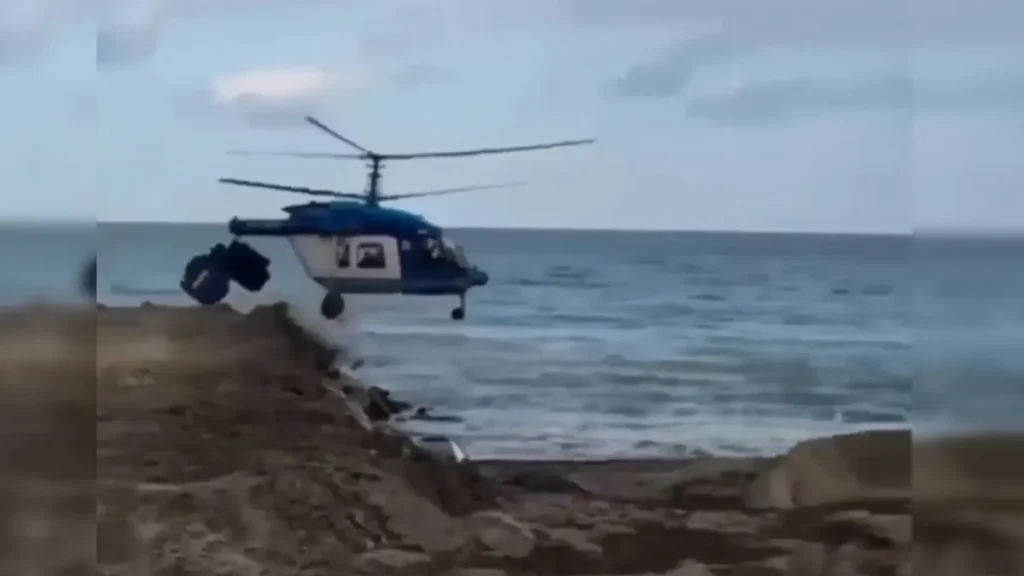
Russian Ka-226 Helicopter Crashes: A tragic aviation disaster struck Russia’s southern region of Dagestan on November 7, when a Russian Ka-226 helicopter went down near the village of Achi-Su, close to the Caspian Sea. The crash resulted in five fatalities and left two others injured. Authorities have confirmed that an official probe is underway to determine what caused the deadly incident.
Helicopter Lost Control Before Exploding
Eyewitnesses described a terrifying scene: the helicopter appeared to lose control, slammed into the ground, briefly lifted again, and finally plunged into the sea, where it exploded. A short video of the event has since circulated across social-media platforms, showing the aircraft spinning wildly before bursting into flames.
Local emergency-response teams arrived quickly, but five people were pronounced dead at the scene. Officials stated that the two survivors were taken to a nearby hospital and remain in serious condition.
Victims Were Employees of Russian Defense Firm KEMZ
The aircraft was operated by personnel from Kumertau Electromechanical Plant (KEMZ) — a major Russian defense and aviation-equipment manufacturer. The company confirmed that four of its employees were killed, including its Deputy General Director. A fifth victim was the flight mechanic assigned to the Ka-226.
KEMZ released an official statement expressing condolences:
“This is a profound loss for our company and for the families of our colleagues. We are cooperating fully with authorities to help uncover the cause of this tragedy.”
What Is the Ka-226 Helicopter?
The Ka-226 is a light, twin-engine helicopter developed by the Kamov Design Bureau in the 1990s. Its unique coaxial rotor system (two rotors turning in opposite directions) allows for stable flight and exceptional maneuverability — particularly in confined areas and mountainous terrain.
Designed for both civilian and military roles, the Ka-226 can be used for cargo transport, medical evacuation, search-and-rescue, and patrol operations. Despite its versatility, the model has faced previous safety incidents, prompting ongoing concerns over maintenance quality and aging components.
U.S. Sanctions Against KEMZ
The crash has drawn international attention because KEMZ is currently under United States sanctions for its links to Russia’s military operations in Ukraine.
The company manufactures ground-control and diagnostic systems for Sukhoi and MiG fighter aircraft — the same jets reportedly used to launch missiles and bombs in Ukrainian cities. Analysts suggest that sanctions could have restricted the company’s access to replacement parts and international safety-certification support, potentially affecting its overall maintenance standards.
Authorities Open Official Investigation
Russia’s Federal Air Transport Agency (Rosaviatsia) has classified the crash as a “disaster.” Investigators from Rosaviatsia and local law-enforcement agencies are collecting evidence, including flight-record data, mechanical components, and maintenance logs.
Preliminary findings indicate the possibility of a technical malfunction, though other causes — such as pilot error or severe weather — have not been ruled out. The recovered black box is being analyzed to reconstruct the final minutes before impact.
Officials said results from the technical investigation will be made public once completed, emphasizing transparency and cooperation among all aviation-safety bodies.
Video of the Crash Goes Viral
It seems they had the perfect opportunity to power down but I don't know anything about flying a helicopter so… 👀🚁
— Mrgunsngear (@Mrgunsngear) November 8, 2025
"A Russian Ka-226 helicopter crashed in the Republic of Dagestan on Nov. 7, killing five people, including four employees of the Kizlyar Electromechanical Plant… pic.twitter.com/cIHypNUBXk
Within hours, footage allegedly showing the crash spread rapidly on social media platforms like Telegram and X (formerly Twitter). The video depicts the Ka-226 spinning erratically before erupting in a fireball upon impact.
While Russian authorities have not confirmed the video’s authenticity, its wide circulation has reignited national debate about aircraft safety standards and the risks associated with older helicopter fleets still operating under challenging economic conditions.
Aviation Experts Voice Concerns
Aviation analysts say the incident highlights persistent problems in Russia’s aviation sector, including limited spare-part supply, outdated airframes, and inconsistent safety oversight.
According to one Moscow-based aviation specialist,
“The Ka-226 is a solid platform in design, but decades of overuse and insufficient maintenance create hazards. Even minor system faults can cascade into catastrophic failures.”
Experts also note that because several KEMZ engineers were aboard, the helicopter may have been performing a test or demonstration flight, which typically involves additional risk compared with standard passenger operations.
Local and National Reactions
Regional officials in Dagestan have extended condolences to the families of those who perished. A memorial service is being arranged in Kumertau, where KEMZ’s main production facility is located.
Russia’s Defense Ministry also acknowledged the tragedy, urging the public and media to avoid speculation until official findings are released.
Global Attention on Russian Aviation Safety
The Russian Ka-226 helicopter crashes have once again drawn scrutiny from global aviation watchdogs. The International Civil Aviation Organization (ICAO) and several European monitoring bodies are expected to review the investigation’s conclusions closely, as the Ka-226 has been exported or jointly produced with other nations in the past.
This renewed spotlight could influence future certification and export prospects for Russian-made aircraft, particularly those tied to defense-industry manufacturers currently under Western sanctions.
Background on Past Ka-226 Incidents
Although the Ka-226 is considered reliable under ideal conditions, there have been previous reports of hard landings and control-system failures. Experts believe Russia’s vast geography and harsh weather conditions add extra stress to helicopters operating in remote regions.
In recent years, aviation maintenance budgets have been stretched thin by economic pressures and international restrictions, raising further concerns about long-term safety compliance.
Also read: Melissa Cyclone Devastates the Caribbean: Over 75 Dead, Millions Displaced as UN Steps In
Ongoing Investigation and Next Steps
Rosaviatsia confirmed that an inter-agency task force is now examining all mechanical, operational, and environmental aspects of the crash. Investigators are focusing on three key questions:
- Was there a sudden technical failure in the rotor or engine system?
- Were proper maintenance and safety protocols followed before take-off?
- Did the flight meet weather and operational clearance standards?
Until the final report is released, all Ka-226 flights in certain regions may face additional safety checks or temporary restrictions.
Tributes and Condolences
The tragedy has left a deep emotional impact on KEMZ staff and the wider Russian aviation community. Colleagues of the deceased have described them as “dedicated professionals who served their nation’s aerospace industry with distinction.”
Social-media users across Russia have shared messages of sympathy, calling for stronger oversight and better safety infrastructure to prevent such accidents in the future.
Also read: Nepal Avalanche Kills Seven Climbers on Yalung Ri Peak; Search Operation Continues Amid Bad Weather
Conclusion
The Russian Ka-226 helicopter crash in Dagestan stands as a grim reminder of the urgent need for consistent aviation-safety standards and transparent technical maintenance practices. With five lives lost and two critically injured, the event has sparked both national mourning and international concern.
As investigators analyze flight data and mechanical evidence, the world will be watching closely for answers — and for assurances that lessons will be learned to prevent similar disasters in the years ahead.